

Published on: 06/30/2026
This news was posted by Oregon Today News


Description

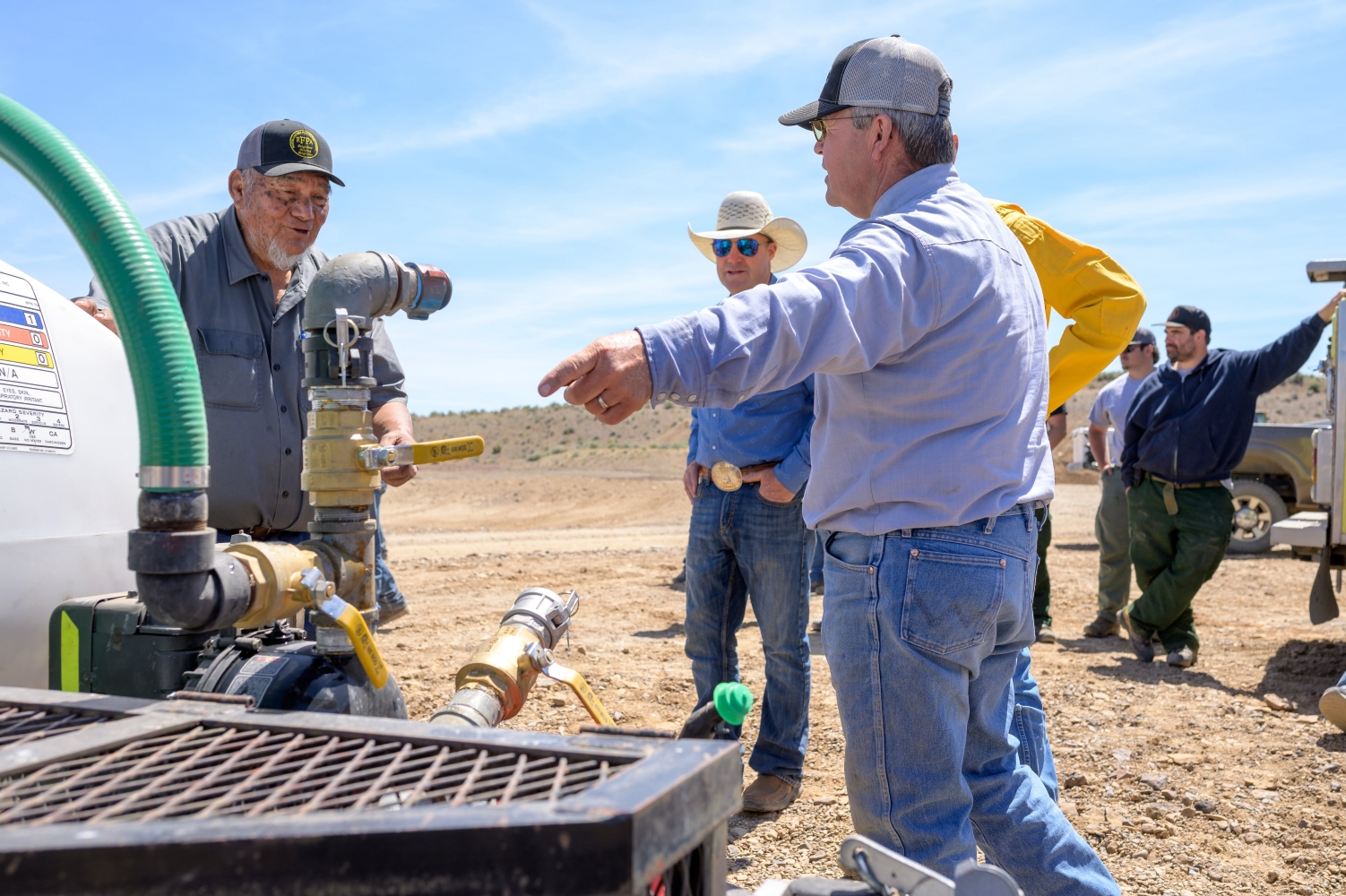
Cattle rancher Matt Bixby hoists a water hose over his shoulder while Kurt Beaubien carries a drip torch and pretends to light a fire around an M-35 military cargo truck. It’s been retrofitted for firefighting, with a tank and a roaring diesel-powered water pump in the back.
Bixby douses the pretend flames to keep them away from the fire engine. The idea is to burn any fuels around the truck — a practice for if or when these ranchers need to protect themselves in case they’re surrounded by fire with no way out.
“I saved it, I saved the truck,” Bixby shouts right after shutting off the water pump.
This is just a drill — for a very real scenario Bixby hopes he never actually has to put into practice.
“I honestly hope it rains all summer and we don’t have to fight any fires,” he says. “But we are definitely preparing to fight some fires if we have to.”
Like many ranchers across Oregon, he’s bracing for what could be a bad wildfire season.
But when limited wildland firefighting resources run thin, federal and state fire crews usually prioritize more populated areas, protecting lives and property. That doesn’t always include cattle ranchers in vast remote areas that are mostly grassland.
That’s left many in these remote rangelands with limited protection and a novel solution that brings neighbors together to fill firefighting gaps: rangeland fire protection associations.
At least two other states — Nevada and Idaho — have a similar model to fight wildfires.
Rangeland fire protection associations, or RFPAs, are similar to volunteer fire departments, except they don’t respond to structure fires. They’re approved by the state Board of Forestry, a volunteer advisory board appointed by the governor. They exist only in areas where private land is not protected by either the state Department of Forestry or a rural fire district.
Ranchers pay dues to become members, rather than rely on tax dollars. Across Oregon, 29 RFPAs cover 17.8 million acres of rangeland, 60% of it federally owned.

Members receive training, radios and retired fire engines from federal government agencies and the Oregon Department of Forestry.
A record-breaking winter brings worries of bad wildfire season
This training could prove critical in remote regions of the state this fire season.
The roads outside Burns, a small town in Southeast Oregon’s remote high desert, go on for miles, cutting through sagebrush country that seems to spill over the horizon.
Steens Mountain in the distance should still be covered in a blanket of snow for this time of year, but it barely is.
“That’s a sad little patch of snow up there,” Beaubien said as he sat on the driver seat of his RFPA’s wildland fire engine.

The Pacific Northwest didn’t get a lot of snow following a record warm winter. The little snow it did get is already melting earlier than usual.
Combined with a warmer summer and ongoing drought, forecasters say the ingredients that could make a wildfire season worse are present.
Oregon Gov. Tina Kotek recently declared an emergency due to the imminent threat of wildfires in the state.
Now, as these ranchers wrap up with their firefighting training, they stare at a summer where they will likely have to rely more on each other. These vast stretches they protect might look like nothing in the middle of nowhere to some. But to these ranchers, this landscape means everything.
“You don’t have to be a firefighter to appreciate that you don’t want to lose your home. If you’re a farmer or a rancher, you don’t want to lose the natural resources your economy might be based upon,” said Tom Sharp, a rancher and the chairman of the North Harney Rangeland Fire Protection Association.
When a fire hits, local ranchers will know what service roads to take, where to find water sources nearby and where cattle are, Sharp said.
“They want to protect their resources, they want to protect livestock. And so they have an inherent motivation to engage their services as volunteers to get out there,” he said
Ranchers and federal government agencies don’t always see eye to eye
But fighting rangeland wildfires isn’t without conflict between ranchers and federal firefighters.
Sometimes, ranchers disagree with the way federal agencies allocate resources to one fire compared to another, or the tactics they use to fight a wildfire, like intentionally burning grass to create fire breaks.
“If you’re a rancher watching the federal government light fires on purpose, you can understand how that would be a little bit perplexing,” said Katie Wollstein, a rangeland fire specialist at Oregon State University. “You would be seeing the loss of grass or maybe you would be interpreting it as less aggressive firefighting.”
Federal agencies also have to prioritize multiple uses of lands held in trust for the American public, Wollstein said.
“They’re thinking about sage grouse [habitat], they’re thinking about wilderness areas,” Wollstein said. “They’re having to balance the resources they put on a fire with all the other fires that might be going at the same time.”
And it’s not that the federal government doesn’t respond to wildfires on public rangelands. But when federal firefighters are out responding to multiple fires, they often prioritize human life and property ahead of natural resources, said Shane Theall, the unit fire chief for the U.S. Wildland Fire Service in Burns.
“The first fire is the most important fire, and then as we get more and more fires, we’ll prioritize where we send resources,” Theall said. “If it’s a major wildfire and it looks like it’s going to impact some major infrastructure, homes and just the public in general, that’s typically our top priority.”
That means on federal land, the grass cattle graze may not get firefighting resources right away — even though it can sometimes take two years for that grass to recover enough for grazing to resume after a fire.

“If it were up to me, we would staff every fire equally,” Theall said. “Every fire would be a priority, but unfortunately, that’s not the world we live in, and there are higher priorities.”
Mark McBride, a fourth-generation rancher and member of the Vale Rangeland Fire Protection Association, remembers a time when these different approaches meant ranchers and federal agencies did not get along.
But while some groups now have better relationships with federal partners, that’s not all RFPAs around the state, rangeland specialist Wollstein said.
“People and relationships are different in different places,” Wollstein said. “These are all humans. There are different histories. There are different memories of what relationships had been like with the government.”
McBride might not agree with some of the decisions federal officials make, he noted while sitting at a corner booth in a diner just a few miles west of the Idaho border. But RFPAs help.
They’ve given ranchers the tools they need to work together with the government and make sure their priorities aren’t overlooked, he said.


“We have an understanding. And both sides follow it pretty well. So we’re like one unit instead of two teams fighting across the line from each other,” he said, referring to the formal agreements these groups have with federal agencies. “It gives us the benefit of getting better equipment which makes us more available to help ourselves and our neighbors.”
That’s the motto of RFPAs: “neighbors helping neighbors.”
That felt especially true when the 2024 Cow Valley Fire burned over 133,000 acres of rangeland south of Baker County. McBride battled the flames for days at his neighbor’s ranch.
“They’d fought all the fire they could fight. And I said, go home, get some rest, get something to eat. Short of dying, I will save what I can of your ranch,” he said.

After he was done, he got home to a voicemail from that neighbor. “And it said, I knew you were my friend. I had no idea how good a friend you were,” he said.
For now, many ranchers hope they’re training for a fire they never have to fight. But at least they know what to do if one comes.
News Source : https://www.opb.org/article/2026/06/30/rangeland-fire-protection-association-oregon/
Other Related News

06/30/2026
Robert F Kennedy Jr and WWE legend Triple H showed up on NewsNation together to discuss Ma...
06/30/2026
Apparently Iranian leadership wants to retain power after the war But in order to maintain...
06/30/2026
Usually Portland sees a rash of restaurants and bars closing in midwinter when business ow...
06/30/2026
The OregonianOregonLive reached out to every Oregon high school in every classification to...
06/30/2026
Oregonians will soon be able to turn to one of the states most experienced judges when the...

Follow

Download Our App


Copyright 2022 © EPUERTO. All Rights Reserved