

Published on: 08/27/2026
This news was posted by Oregon Today News


Description
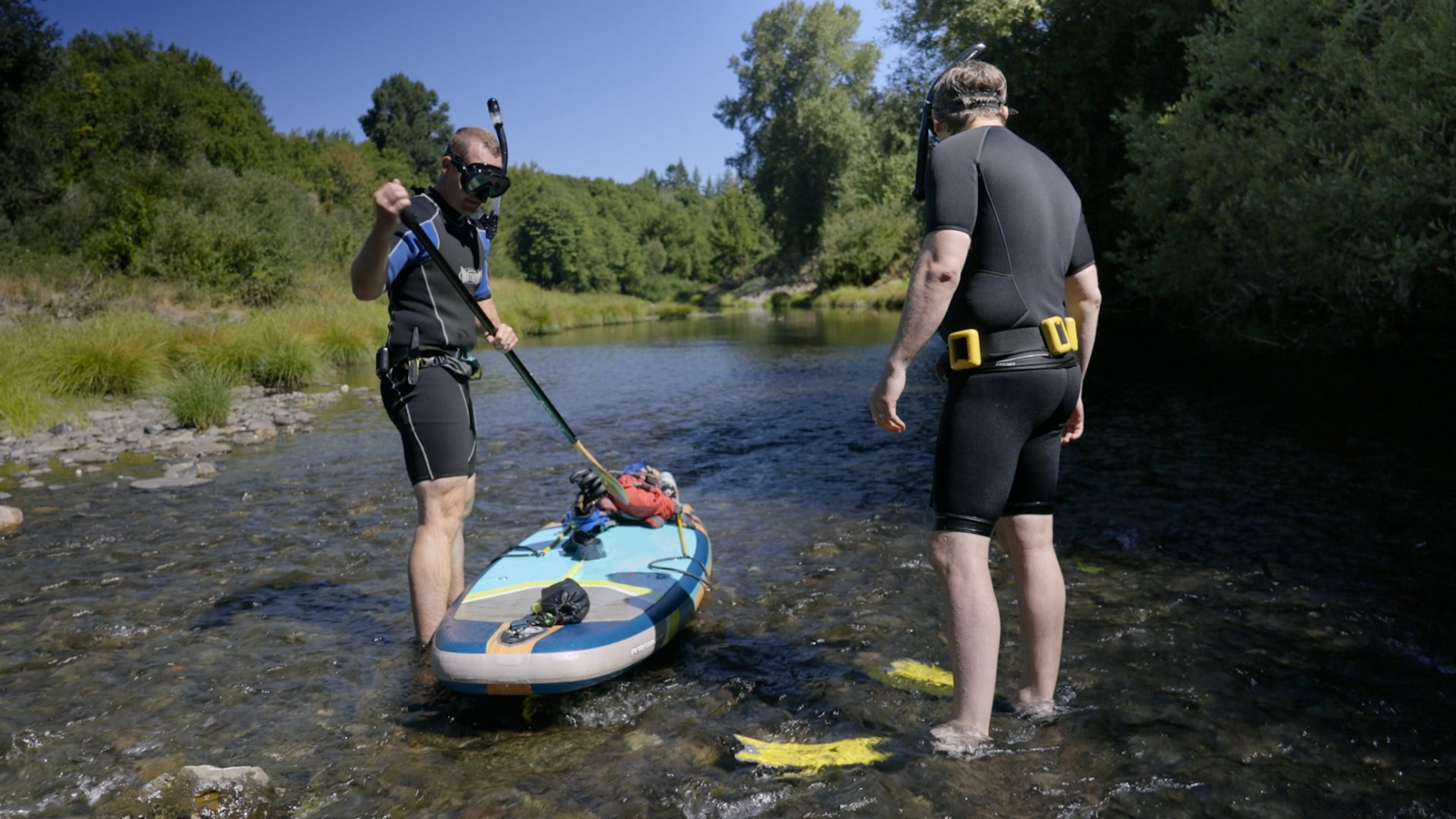
Last August, Jared Nagreen and Aaron Griffin drove five hours from where they live in Hood River to the Coquille River in Southern Oregon, where fall Chinook salmon populations had recently crashed to less than a thousand fish.
Along with a paddle board, wetsuits and snorkeling masks, they brought some new, unfamiliar fishing gear with them.
“So we got spears on Amazon,” Nagreen said, lifting a pole with three sharp prongs on the end.
They geared up to test out an experimental new fishery the Oregon Department of Fish and Wildlife opened on the Coquille after salmon numbers plunged from more than 10,000 adults to less than 500 in 2018.
Wildlife officials linked the collapse primarily to the illegal introduction of smallmouth bass to the river, where the non-native species were gobbling up juvenile salmon.

In response, ODFW ramped up an electrofishing operation with the Coquille Tribe to stun and remove as many bass as they could from the river. The agency also started looking for new ways to inspire people to catch more of these invasive bass. They removed catch limits on smallmouth bass and opened the Coquille to spearfishing – a new sport that adds a bit of adventure to removing invasive species.
Nagreen got an email from ODFW alerting him to the invasive bass problem and the new opportunity to go spearfishing.
“I thought, ‘OK, it’s a really creative way to manage the population of invasive fish,” Nagreen said. “But I had never been spearfishing.”
He teamed up with Griffin, his brother-in-law, to start planning a new kind of fishing trip.
“This is our first time ever hunting with a spear,” Nagreen said. “I’ve done a lot of rod-and-reel fishing for bass. Aaron has done a lot of snorkeling. This is going to be our first excursion of this type.”
As Nagreen and Griffin tethered gear to their paddle board, they set modest expectations for themselves while holding out hope that they’d catch enough fish to make tacos for dinner at their campsite.
“We brought food in case we don’t catch a lot of fish,” Nagreen said.

But the trip had potential for a win-win-win: An outdoor adventure that helps protect salmon while putting food on the dinner table.
They launched the paddle board and started making their way down the river with Nagreen paddling and Griffin swimming with fins and watching for bass.
Prized game fish becomes a problem
Smallmouth and largemouth bass are prized game fish in the eastern half of the U.S. and in stocked lakes across the West. ODFW promotes bass fishing in lakes and reservoirs, and sport fishing groups across the region tout bass fishing tournaments where anglers compete to see who can catch the biggest fish.
But in Northwest rivers, these non-native fish hurt the ecosystem by eating the native fish that are struggling to survive here, including salmon, steelhead and Pacific lamprey.
Smallmouth bass have already established themselves in many major Oregon waterways, including the Columbia, Willamette, Deschutes, John Day and Umpqua rivers.
“They will have massive ecosystem impacts,” said Kirk Blaine, wild fish manager for the Wild Salmon Center.
State conservation plans identify removing smallmouth bass as an important step toward restoring salmon populations. Increasing recreational fishing can help with that, Blaine said.

His group pushed for new state regulations that eliminated catch limits on bass in Oregon rivers in 2023 and allowed recreational spearfishing in rivers and streams statewide last year.
“There was a lot of support for permanent rules in 2025 to open up spearfishing,” Blaine said. “I don’t think it’s going to have a measurable impact, but it is an opportunity to get people out on the water and spread the word that these are a problem that are causing impacts to native fish and salmon.”
Increasing water temperatures with climate change will make Oregon rivers more hospitable to smallmouth bass and more dangerous for salmon, he said.
“The biggest thing we can do now is cool our waters,” he said.
Electrofishing to “stop the bleeding”
ODFW biologist Gary Vonderohe said the agency’s staff was surprised to see how quickly smallmouth bass expanded their range and damaged the salmon population after being introduced to the Coquille River in 2011.
“It happened way faster than we thought,” he said. “There are a lot of rivers in Oregon that have smallmouth bass in them. None of them have seen the impacts quite as much as we have in the Coquille.”
For the past six years, biologists with ODFW and the Coquille Indian Tribe have spent long summer days running electrofishing boats on the Coquille River. The technology sends an electrical current through the water that stuns the fish, so the operators can scoop them up with nets.

Vonderohe said their efforts have removed more than 40,000 bass, and every catch counts because larger bass can eat as many as 10 baby salmon every day. But there’s no hope of eradicating these fish.
“There’s over 100 miles of river that have smallmouth bass in it,” he said. “We’re just trying to give a little bit of an edge back to salmon when they migrate through. It’s just a band-aid. We’re trying to slow down the bleeding.”
Every year, the state and tribe increase the number of hours electrofishing boats are spending on the water.
“We’re hoping it’s making a difference,” said ODFW biologist Morgan Davis. “It’s a battle.”
Some of the bass they catch still have baby salmon in their mouths, said Zach Nemeth, senior fisheries biologist for the Coquille Indian Tribe.
“You could see the little caudal fin hanging out of the mouth,” he said, pointing to one example. “That Chinook was not much smaller than that bass. … They eat anything and everything they can. And unfortunately for us, it’s the Chinook.”

The bass are also eating other native fish.
On board the tribe’s electrofishing boat last August, fisheries tech Jordan Henkel found several Pacific lamprey inside the mouth of a smallmouth bass the boat had just netted.
“It just shows they’re a voracious predator,” he said. “The lamprey are native, and they’re really important to our tribe.”
Smallmouth bass have no natural predators in Northwest ecosystems because they didn’t evolve in the rivers here, Nemeth said.
“Ideally, I’d like to come out here and really struggle to find a single bass one day,” he said. “That would be the dream.”
The Coquille tribe also collects salmon brood stock for hatcheries that aim to boost the salmon population and leads an extensive habitat restoration program as co-manager of fisheries on the Coquille, Nemeth said. To get even more bass out of the river, in 2022 the tribe tagged a few bass and offered cash prizes to anglers who catch the tagged fish.
In the last two years, the Coquille River has seen fall Chinook populations rise to about 1,200 adult fish.
“It is encouraging; it’s the first time in several years it’s been up over a thousand,” Nemeth said. “Is it the restoration work? Is it the smallmouth bass suppression? Is it putting more fish out from the hatcheries? There are so many factors. That’s why we’re out there doing as much as we can. Any little thing that you can.”
Spearfishing: ‘A small dent’
Hoping to do their part to help struggling salmon, Nagreen and Griffin made their way down the Coquille last August.
The summertime river flows were low, so their spearfishing adventure started out … slowly. Griffin had to take off his flippers and walk through trickles of water for long stretches — often carrying the paddle board with Nagreen.
“I thought you guys were going to be paddle boarding,” Nagreen joked while carrying the paddle board over a long stretch of shallow water.
They found some deeper water where they could test out their new spears, diving underwater with flippers and snorkel masks and using a rubber band mechanism to shoot their pole spears at the bass fish they saw.

But their first catches were just pieces of trash they retrieved from the bottom of the river while trying to spearfish.
At one point, Griffin hit a rock that bent one of the prongs on his spear.
Then, finally, things started to pick up. In the deeper pools, they saw bass everywhere – along with a clearer vision of fish tacos for dinner.
“I got one!” Griffin said, emerging from the river with a 4-inch bass on his spear. “There’s a lot down there – a lot bigger ones, too.”

Nagreen started catching fish, too, as he learned how to snorkel.
“Being new to snorkeling, it was difficult for me to hold my breath long enough to just be calm and wait for the fish to come,” he said. “But that feeling of hitting the fish is such an exhilarating feeling of: I did it. That’s one more out of the water and one more delicious taco later.”
They spent a long day catching about a dozen smallmouth bass. It was a ton of hard work, Nagreen said, but definitely a fun adventure.

When they finally reached their takeout, exhausted, they went through their haul. Nagreen pulled out the 10 fish that they caught — most were 6 inches or less.
“All of these look delicious. We actually got more than I thought we did,” he said. “This is ten fewer fish who are going to be eating salmon as they get bigger.”
Then, they unpacked the trash: beer cans, a Taco Bell wrapper … “all the stuff that doesn’t belong in the river,” Nagreen said, looking at their catch of bass and garbage on the riverbank.
“It’s a small dent – but if a lot of people do this kind of stuff, it makes an impact. It will make a difference,” Nagreen said. “If we can do it, anyone can do it.”

They went out again the next day and caught enough fish for tacos.
About a month after their trip to the Coquille last year, the Oregon Fish and Wildlife Commission voted to open all Oregon rivers to spearfishing for smallmouth bass.
So next time, Nagreen and Griffin could try a river a little closer to home.
News Source : https://www.opb.org/article/2026/08/27/new-bass-fishery-in-oregon-helps-salmon-by-spearing-their-invasive-predators/
Other Related News

08/27/2026
Popular actor Samuel Monroe Jr has died

08/27/2026
On Friday evening the Seattle Seahawks will battle the Patrick Mahomes-less Chiefs in Kans...

08/27/2026
The NRC is preparing to change a foundational rule designed to minimize radiation exposure...
08/27/2026
Subscribe to OPBs First Look to receive Northwest news in your inbox six days a weekGood m...

08/27/2026
A man was found dead on Portlands Eastbank Esplanade after witnesses heard popping noises ...

Follow

Download Our App


Copyright 2022 © EPUERTO. All Rights Reserved