

Published on: 10/13/2026
This news was posted by Oregon Today News


Description
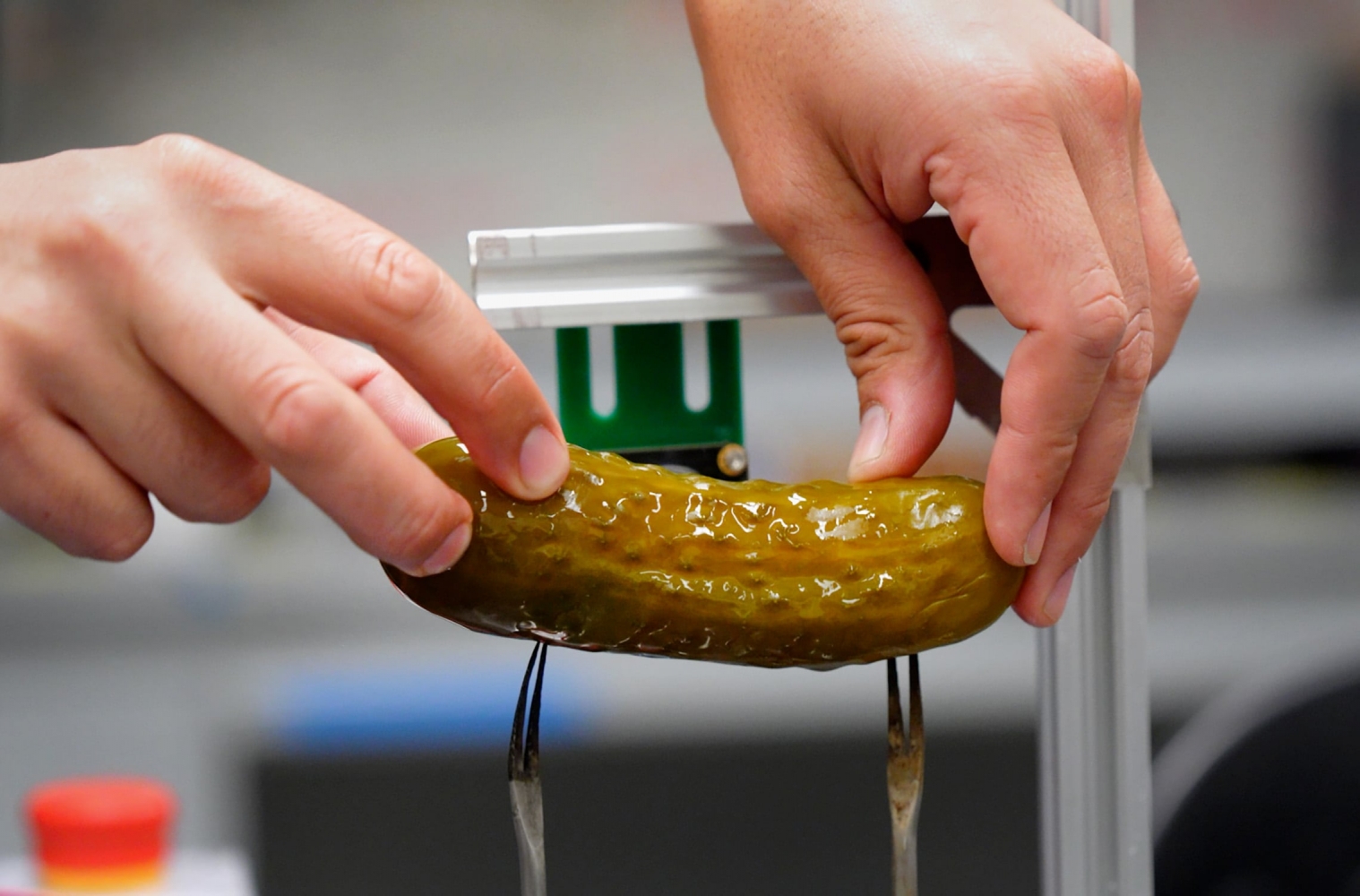
Earlier this month, in his lab at Portland State University, Joshua Méndez dug into a big jar of pickles, looking for a good one to zap.
He skewered it on two small forks that were attached to wires, a control board and a laptop computer. He sent 120 volts of electrical current to the pickle, and one end of it pulsed a rich orange color for about 10 seconds.
Gray vapor curled around and over the pickle, which gave off an acrid smell of burning salt.
“Sorry, it’s not the best smell in the world,” Méndez said.
Méndez, an assistant professor in the electrical and computer science department at PSU, has done this demonstration hundreds of times. But he’s not just trying to impress people with a common party trick.
He’s trying to solve a mystery.

“About a year and a half ago, one of my students came to me and said, ‘You know, this is something that actually hasn’t been settled scientifically: why a pickle glows,’” Méndez says. So he decided to take a closer look.
The fact that a pickle glows when you send current through it is not a new discovery. High school teachers and amateur scientists have been doing it for decades. But every time someone comes up with an explanation for why it happens, inconvenient facts arise.
We know electricity creates sodium ions from the pickle brine, and those ions give off light when excited. Simple, right?
But here’s the thing: The pickle is hooked up to an alternating current, as we all have in our houses. It has a positive and negative phase. The pulsing light in the pickle only happens during the negative phase — unlike a light bulb that glows constantly.
“There’s something else going on there,” Méndez says. “Why isn’t the pickle glowing during the positive portion of the wave?”

To solve the mystery, Méndez needed to test some theories. One is that the vapor being released is causing electrostatic breakdown.
“That’s just a fancy word for a spark,” Méndez says.
When you pass current through the pickle, it heats up so much that you create a vapor barrier near the electrodes — the steel forks on either side of the pickle.
“And at some point that vapor layer becomes continuous enough that it shuts off current in the pickle,” Méndez says. “And as the current shuts off in the pickle, the pickle cools and those vapor layers collapse.”
With that barrier dissipating, the brine gets closer to the hot electrode and creates sparks, like what happens when the end of a jumper cable gets closer to a battery terminal. And the cycle of heating, vapor creation, cooling and sparking happens over and over.
The problem with that theory is it doesn’t explain why the sparks only happen at the negatively charged electrode on one end of the pickle. If that theory were correct, sparks from cooled vapor would happen on both ends of the pickle — at both the positive and negative electrodes. So much for that theory.
Here’s another one: Electrolysis happens when you electrify brine. That chemical process splits molecules in the brine into oxygen and hydrogen.
“Hydrogen is actually a relatively flammable gas,” Méndez says. “At some point, the concentration of that hydrogen gas gets sufficient that you can ignite it.”
Hydrogen is created only at the negative electrode during electrolysis.
Méndez tested the theory by sending negative direct current — the kind you use for emergency backup power during a blackout — through the pickle. It created a lot of heat and hydrogen, but no glow at all. So, that theory doesn’t explain it either.

Méndez believes the answer lies in some combination of these processes involving heat, hydrogen and sparks, and it’s going to take more experiments and observation to arrive at an answer.
It’s a great example of the complexity of electrostatics — how electricity interacts with objects. It’s happening all around us, and even with our modern tools of scientific observation, it’s still hard to understand.
“Everybody knows lightning happens in a thundercloud,” Méndez says. “But actually how you get a lightning strike, something as fundamental as that, is still under question. So it doesn’t surprise me that something like a pickle is still a mystery too.”
But not such a mystery that it can’t be solved.
Méndez says — after hundreds of experiments — he expects to have a definitive answer for why an electrified pickle lights up by the end of the year.
News Source : https://www.opb.org/article/2026/10/13/why-does-an-electrified-pickle-glow-were-not-exactly-sure/
Other Related News

10/13/2026
RJ Mitte who played Walter White Jr on Breaking Bad died on Monday He was 34

10/13/2026
New White House press secretary Katie Zacharia confirmed Tuesday that the president had as...
10/13/2026
Attorneys for Albertsons filed a lawsuit Monday in Delaware demanding more than 9 billion ...
10/13/2026
A man who died after entering a tiger enclosure at a wildlife park in England appeared to ...
10/13/2026
Wednesday is a much-anticipated day for tens of millions of Social Security recipients acc...

Follow

Download Our App


Copyright 2022 © EPUERTO. All Rights Reserved