

Published on: 02/17/2026
This news was posted by Oregon Today News


Description
Washington state moved one step closer Monday to creating a personal income tax two years after the Legislature said it wouldn’t.
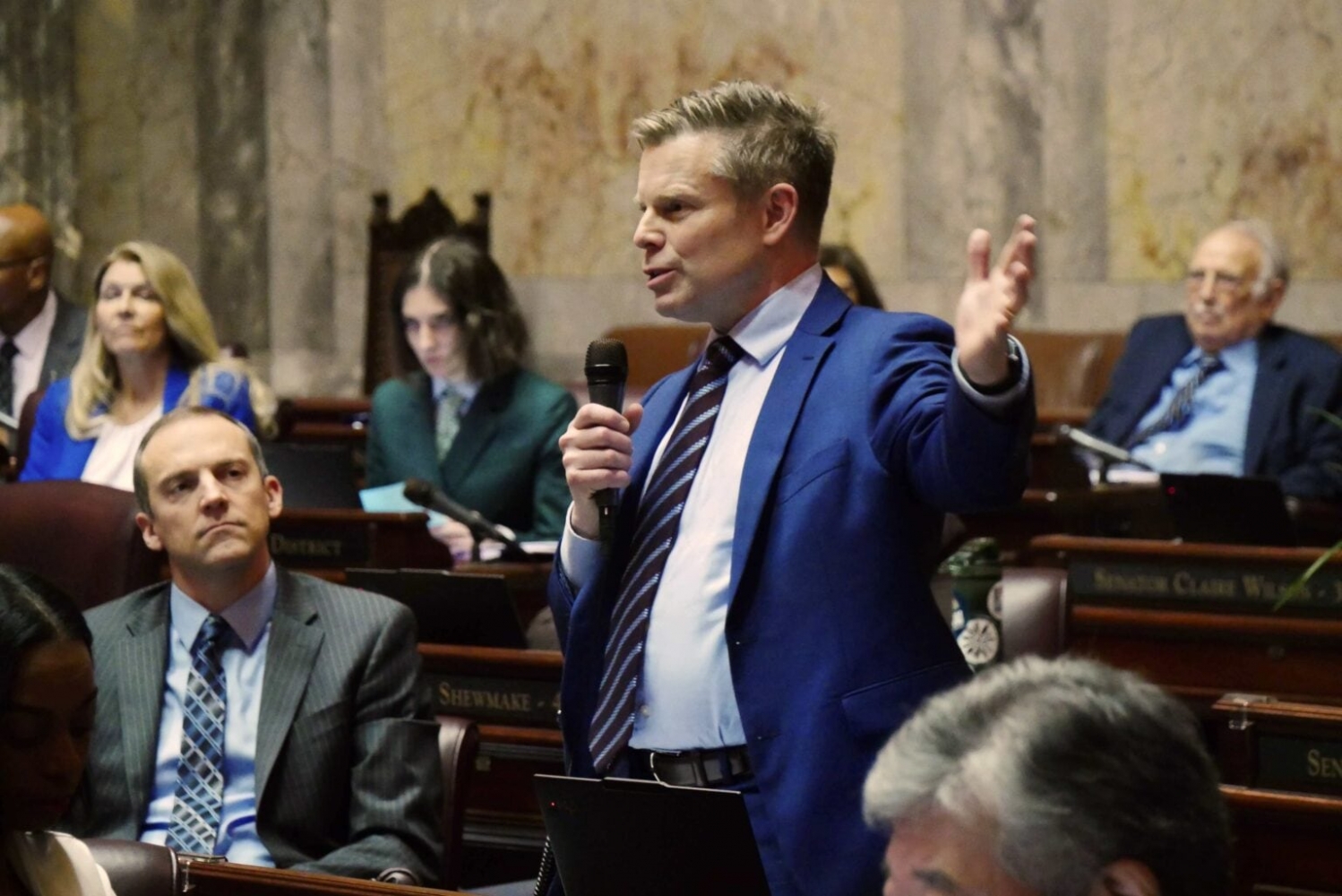
Majority Democrats in the Senate advanced legislation on a 27-22 vote to tax households earning more than a million dollars. Passage of the bill followed a three-and-a-half hour debate on whether this will make for a fairer tax code or harm the economy and incite an exodus of Washington’s wealthy residents.

House Speaker Laurie Jinkins, D-Tacoma, who watched the vote from the wings of the Senate, was all smiles as she returned to her chamber.
“This is a place where the people and the governor and the Legislature are well-aligned,” she said of the tax. “We’ll keep working on the details.”
Senate Bill 6346 is one of the most politically divisive bills this session. Dubbed the “millionaires’ tax” by backers, it would impose a 9.9% levy on personal income over $1 million a year. The tax applies to household income, meaning married couples and registered domestic partners with combined earnings over that amount would pay.
Three Democrats joined all 19 Republicans in opposing the bill, which now goes to the House for consideration. The three Democrats voting no were: Sens. Adrian Cortes, D-Battle Ground, Drew Hansen, D-Bainbridge Island, and Deb Krishnadasan, D-Gig Harbor.
If enacted, the tax would take effect Jan. 1, 2028. Collections would start in 2029 and could total nearly $2.5 billion for the next budget, according to the most recent fiscal analysis. When fully up and running, this income tax is expected to generate $3.4 billion a year from an estimated 21,000 filers.
It would be exempt from the prohibition on new statewide personal income taxes embedded in Initiative 2111 that the Legislature approved in 2024. It passed on bipartisan votes of 76-21 in the House and 38-11 in the Senate.
Proceeds from the new tax would be used to bolster public defense services in local courts around the state, expand the Working Families Tax Credit program and increase tax breaks for businesses grossing less than $600,000 a year. What’s left over would be funneled into the state’s general fund, where it could be spent in other areas, such as public schools, higher education and health care.
Supporters of the bill caution that it will be little help to the state’s finances in the near-term.

“This is not a panacea for our current budget,” said Senate Majority Leader Jamie Pedersen, D-Seattle, the bill’s prime sponsor. “However, this is a way of changing our direction, so that our tax system is adequate to the needs that we face in the 21st Century.”
But Sen. Chris Gildon, R-Puyallup, the lead Republican on the Senate Ways and Means Committee, warned that it will hurt families and businesses, and could one day be expanded to cover households that make less than a million dollars a year.
He also argued that Democrats’ claims the bill will bring tax relief and steer more money to schools and health care are misleading.
“This bill offers the false hope of reform. It offers no direct dollars to support education … and provides a paltry tax break on personal hygiene products,” he said. “It‘s laughable at how low the level of direct tax relief is. Pure and simple, this is not tax reform. This is tax layering.”
Gov. Bob Ferguson supports the idea of an income tax on those earning over $1 million a year. But when legislative Democrats rolled out their bill this month, he said he wasn’t satisfied with the amount of tax relief it offered for lower- and middle-income residents and small businesses.
He signaled that this was still the case on Monday.
“The proposal is moving in the right direction,” said the first-term Democrat. “That said, as the process moves forward in the final weeks of the legislative session, we must direct significantly more revenue directly back to hardworking Washington families and small business owners.”
‘It is historic’
For progressives in Washington, the significance of Monday couldn’t be overstated.
They’ve pressed for decades to get lawmakers to own up to the inequities of a tax system that favors the rich and forces lower-income residents to pay an outsized share of their income in taxes and fees.
But their Democratic allies, even when they had large majorities, eschewed the income tax, long perceived as a third rail of Washington politics.
This year, the Democratic-controlled House and Senate and Ferguson are all interested in getting it done.
“It is historic,” said Paul Benz of Everett, who’s been a voice for the faith community on this issue for three decades.
“Are there concerns about the 67-page bill? Yes. But is it time for our state to move forward on it, yes,” said Benz, who watched the debate unfold from the Senate gallery. “We understand all the arguments against it. One of our biblical quotes we cite is ‘to whom much is given, much is required.’”
Nick Federici, a longtime lobbyist who works with social service organizations, was in the gallery on the opposite side of the chamber. Federici said he sat in for the three-hour debate “to be part of history.”
“We’re only one-third of the way there. There’s a lot of hard work left to be done,” he said.
That could mean defending the legislation through expected challenges on the ballot and in the courts, two arenas where backers have had little success with income tax proposals in the past.
Voters have rejected measures to adopt a state personal income tax or corporate income tax 10 times, the most recent in 2010. They did say “yes” on one occasion, in 1932, but that initiative was invalidated by the state Supreme Court on a 5-4 decision in 1933.
Rosier forecast and moves to roll back other taxes
Monday’s discussion followed release of a revenue forecast showing tax and fee collections surging by $827 million in the current budget and more than $1 billion in the next biennium. Those figures effectively erase a projected shortfall over the next three years and, in some minds, the need to push ahead on an income tax.
Notably, a Democratic-backed amendment made Monday to the income tax bill would roll back expanded retail sales taxes lawmakers adopted last year on services. Under this amendment from Sen. Marko Liias, D-Edmonds, the repeal would take effect Jan. 1, 2030. A tax on advertising services that drew a lawsuit from cable giant Comcast would remain in place.
Democrats rejected five other amendments from Republicans.
These included proposals to double the income threshold to $2 million for couples filing jointly, and nullify the legislation unless voters, by the end of the year, approve amending the state constitution to explicitly allow for the income tax.
Another one of the amendments sought to remove a clause that would prevent a referendum on the bill. A lengthy debate also occurred on an amendment from Sen. Nikki Torres, R-Pasco, to stop charging the state’s retail sales tax on diapers.
The original bill would remove the sales tax on grooming and hygiene products, like soap and toothpaste. While Democrats were not willing to add diapers on Monday, they did not close the door to doing so at a later stage in the process.
Following the vote on the income tax bill, most Democrats in the chamber joined with Republicans to approve a bill to undo estate tax hikes lawmakers approved last year. This is the tax on transferred property at time of death. That bill passed 38-11, with only Democrats opposed.
Editor Bill Lucia contributed to this report.
Washington State Standard is part of States Newsroom, a network of news bureaus supported by grants and a coalition of donors as a 501(c)(3) public charity.
This republished story is part of OPB’s broader effort to ensure that everyone in our region has access to quality journalism that informs, entertains and enriches their lives. To learn more, visit opb.org/partnerships.
News Source : https://www.opb.org/article/2026/02/17/washington-state-senate-approves-tax-personal-income-over-1-million-dollars/
Other Related News

02/17/2026
As 90 Oregon lawmakers all try to push their priority bills through in this years five-wee...
02/17/2026
Oregon State Parks are hiring Park Rangers and Park Ranger Assistants for the 2026 season
02/17/2026
DEAR ABBY My husband and I both male have been together for 28 years The last few years ha...
02/17/2026
A new documentary from Oregon Public Broadcasting explores the story of the murder of Mulu...
02/17/2026
Cancel all your weekend plans Bruce Springsteen is coming back to Portland this spring and...

Follow

Download Our App


Copyright 2022 © EPUERTO. All Rights Reserved