

Published on: 06/12/2026
This news was posted by Oregon Today News


Description
Public entities across the state are spending around $120 million to host the World Cup, according to a KUOW analysis.
KUOW combed through more than a dozen budgets from the largest local government agencies and tabulated public money that’s already been budgeted or spent on the World Cup. The biggest chunks of change are funding transportation and capital improvements, specifically for Lumen Field.

FIFA estimates 750,000 visitors will come to the Seattle area for the World Cup, and local officials expect $845.6 million in economic impact.
Tax revenue will get a $95.8 million boost, according to economic projections commissioned by the Seattle tourism bureau, Visit Seattle. But local governments and agencies are already spending more than they’ll get back in taxes, according to KUOW’s tabulation.
At the same time, some cities and organizations are seeking to capitalize on our region’s role as World Cup host. For them, the World Cup is a catalyst to complete projects they needed anyway, such as parking lot lighting upgrades and brand-new public spaces.

From the beginning, local World Cup organizers have encouraged that dynamic of “getting the event to work for the community,” rather than the other way around. That’s according to Leo Flor, the chief legacy officer of SeattleFWC26, the local World Cup organizing committee.
“Let’s use this moment, this fleeting moment of global focus, to make lasting local progress,” Flor said in an interview with KUOW.
But some residents warn that the World Cup’s local economic benefit is illusory, while the damage and budget holes are very real.
“This is all a choice to spend this much money on a one-time event,” said Leah Salerno, an organizer with the Protect our Pitch 206 community coalition (POP206). The community groups have been working to educate the public on the potential harms of hosting the World Cup, such as increased clearing of homeless encampments.
“This money could be spent in a lot better ways that are sustainable and focus on the people who live here and building up our local communities,” Salerno said.
‘We are ready!’
From the ferries and the buses to the highways, agencies are staffing up and deploying people and equipment to key areas, just in case.

At a mid-May news conference, a wide cast of local officials stood in front of Lumen Field and staged buses, smiling for a photo op. They lauded our region’s top-notch transit infrastructure and detailed how every agency is preparing to handle an increase in crowds potentially filled with lost and confused out-of-towners.
“I’m here to tell you my friends, we are ready!” trumpeted Sound Transit CEO Dow Constantine.
Sound Transit is spending more than $20 million, with a large portion dedicated to capital investments, such as fixing the elevators and escalators at the International District/Chinatown station.
Most of the spending is just to keep people moving, including crowd management, signage, and more frequent trains on match days.

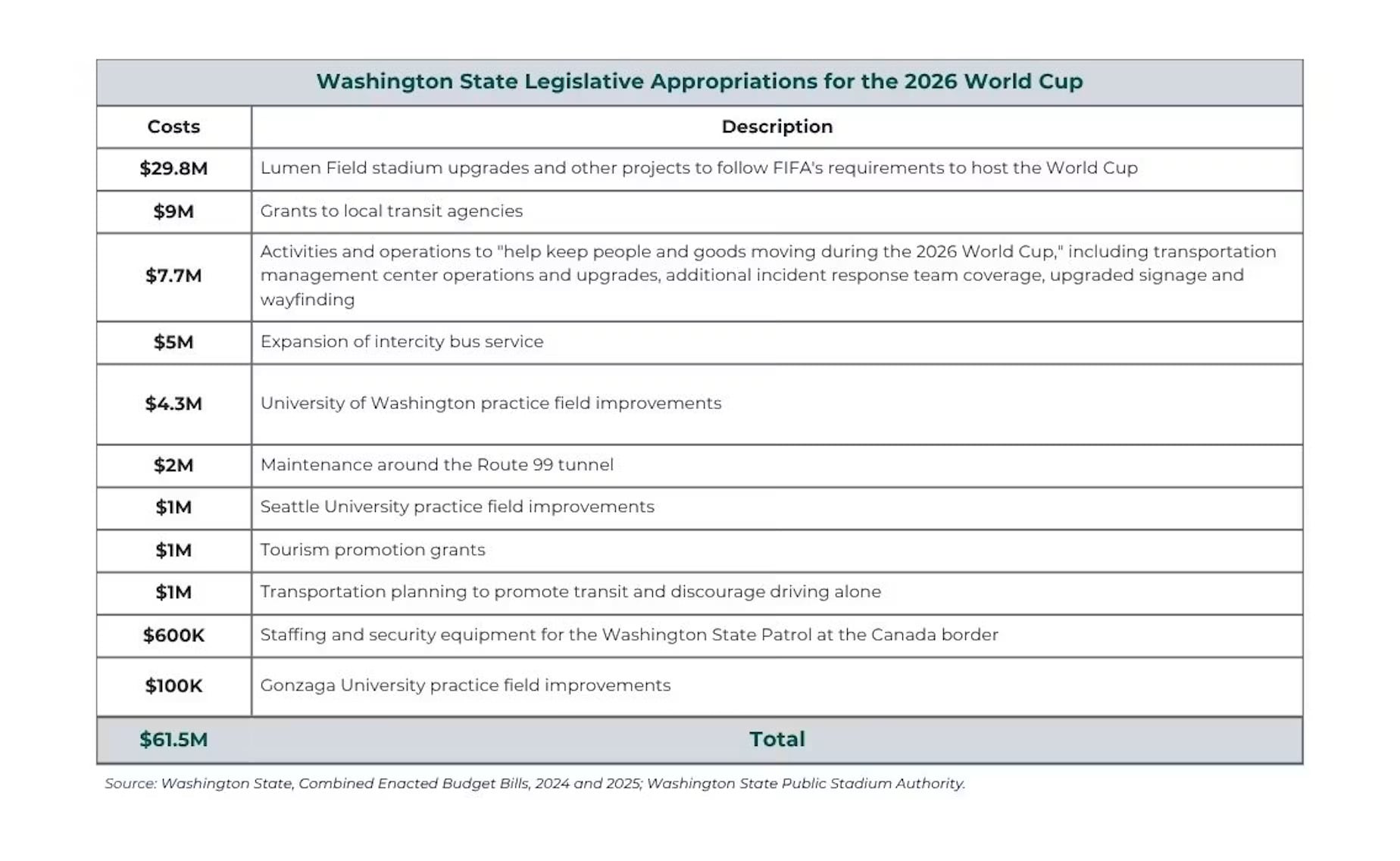
Transportation is a major focus of Washington state’s spending as well. The legislature devoted $25.25 million in the 2025 transportation budget, including grants to local transit agencies, expansion of intercity bus service, and additional incident response teams to clear highway collisions.
Salerno of POP206 said it’s great that some transit infrastructure is getting a boost, but the elevators at the International District/Chinatown station should have been fixed years ago, as the local community has been requesting.
“When a big flashy sporting event is coming in, suddenly they can find the money to upgrade these elevators,” she said.
The stadium
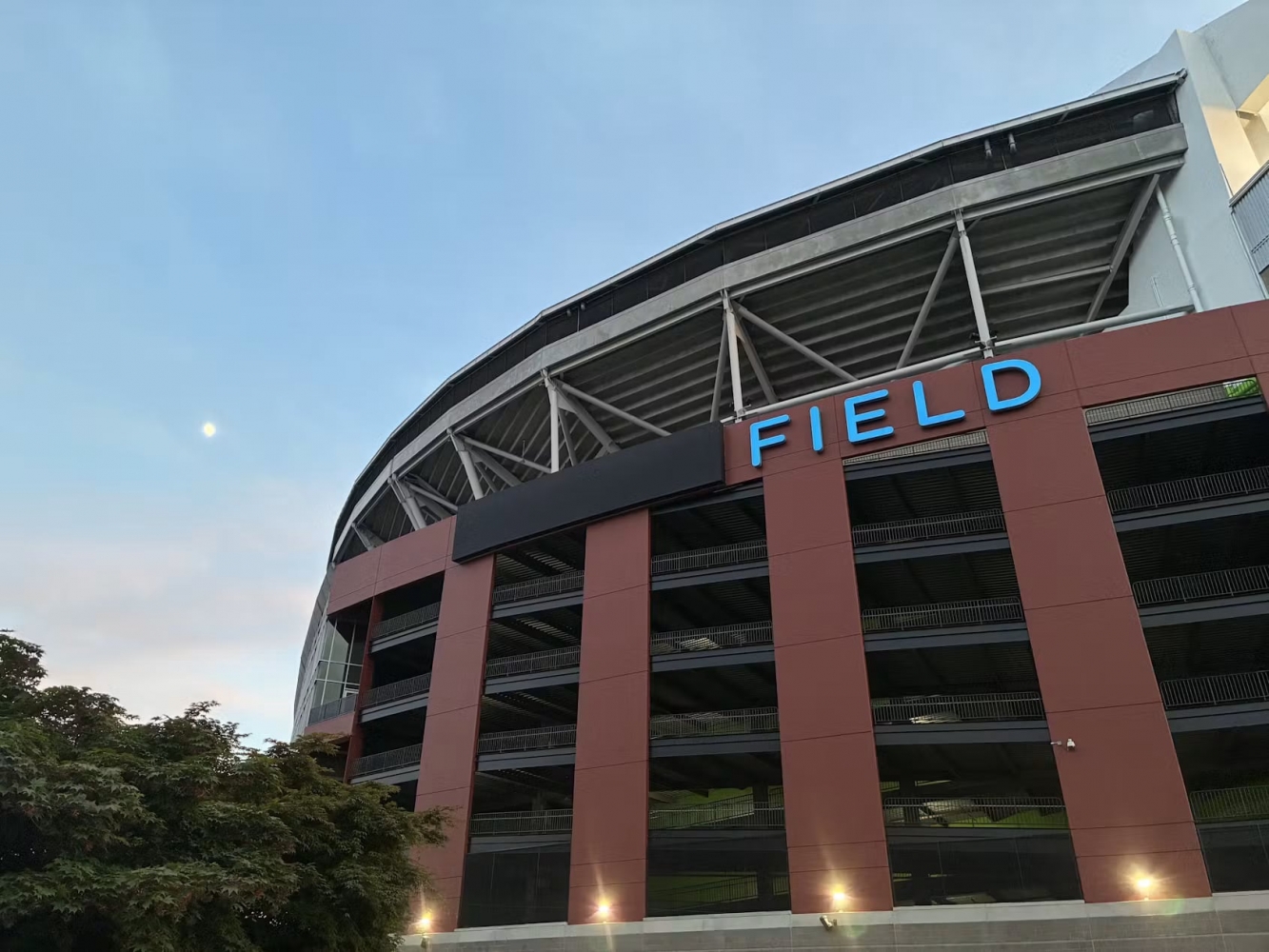
The largest single recipient of public funds for the World Cup is Lumen Field (aka “Seattle Stadium” during the World Cup).
Following FIFA’s requirements come at a cost: $1.85 million in state funds to wipe away any trace of non-FIFA-sponsor brand names for the duration of the games, and $3.3 million to modify the width of the soccer pitch, according to the Washington State Public Stadium Authority.

State grant money also pays for the transformation of Lumen Field’s north parking lot into the Gate 1 entrance to “Seattle Stadium,” along with gates, lines for security, and a “Stadium Fan Experience” area. The infrastructure, lighting, and safety measures for the area were funded by state grants, John Marchione, executive director of the Washington State Public Stadium Authority, said in an email.
At least one investment will help the stadium after the World Cup, though: a storage shed. Lumen Field’s operators, the company First & Goal Inc., recently upgraded the stadium’s HVAC system, which involved demolishing three 40-feet tall concrete cooling towers once used by the Kingdome (may it rest in peace).
In their place, First & Goal built a state grant-funded storage space for the theatrical equipment needed to host various events because, with all of FIFA’s requirements, the stadium ran out of space to store its own stuff.
The storage space will help event organizers be “incredibly” more efficient in the long term, Kathy Brown, managing director of project development at First & Goal, said at the May meeting of the Public Stadium Authority.
“On an ongoing basis, this affords us the opportunity to much, much more quickly flip over from event to event in the event center,” she said.

A ‘lasting legacy’
The local World Cup organizing committee is a nonprofit and, among other things, tasked with fundraising and reimbursing the City of Seattle for millions in hosting-related costs.
The organization is also funneling donations to other local priorities, such as new lighting upgrades for a parking lot in the Chinatown-International District, where the employees at local businesses will be able to park for free on match days.
Other examples include sponsoring public art works, working with the Puyallup Tribe to advance the Lushootseed language and Coast Salish culture, and fostering a local community for the Paralympic sport of blind soccer.
Flor is careful not to be “grandiose” about the World Cup’s benefits to the region, though.
“At the end of the day, the World Cup is both the world’s largest sporting event, and it’ll be here for about three and a half weeks,” he said.
Economics
Public officials are banking on getting a positive return on investment.
“The world is coming to Seattle and that is an amazing opportunity for us as a state and as a city,” Gov. Bob Ferguson said at that mid-May press conference.
“It’s going to be great for our economy,” he said. “We’re expecting $846 million in economic impact.”
That often-cited number comes from a Visit Seattle-commissioned study, which was produced by the company, Tourism Economics.

Host cities usually hear a lot about the mega bucks that are supposed to roll in, said Wolfgang Maennig, a University of Hamburg economist and expert on the economics of mega sporting events who has been involved in more than a dozen publications on the World Cup alone.
After all the confetti falls and the athletes and tourists go home, though, academics come in and examine the data of what actually happened. Those big numbers basically vanish, Maennig said.
“If academic studies find some effects, they are very, very, very small and very, very short term, but in general neglectable,” Maennig said.
In spite of a considerable amount of research, there is no evidence that mega sporting events have a statistically significant effect on the local economy of the host city or country.
Maennig cites various named “effects”: The “couch potato effect” explains how, during a sporting event, locals celebrate at home with a six-pack of beer and a family barbecue instead of going out and spending lots of money. The “carnival effect” explains how other locals skip town to avoid the hubbub of the event and get some peace and quiet. And there’s the “crowding out effect,” where soccer tourists just displace regular summer tourists, and don’t represent an overall increase in tourism.
“You will see some internationals, some German, French, Italian fans coming to the soccer games,” Maennig said. “But what we also see in almost all instances, there’s a crowding out of normal tourism.”
Of course, street vendors selling pretzels, hot dogs, and beer might make an extra buck, but that’s just money that would have gone to a different local business anyway, he said.
Now, even if the economics are a wash, Maennig says something else could make hosting the World Cup worth it: The “feel good effect.” That’s where some host cities get a short term but significant boost in happiness.
And in Seattle? Well, how hard can we party? It’s just like the Germans say: “Every party is as good as you make it.”
Anna Boiko-Weyrauch is a reporter with KUOW. This story comes to you from the Northwest News Network, a collaboration between public media organizations in Oregon and Washington.
It is part of OPB’s broader effort to ensure that everyone in our region has access to quality journalism that informs, entertains and enriches their lives. To learn more, visit our journalism partnerships page.
News Source : https://www.opb.org/article/2026/06/12/washington-world-cup-seattle-soccer-sports-lumen-field-seattle/
Other Related News


06/12/2026
Pride Month is in full swing across Oregon as communities come together to celebrate LGBTQ...
06/12/2026
Multnomah County has not decided yet if it will open its cooling centers this weekend as P...
06/12/2026
If this article were a novel the following would be the blurb on the cover Portland loves ...
06/12/2026
A man accused of assaulting a federal officer during protests at the US Immigration and Cu...

Follow

Download Our App


Copyright 2022 © EPUERTO. All Rights Reserved