

Published on: 12/01/2025
This news was posted by Oregon Today News


Description

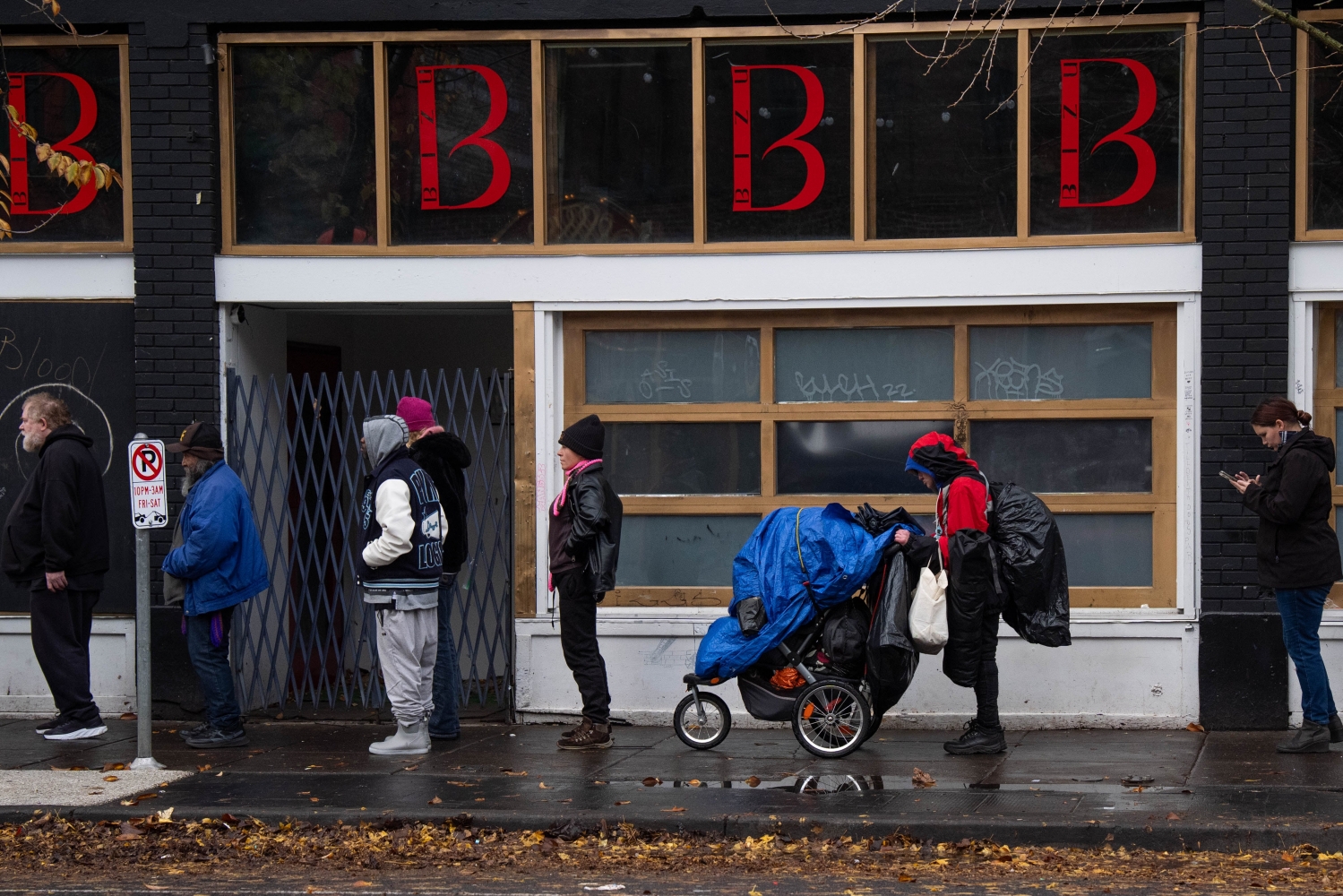
It’s Thanksgiving morning in downtown Portland, and the line for a free meal at the Union Gospel Mission in Old Town wraps around the block. People in line wear puffy jackets and blankets, some are damp from spending a rainy night outside. Several tents line a nearby sidewalk.
Inside, James Gard and his friend Eric May sit across from each other on a long table, taking bites of mashed potatoes and turkey between swigs of coffee. They’ve been looking forward to this meal.
“At the shelter I was at last night, they just gave me a beef stick for dinner,” Gard, 37, said. “That was it.”
“And that was after waiting in line outside an hour to get in,” May, 33, interjects. But, he admits, it was the best sleep he has had in a while.
Gard and May both spent the previous night at the Northrup Shelter, a 200-bed overnight-only shelter in the Pearl District. The shelter is one of several opened since Portland Mayor Wilson entered office in January with an ambitious goal.
“On December 1st, it is our promise to the community to end unsheltered homelessness,” Wilson told a group of city and county officials at a Jan. 22 meeting.
To do so, Wilson pledged to swiftly open 1,500 new shelter beds.
But now, three days before Wilson’s self-imposed deadline, people are still sleeping on Portland sidewalks and searching for housing. Since Wilson entered office, the total number of people in Multnomah County considered unsheltered – meaning living outside or in a vehicle – has risen by more than 1,000, to nearly 7,500.

Under Wilson’s plan, people like Gard and May should be on the path out of homelessness. But asked to describe his current housing situation, Gard doesn’t hesitate.
“Oh, homeless,” he said. “A shelter is not a home.”
Wilson did hit one goal: He secured funding to open 1,500 beds. He said he has locations identified for all of them. Yet, as of Nov. 30, only 890 of those beds are open for use.
Many see success in Wilson’s strategy, reflected in empty neighborhood sidewalks once crowded with tents. Others are skeptical about the mayor’s narrow focus on shelter over other conditions contributing to homelessness.
But in OPB’s conversations with more than 15 Portlanders close to this issue — including people experiencing homelessness, politicians, neighborhood organizations, and shelter providers — no one doubted that Wilson has the right attitude to tackle what’s become Portland’s most intractable issue. And they’re hopeful it can eventually turn the tide.
“I am a fan of the mayor’s willingness to try something different,” said Sahaan McKelvey, director of advocacy and engagement at Self Enhancement, Inc., a nonprofit that connects low-income families to affordable housing.
“I’m not opposed to what he’s trying to do, and I won’t judge him if it doesn’t work,” he continued. “I would judge an inability to pivot if and when he sees it is not working as well as he had hoped.”
The mayor’s plan
Since the mid-80s, Portland mayors have pledged to end homelessness. But as leaders unveiled their various “12-point plans” and “roadmaps,” the crisis only grew.
By 2016, the plan was to merge city and Multnomah County resources to create a “joint” office to address homelessness.
Now called the Homeless Response System, this shared responsibility has become a point of division between city and county politicians who don’t always agree on how to spend money to address homelessness. These arguments have only escalated as the office’s budget has ballooned in recent years, thanks to a flush voter-approved tax on high-income earners that funds homeless services.

When he entered office in January into an entirely different form of government than his predecessors, Wilson inherited a legacy of fractured, politicized solutions to homelessness, a skyrocketing homeless population, and a public distrustful of pumping more money into a seemingly rudderless system.
But that didn’t give him pause.
In January, he unveiled his plan to open 1,500 new shelter beds by December. Paired with 1,500 new shelter beds already funded through the Homeless Response System, this would roughly double the number of total shelter beds in Multnomah County to 6,000.
By June, Wilson had secured enough additional money from the state, county, and Metro regional government to fund his $25 million plan.
The result is a network of nine city-funded emergency shelters spread across the city, and funding for additional beds in two already-operating private shelters. These shelters are all only open at night, meaning guests can’t enter before 8 p.m. and have to leave by 6 a.m.
Unlike most 24-hour shelters in Portland, these shelters offer little in the way of a path out of homelessness. There are no social workers on site to help connect people with housing, health care, or addiction services. There are no meals served or storage for guests’ items. They are also all congregate shelters, or large open rooms filled with rows of beds — and little privacy. These types of shelters are cheaper to set up and run than other models.
Meredith Sellers has stayed at the downtown women-only overnight shelter run by the Salvation Army. She said she doesn’t feel safe leaving when it’s still dark outside.
“As a single woman, I don’t like being alone in downtown Portland at 5:30 in the morning,” said Sellers, 33, who said she prefers sleeping in a tent for her own safety.
She’s not alone. Last year, nonprofits Welcome Home Coalition and Sisters of the Road polled roughly 450 people experiencing homelessness in Portland. When asked to rank their preferred sleeping option, congregate shelter was ranked last, tied with sleeping outside.
Hundreds of the new shelter beds lie vacant most nights. In October, shelters were just over 50% capacity each night on average, according to city data (which doesn’t include statistics on four shelters opened this month). That’s far lower than the average for shelters open 24 hours. According to the most recent county data, the county’s roughly 3,000 24-hour shelter beds were at 87% capacity in September.

On a cold November evening, Crystal Hart chose to stay at one of the shelters, located at a Southeast Portland church.
Hart, 50, said she prefers staying in shelters that don’t force you to leave early in the morning. But when the temperatures drop and there’s no room in other shelters, she has few options.
“It was nice and warm,” Hart said. “That’s all I needed.”
This is how Wilson said he believes these shelters work best — as an emergency option to urgently address a grave crisis.
“We have people suffering and dying on the street,” Wilson told OPB in an interview last month. “This is about taking action.”
Most shelters in Portland are open 24 hours, like those run by Transition Projects, Inc. The nonprofit stopped running overnight-only shelters decades ago, after concluding they weren’t helping get people out of homelessness.
But Director Tony Bernal sees value in Wilson’s overnight shelters.
“Every day our shelters that we operate and that others operate are at capacity,” Bernal said. “I do think there is a bit of a relief valve with the city’s overnight-only shelters.”
Transition Projects agreed to run one of Wilson’s overnight-only shelters for people with substance use disorders, seeing a vacuum in this kind of service. Ideally, Bernal said, he’d want to find the funding to turn this shelter into a 24-hour facility. But with scant state and federal dollars for these types of programs, he’ll take what he can get.
“We don’t want the perfect to be the enemy of the good,” he said.
Funding is a constant concern for nonprofits that rely on government contracts and grants to run shelters and programs that help move people into affordable housing. The U.S. Department of Housing and Urban Development has threatened to pull tens of millions of dollars from state affordable housing programs. At the same time, the federal government is rolling back benefits for low-income families that help keep them from losing their housing.
Bernal said it’s time to reconsider the best way to spend limited public dollars on homelessness.
“Ultimately, I think the most effective shelters are shelters that are moving people through and not just keeping them there,” Bernal said.
To do so requires investments in more than shelter alone, Bernal said. This is the central criticism against Wilson’s shelter plan.
A missing piece?
City Councilor Candace Avalos believes that overnight shelters are helping some Portlanders. But she said Wilson’s plan doesn’t address what’s making people homeless in the first place.
“He opened sheltered beds, sure,” said Avalos, chair of the city’s Homelessness and Housing Committee. “But that’s not the same as ending unsheltered homelessness. The problem has only gotten worse.”
According to county data, more than 1,000 people have become homeless since the start of the year. That data also shows that every month this year, more people became homeless than left homelessness behind. On average, about 1,400 people have become homeless every month in Multnomah County, while just 1,100 have moved into housing each month.
“That’s just a crazy statistic,” said Councilor Jamie Dunphy, vice-chair of the city’s homelessness and housing committee. “Every month, we’re in a worse off position than we were to start, and the bottom just feels like it’s falling out.”
Both councilors want to see the city shift its focus, and resources, to efforts that keep people from losing their homes — whether that’s rent assistance, social services or simply building more affordable housing to meet the demand.
According to the city, Portland is short some 20,000 units of affordable housing to meet the needs of low-income Portlanders.
“I’m concerned the mayor’s plan is creating a bottleneck,” said Avalos. “If we spend all our money on increasing a resource that is meant to be temporary, we are hurting our chances of actually making an impact.”

Charlotte Forney has seen this “bottleneck” firsthand. Forney, 67, was homeless for nearly six years, living in her car and shelters, before she was able to move into permanent housing. She points to a fateful encounter with a social worker who somehow “pulled the right strings” to get her an apartment.
Through her experience, Forney saw a real shortfall in services that would genuinely help people get off the streets.
“There’s not enough recovery treatment, there’s not enough people who can get you into housing, there’s not enough mental health care,” she said. “As a city, we’re in an abusive relationship. We keep coming back to the abuser instead of finding a real solution.”
Longtime service providers believe those solutions exist, and have tried to share them with Wilson. But they worry it’s falling on deaf ears.
Experts left out
Brandi Tuck has been the executive director of Path Home for 18 years. The nonprofit focuses on helping unsheltered families, an often unseen but significant portion of Portland’s homeless community.
Path Home used to run overnight-only family shelters.
“The behavior in those shelters is one where people are in survival mode — fight, flight or freeze,” said Tuck. “There’s no critical thinking. There’s lots of yelling. The kids, they’re running around. It’s just chaos.”
The nonprofit now runs a shelter that is open 24 hours with private rooms for families and services on site to connect them with permanent housing. It’s led to results: 90% of families that stay at the shelter move into housing each year.
Tuck was surprised to hear Wilson’s recent plan to open three overnight-only family shelters, where not all families are guaranteed a private space. Tuck works closely with the few other family shelter providers in town, and said that Wilson’s office didn’t ask any of them for advice before opening these shelters.
Tuck has since received panicked calls from staff working at these new shelters asking for guidance on handling scenarios they’re not prepared for, like a guest about to give birth.

While she isn’t interested in running more shelters, Tuck said she would have gladly offered advice on how to run a successful one.
“We could have set up these protocols so that the staff weren’t at the last minute freaking out,” Tuck said.
Other longtime service providers say Wilson never reached out for their input on his larger shelter plan. Instead, elected officials are coming up with their own ideas, not always backed by research.
McKelvey, with Self Enhancement, Inc., said this dynamic is what happens when policy is driven by politics.
Right now, the city operates some shelters while the county runs others, and the two sides are quick to point fingers at each other — or their nonprofit contractors — when things go awry.
“When you are working within a political system, it is very hard to operate in a way that does not care about credit and does not care about blame,” he said. “And I think we would all be able to accomplish a whole lot more if we were able to operate outside of that.”

Multnomah County Chair Jessica Vega Pederson has often been cast as a barrier to the city’s shelter plan by some members of the public, as the county has advocated for spending more money on 24-hour shelters and housing.
But, in a statement emailed to OPB, Vega Pederson congratulated Wilson for hitting his goal and made a commitment to work with the city on what comes next.
“We all need to think about where people are supposed to go after their stay in an overnight-only shelter, and how those shelters can help end someone’s homelessness permanently,” she said. “It’s too big of an opportunity to let slip away.”
Some in Portland believe Wilson’s plan is already addressing these issues.
Empty sidewalks
In July, hundreds of people who live in Northwest Portland squeezed into an auditorium to share their opposition to Wilson’s plan to open the Northrup Shelter in their neighborhood.
“We were upset,” said Linda Witt, a member of the Pearl District Neighborhood Association. “Because the more homeless services you put in the neighborhood, the more livability issues you’re gonna introduce.”
Witt has seen some of those concerns play out in an increase in people who appear unhoused hanging out in the neighborhood during the daytime, when the shelter is closed.

Wilson’s plan included opening a new daytime drop-in center for unsheltered people located on an empty lot near the Northrup Shelter. That space, called the Oasis, has restrooms, showers, and some snacks. But several people who’ve visited the space told OPB the cold weather makes it unappealing.
Despite her concerns, Witt said she is pleased by the additional staff the city has hired to keep the neighborhood clean and tent-free.
And she’s hopeful that a new piece of Wilson’s plan will keep it that way.
“Since the camping ban enforcement,” she said, “we have seen an improvement in overall conditions.”
On Nov. 1, Wilson directed police to resume enforcing the city’s policy banning camping on public property. People who refuse to move or accept shelter will receive a ticket that could turn into a fine or jail time.
Wilson was waiting to enforce the policy until he had opened enough overnight shelter to accommodate people on the streets. It’s why he’s not worried about the high vacancy rate in his shelters.
“Having a system with no empty beds means our system fails,” Wilson told OPB.
Attorney John DiLorenzo sued the city in 2022 on behalf of a number of people with disabilities, arguing that by not removing homeless camps from sidewalks, the city was violating the Americans with Disabilities Act. The litigation ended in a settlement agreement, under which the city must remove a certain number of camps from sidewalks each year.

He sees Wilson’s enforcement decision as critical to addressing his clients’ concerns.
“The positive is he has now created sufficient shelter space so that no one can credibly suggest that there isn’t another place for a person to go,” he said.
At the same time, he worries Wilson won’t bring the rigidity needed to truly end street camping.
“He is a nice, compassionate man,” said DiLorenzo, who is also leading a ballot measure to make it easier for cities to remove homeless camps. “But I think his compassion is sometimes unrealistic. If someone is not willing to take advantage of services, they should be shown the door.”
DiLorenzo has his doubts. But he also has faith in Wilson’s drive to be successful.
“It’s good to set big expectations,” he said. “As long as you’ve got a Plan B.”
Is there a Plan B?
Portlanders are waiting to see if Wilson will be willing to adjust based on any lessons from the first 11 months.
“We’ll see in the coming months how he is able to reprioritize components of his plan to ensure that his goals regarding shelter are in alignment with the entirety of a system that is working well,” said McKelvey.
For months, Wilson has been asked by the media and fellow policymakers what his plan is if he’s unable to end unsheltered homelessness. Each time, he smiles and shakes his head, deflecting the question with a reassurance that failure is not an option.
“We’re going to try, we’re going to fail where necessary, improve on it and then try again,” Wilson told city and county leaders at a January meeting.
Wilson’s shelter plan is expected to last until next June, when the program’s budget ends — unless he gets more money.

Dunphy, the city councilor, said he won’t support a second year of funding. Avalos said she’s withholding an opinion until she learns more about the shelter plans’ results, which Wilson is expected to share at a Dec. 4 council meeting.
Both councilors said they will be ready with a slate of new proposals to address the city’s housing shortage and affordability crisis.
“We need a plan,” said Avalos. “We owe it to Portlanders.”
Back at the Thanksgiving table at Union Gospel Mission, May and Gard talk about their plans. Both are on years-long waiting lists for permanent housing. In the meantime, they’d like to find temporary housing. But help is scarce. Gard said no one at Northrup Shelter has been able to help him find that next step out of the shelter.
“They don’t do that there,” he said.
In Portland, the path out of homelessness requires patience. And distractions.
May and Gard will spend the rest of the day riding TriMet’s MAX system between Hillsboro and Portland until the shelter opens.
“It’s what we do for now,” said May.
News Source : https://www.opb.org/article/2025/12/01/homelessness-housing-portland-oregon-keith-wilson-shelter/
Other Related News

12/01/2025
Early Monday morning Portland finally dipped down to freezing but only for one little shor...
12/01/2025
It is clear that Fox News I prefer Faux News willfully manipulated video and repeatedly ...
12/01/2025
No 6 Oregon beat Washington 26-14 on Saturday at Husky Stadium
12/01/2025
The OregonianOregon Live Editorial Board correctly notes that the role of Portland Public ...
12/01/2025
PHILADELPHIA President Donald Trumps former personal lawyer Alina Habba whom the administ...

Follow

Download Our App


Copyright 2022 © EPUERTO. All Rights Reserved