

Published on: 12/03/2025
This news was posted by Oregon Today News


Description
On an overcast October afternoon, three protesters led a chanting crowd through the streets of South Portland to the doorstep of the U.S. Immigration and Customs Enforcement building.
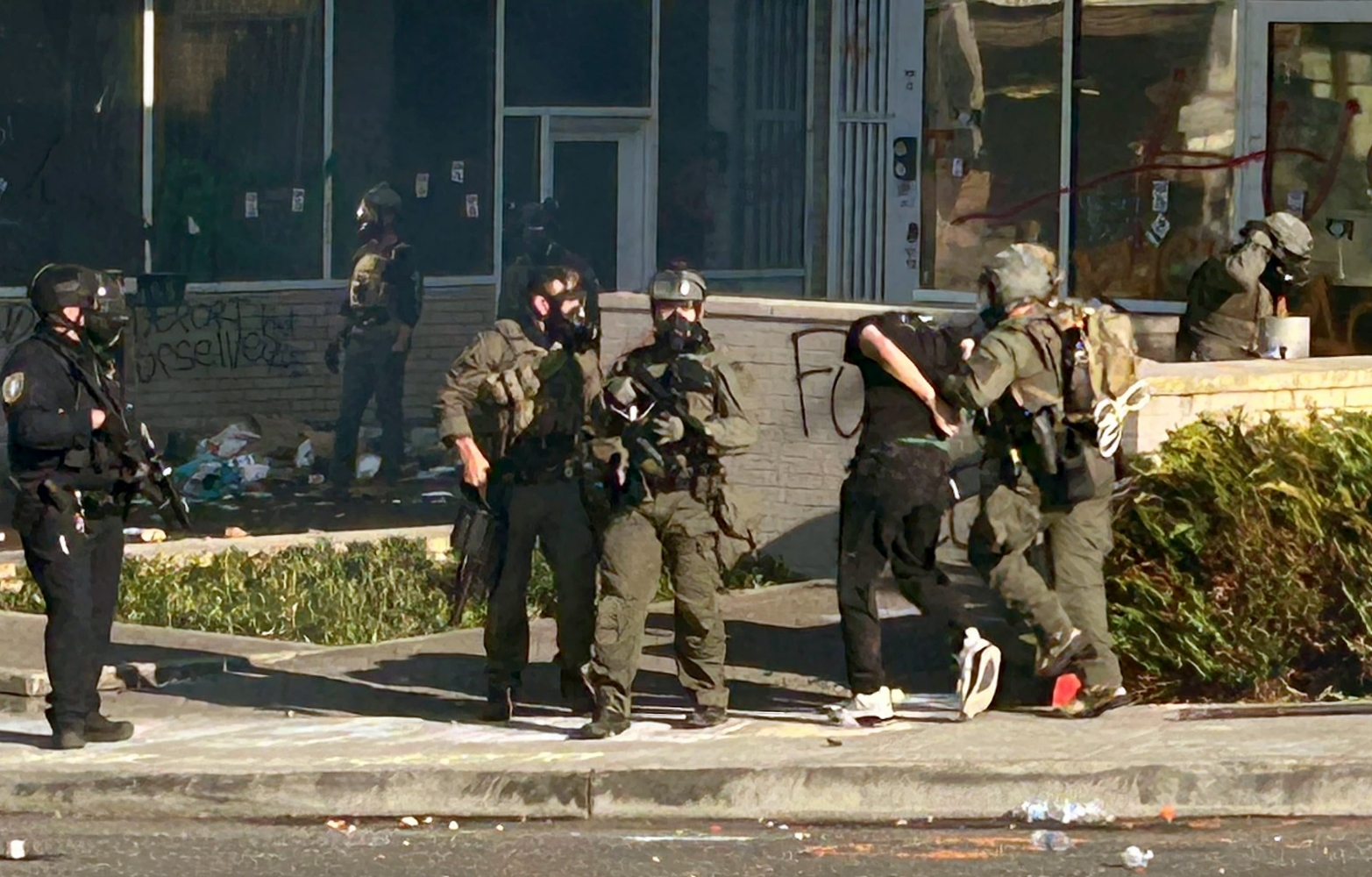
Within moments, they say, they were dragged to the ground and arrested by federal officers who had marched out of the heavily-barricaded building.
None in the trio knows exactly what they did to warrant the arrests, even a month later.
They’ve seen no documents explaining how the officers justified taking them into custody.
They have not yet been formally charged.

“That’s honestly been the most frustrating thing — the unknown, you know?,” said Beatriz Ibarra, one of the three arrested that day.
OPB interviewed more than a dozen people who were arrested at the ICE protests between June and October. What they described was an apparent lack of standard operating procedures as various federal law enforcement agencies cycled through the facility.
Several demonstrators were never informed of the reason for their arrest and weren’t advised of their constitutional rights to an attorney or to remain silent.
Some were photographed next to their arresting officer, while some only had standard mugshots and tattoo photos taken. Others were interrogated about their ties to “antifa.”
Forty people have been federally charged with crimes related to the protests, according to the U.S. Attorney for Oregon. Federal law enforcement records suggest at least 60 people have been arrested and roughly 70 people have been given citations for low-level offenses.
But that isn’t the full picture.
It doesn’t include people who were detained but haven’t been cited or charged with a crime, like Ibarra.
About half of the people OPB interviewed fit that description.
Protesters’ accounts of inconsistent arrest practices don’t shock legal experts.
“You have a chaotic situation here,” said Mary Fan, a criminal law professor at the University of Washington School of Law. “The fact no one knows what’s even going on in their case is unsurprising given all the cooks you have in the kitchen.”
Homeland Security officials did not respond to OPB’s multiple requests for an interview.
Christine Cuttia, a spokesperson for its ICE subdivision, did not answer written questions about law enforcement at the protests and instead defended the agency’s deportation tactics.
“We are committed to creating safe and thriving communities by supporting effective and fair law enforcement practices,” Cuttia said.

Intelligence gathering?
One late afternoon in July, Tayton Lamont, a frequent protester, was filming federal law enforcement at the ICE facility on his phone.
Within a half hour, Lamont said, an officer pointed at him, and other officers rushed into the crowd to arrest him.
Once inside, Lamont said he wasn’t offered access to an attorney.
Instead, officers brought him into a room and peppered him with questions for over two hours.
“They were like, ‘How are you guys organizing? Who is funding you guys?” Lamont recalled in an interview with OPB.
He said officers asked him about “antifa,” a word that describes opposition to fascism that some believe, without evidence, to also be the name of an organized cell of domestic terrorists.
The Trump administration named “antifa” a domestic terror threat in September. In October, White House representatives accused “antifa” of engaging in street battles with officers in Portland.
“They were trying to get me to like, you know, fess up to where antifa headquarters is,” Lamont said.
He told them he knew of no such place or organization.
“Like, no, absolutely not, bro. I’m out here defending our rights.”
Several other people OPB spoke with said they faced the same line of questioning about antifa.
Some said they were asked if they’d been “flown in” by a moneyed group to protest, and were pressed to share the name of their “leader.”
Some weren’t interviewed at all.
Many arrestees asked to remain anonymous out of fear of retribution.

“They were like, ‘Where did you all get those masks?’ And I just said ‘the hardware store,’” said Chandler Patey, who was detained three times this summer, but only cited once.
“They asked who we’re being paid by. I was like, ‘Wow, I fucking wish.’ Who would pay us to be down here? The liberal politicians in the state and city don’t want us to be down here.”
Some of the people questioned said they had never been read their Miranda rights. That’s a statement officers must read to a criminal suspect after arrest, advising them about their constitutional protections against self-incrimination and right to an attorney.
Without it, a person’s statements cannot be used against them in court.
But these interviews can still serve a purpose.
Seth Stoughton, a criminology professor at the University of South Carolina, said officers can use an interrogation where the subject hasn’t been read their rights to collect information about someone else or build on a larger investigation.
“They can violate my Miranda rights and not use what I say against me – but they will still be able to use what I say against you,” Stoughton said. “The Miranda rights are intended to protect the person who is being questioned.”
Another reason why some arrestees were read their rights and others weren’t could simply come down to an officer’s training.
For instance, U.S. Customs and Border Protection officers are largely allowed to detain and search people without a warrant within 100 miles of the U.S. border, meaning they might not get the same kind of training on Miranda rights as their colleagues at ICE.
“Depending on who’s actually handling the arrest, they just might not know,” Stoughton said.
Scattered response
As protests at the ICE facility continued building throughout the summer, the situation became more complicated by entire federal agencies and individual officers cycling through the facility.
Records recently shared in the federal trial over whether President Donald Trump can send National Guard troops to Portland gave a glimpse into the building’s revolving door for law enforcement.
On average, the Federal Protective Service stationed about 28 people at the ICE facility during protests.
The agency – a subdivision of the U.S. Department of Homeland Security – is tasked with protecting federal property, and its supervisors took a prominent role in the federal trial.
A grab-bag of compatriots joined in, mostly from other branches of Homeland Security like ICE.
But the U.S. Department of Justice also had boots on the ground, with personnel from the FBI, Drug Enforcement Administration, the Bureau of Alcohol, Tobacco, Firearms and Explosives, and the Bureau of Prisons picking up shifts.
On its busiest nights, nearly 200 individual officers stood by at the Portland ICE building.
According to records from the federal trial, individual officers even outnumbered the crowd on some nights.

“It was clear they weren’t accustomed to the detainment process,” Patey said. “Each different agent would do the paperwork differently.”
Having at least six different federal agencies handling arrests at the ICE facility will undoubtedly lead to different experiences by arrestees, according to Fan, the criminal law professor at the University of Washington School of Law.
“When you have unprecedented times with a patchwork of agencies cobbled together, the way arrests are carried out is not going to be consistent,” Fan said. “You have a lot of layers there for potential variability.”
A supervisor with the Federal Protective Service testified that the conditions at the protests led them to cycle officers through even quicker. The 30-day rotation for FPS officers was shortened to 20 days.
It’s unclear how many total federal officers have been stationed there between June and October, but supervisors overseeing the protest policing have testified that officers themselves appear overwhelmed by all the new faces and uniforms.
On at least one occasion, a supervisor testified, officers were suddenly exposed to tear gas without warning. The supervisor said the gas was shot by another federal agency — but they still hadn’t figured out which one.
“I can’t name the agency responsible, predominantly because they all dress the same,” said that supervisor, who testified anonymously. “Even in close proximity, it’s hard to tell.”
The U.S. Department of Justice declined to comment on its agent’s response to the protests in Portland.
The Federal Bureau of Prisons Director William K. Marshall III also did not answer direct questions, but instead issued a statement praising law enforcement and condemning “political violence.”
Inconsistent policing
The frenzied nature of the protests and fluctuating federal staffing may also have impacted how arrests were documented at the scene.
On three separate nights in June, Nadya Malinowska found herself handcuffed and taken behind the Portland ICE facility’s gates. Then, each time, she was photographed.
Malinowska said she was photographed in front of a whiteboard that listed her name, the date and the allegations against her.
And she wasn’t alone in the photos.
Each time, Malinowska said, she was joined by the federal officer who arrested her.
“The whole thing was a little comical,” Malinowska said.
In a photo snapped around the same time, protester Mara McKenzie grinned next to her arresting officer, her hair tousled and her clothing disheveled from being tackled to the ground during the arrest.
The officer is dressed in camouflage with no discernible agency markers.
Like Malinowska, McKenzie was never given a clear answer as to why she needed to have her photos taken with the arresting officer. She brushed it off as a “silly” exercise.
Over the months, protesters have dubbed these “trophy photos,” in part because federal agencies have not addressed why their officers do it.
Helena Bartkowski was photographed in late July next to the officer who detained her, as well.
“Some even liken it to when men on dating apps will hold up a fish that they caught,” Bartkowski said.
OPB reviewed several of these photos. In them, officers don’t appear to be striking any poses or making any gestures.
While federal officials did not respond to questions about the purpose of the photos, legal experts theorized that they are a quick method of record-keeping in a chaotic situation.
Stoughton, the law professor, said it’s rare to see arrestees photographed with arresting officers, but repeated protests with high volumes of arrests could benefit from photographing the officer, too.
“It’s more normal in this situation,” Stoughton said. “Let’s say I’m working an 8 or a 10-hour shift. I arrest four people. I don’t have time to do the arrest paperwork right as I arrest every one of those people, so I have to do it later.”
Not everyone said they were photographed with their arresting officer, though multiple protesters interviewed by OPB recalled having other photos taken.
“It wasn’t just a mugshot,” Lamont said. “They took pictures of my tattoos, and the back of my head, side profile. They took a lot.”
Many of these photos showed up in documents filed in the federal case against these protesters, where prosecutors laid out the reason for their arrest.
But not everyone detained during the demonstrations has been granted such clarity.
‘This is just to encourage you not to come back’
A lack of paperwork or formal charges has formerly detained protesters, wondering what, if anything, they did wrong, and what it means for their future
Ibarra, one of the three megaphone-toting protesters detained but not charged on Oct. 4, remains confused.
She said she was held for 11 hours at the ICE building before being sent for an 18-hour stint at Columbia County Jail, located roughly 30 miles northwest of Portland.
“I was asking the guards, ‘Do I have court? Do I have a ticket? What are my next steps?’ And they were like, ‘I don’t know,’” Ibarra said.
Fellow protest-leader Elijah Thahir said he ultimately spent more than 30 hours between the Columbia County Jail and the ICE facility.
Federal officers occasionally move detainees to Columbia County jail when there is limited capacity at Multnomah County Detention Center.
Thahir said guards told him he’d get in front of a judge the following morning to hear his charges.
That never happened.
Both Ibarra and Thahir said they were released without any paperwork or formal charges.
Holly Brown, the third member of the trio arrested on Oct. 4, was released from the ICE building just a few hours after being detained.
Brown said when she left, officers handed her a ticket, which said that she was being charged with trespassing on federal property.
But in the box indicating when Brown needed to appear in court to face charges, the paper read “TBD.”

As of Nov. 19, more than a month after their arrest, no charges have yet been filed against Thahir, Ibarra or Brown.
Of the 14 people OPB interviewed who were detained while protesting at ICE, about half of them have never been charged. The uncertainty has kept them on edge.
Some of the demonstrators believe that may be the point of the vague detentions.
Bartkowski, one of the protesters photographed with her arresting officer, said her arrest was for allegedly failing to comply with orders.
After being held for 45 minutes, she said, a guard handed her a citation but remarked that the charges might be dropped by the time she showed up in court. Bartkowski then asked: So what was the point of her detention?
“He said, ‘this is just to encourage you not to come back,’” she told OPB.
The officer was right: Bartkowski’s charges were dropped.
An analysis by OPB showed the vast majority of arrestees were charged with failure to comply. Many others were given misdemeanor citations for low-level charges, like not following official signals or violating noise ordinances.
The U.S. Attorney’s Office, which is responsible for prosecuting federal charges, did not respond to OPB’s questions about how many criminal cases they declined to prosecute or explain why some people were never charged or cited in the first place. An official referred questions to the arresting agencies.
Stoughton warned that federal agencies could be vulnerable to lawsuits if they aren’t documenting probable cause for each and every arrest at a protest.
Otherwise, it can look like they’re just trying to break up the crowd.
“That’s what’s tripped up agencies before in some large protest situations,” Stoughton said. “Frankly, officers get overwhelmed. And the agency gets overwhelmed. And the paperwork starts to either not occur, or it becomes very boilerplate.”
Bartkowski said she was initially drawn to the protests because she thought she had the constitutional right — and the obligation — to protest when she felt her government wasn’t doing the right thing.
Even if she isn’t facing any legal consequences, Bartkowski said she returned to the protests on her “best behavior,” but it didn’t seem to change the way federal officers treated her.
“People in power – who have enormous power over you – can and will use it to intimidate, terrify, punish and hurt you,” Bartkowski said.
News Source : https://www.opb.org/article/2025/12/03/protestors-arrested-at-portland-ice-facility-wait-months-without-charges/
Other Related News

12/03/2025
Missouri sports betting is in full swing and you dont need a DraftKings Missouri promo cod...

12/03/2025
Maya Lupian a beloved third grade student who was killed in the Stockton mass shooting exc...
12/03/2025
Juanita Swartwood and Bob Simril
12/03/2025
Oregon State coach JaMarcus Shephard is already putting in work on the recruiting trail
12/03/2025
The issue involves approximately 3 million glucose sensors in the US about half of which a...

Follow

Download Our App


Copyright 2022 © EPUERTO. All Rights Reserved