

Published on: 07/02/2026
This news was posted by Oregon Today News


Description
Last December, natural dye artist Elan Hagens decided to go to Willamette National Cemetery, where her father and stepfather, both veterans, are buried. It was National Wreaths Across America Day, and she and her sister were there to place wreaths and tiny American flags at every gravesite.
“It was a cold day, and I remember looking up at the flag and seeing it fly so high in the sky, and the sun was shining. It brought in a sense of pride that I don’t get often,” Hagens said.
Like many Americans, Hagens’ family includes generations of veterans, including her sister. Also, like lots of Americans, Hagens’ feelings for the stars and stripes are complicated. As a Black American, whose ancestors were enslaved and not granted citizenship until 1868, the complexities that the flag presents are ongoing for Hagens.
“Within my family, it’s something that we have pride in. And for me, it’s a sense of emotion, it’s history. It’s a lot of things,” she said, hesitating before completing her thought.
“It wavers a lot, my pride. It does waver. But one thing I’ve always wanted to make is a true American flag, one where the dye for the red and the dye for the blue were grown from plants in North America. Because we do love our country and I love what my ancestors have stewarded and worked so hard for.”
Mother Nature’s child
Born and raised in Northeast Portland, Hagens grew up with an innate love of the natural world. But her mom didn’t have a car to allow her to escape the city. Fortunately, neighbors recognized the young girl’s interest, taught her to garden and brought her along on trips to the coast and mountains. It was the beginning of her lifelong passion for the natural world.

“When I was about second or third grade, I started going to outdoor schools and learning that there was somewhere that I could go and experience nature — like 100% full immersion — and it just changed my life.”
Today, Hagens is an entrepreneur with interests that include growing and teaching others to use natural dyes, cultivating sorghum for artisanal brooms, and foraging for fungi and selling them at farmers markets through her business Temptress Truffles. She’s also a social media influencer with thousands of followers, centered on demystifying nature and the notions of who belongs in the outdoors.
“We need to see people and ourselves in all those places because it’s really hard to grow, and it does take some bravery when you have never seen yourself out there before,” she said. “And social media has just, like, busted that open wide for me.”
‘That beautiful blue’
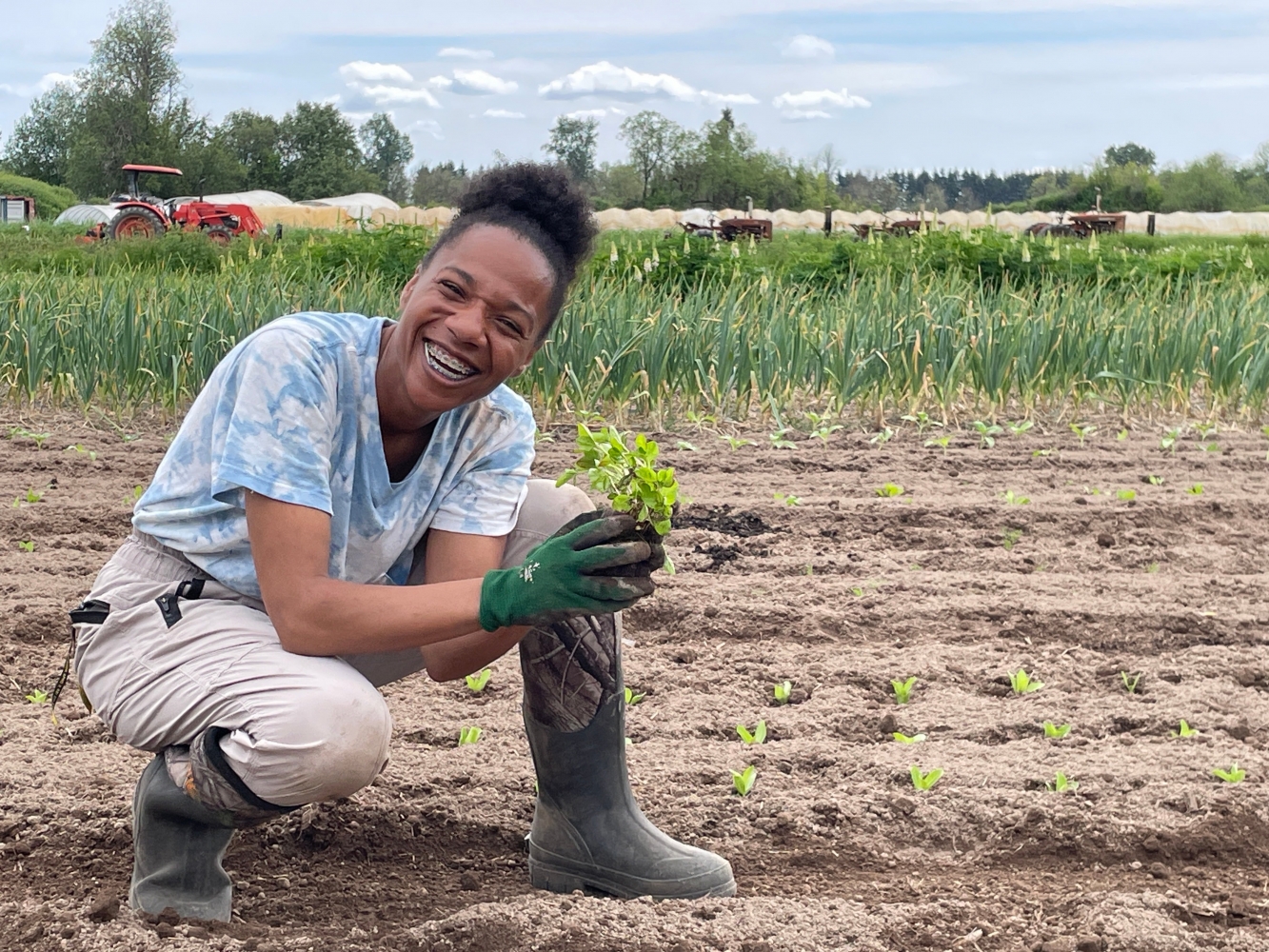
Last spring, Hagens was part of a small team of volunteers planting a Japanese variety of indigo seedlings at Vibrant Valley Farm on Sauvie Island. Once mature, the leaves of these plants would provide the blue pigment for her “true” American flag. But for Hagens, the historical roots of this plant — known for its ability to produce the color blue — run deep.

“Here in America, the beginning of our knowledge of indigo came from Africa,” Hagens explained.
Portuguese records detail West African production and trade of indigo as early as 1342, centuries before the transatlantic slave trade forced people from that region to the colonies that would become the United States.
“When they were kidnapped, they brought all that knowledge of growing indigo with them,” she said. “And a lot of people don’t know that our American flag, the blue color, was actually made and stewarded and the color extracted from a lot of indentured workers in slavery. It’s a very interesting thing when we start thinking about that. That beautiful blue, that’s ours!”
Trial and error
By late summer last year, the farm, which grows garlic, flowers and natural dye plants, was scattered with several large vats containing Oregon-grown, indigo-based blue dye.

“We lost this knowledge of tending to the indigo plant through loss of lands and the advent of synthetic dyes. So, in the beginning we didn’t know what we were doing,” Hagens said.
Now, some eight years later, Hagens and Vibrant Valley Farm co-founder Kara Gilbert have honed their indigo pigment extraction processes — of which there are several — to a science. Still, variations in the resulting indigo dyes are inevitable depending on variety, growing conditions, weather, temperature, harvest timing and a host of other variables in the extraction process.
Last August, “Oregon Field Guide” filmed one method in which Hagens and Gilbert steeped fresh indigo leaves in water overnight. Once the watery brew was poured off, Gilbert added the flocculent calcium hydroxide to it, causing the tiny, suspended particles of indigo to bind together and settle to the bottom of the jar. What remained was a dense blue sludge.
“Pure pigment,” said Hagens. “We then put that pigment into a vat, and that vat will be used to dye many items.”
She used these vats to dye the blue star field of her flag.
Frayed around the edges
As winter set in, Hagens was in her studio last December, arranging strips of red cloth dyed with organic madder root alongside strips of white fabric, both of which she sourced from the Pendleton mill ends store. She smirked benignly, pointing to the fabric’s edges, which are frayed rather than sharp.

“I was cutting my first piece, and it was a little bit crooked and I was like, ‘Oh, let me fix it.’ It got even more crooked,” she said. “And then I cut my second piece, and I’m like, ‘Oh my gosh, they’re not lining up perfect. I’m not gonna have a perfect American flag. They’re gonna be askew. All these edges are gonna be so frayed and awful, and I’m gonna have to redo them.’”
Then, she realized she liked it that way — frayed and imperfect.
“It just started coming together and making sense that it needed to be this way,” Hagens said. “Because we’re tattered right now.”
Am I going to be proud of this flag? Would I hang it outside? ... I’m doing this project and I don’t know.
Elan Hagens
But on this dim winter day, there was something else on her mind.
“Making this flag, it’s been a very interesting journey and like an internal fight that I never thought I would have,” Hagens sighed, pausing for several seconds and furrowing her brow.
“I am fearful if I see a lot of American flags,” she said finally. “Like, if I’m going to move to a neighborhood, if I see more than five flags, I know that neighborhood’s not for me. It might not be safe for me. They probably don’t want me here.”
Hagens continued: “It’s a weird thing. And I also think, am I going to be proud of this flag? Would I hang it outside? And that’s really interesting. I mean, I’m doing this project and I don’t know.”
Reclamation
By early spring, Hagens had finished her flag and hung it on her living room wall. Beside the frayed stripes, a deep, indigo-blue rectangle gleamed with 50 sharp-pointed stars, hand-painted from a mixture of ground egg shells, seashells and chalk. Hagens’ inner dilemma also seemed settled; she said that seeing it hanging on her living room wall made her feel “good inside.”

“I had to make this flag, this true American flag, despite all the feathers that were ruffled and despite all the emotions that were brought up,” she said. “Because our ancestors and people who came before us were fighting hard for this flag, for us, for safety, for freedom, for all these things. I have to show people who think different than me, who were raised different than me, that this is mine as well.”
News Source : https://www.opb.org/article/2026/07/01/oregon-grown-indigo-american-flag-portland-dye-artist/
Other Related News
07/02/2026
Oregon library card holders can now check out parking permits from participating libraries...

07/02/2026
A local athlete who didnt start going to the gym until she was 71 is now a world record ho...
07/02/2026
State fire officials are urging Oregonians to exercise caution with fireworks ahead of a h...

07/02/2026
The US striker was suspended one match after VAR upgraded his foul to a straight red card ...

07/02/2026
On the same morning Mitch McConnell was hospitalized EMS was called to his home to respond...

Follow

Download Our App


Copyright 2022 © EPUERTO. All Rights Reserved