

Published on: 12/31/2025
This news was posted by Oregon Today News


Description
2025 was an eventful year in Pacific Northwest news, to say the least.
In recent months, headlines have largely been dominated by the federal push to deploy the National Guard to Portland and the region’s response to ICE.
But before that, OPB readers engaged with accountability investigations, local impacts of federal funding cuts and stories of everyday resilience.
OPB has compiled a list of 15 of the biggest news stories that resonated with the public this year, from January to December.
1. Oregon passed expensive legislation supporting renters facing housing crisis. Eviction cases are still climbing (Bryce Dole, Jan. 29)

This in-depth analysis of the state of Oregon’s housing crisis published in January, taking a closer look at the statewide housing shortage and surging rental costs that have pushed many to the brink of homelessness.
While property management advocates argued that recent changes to the state’s eviction law in March 2023 made it easier for tenants to repeatedly forgo paying rent, data showed eviction rates continued to rise. In 2019, Oregon landlords filed more than 1,500 eviction cases each month on average. In 2024, that number topped 2,300.
As of January, one in four Oregon households spent more than half of their total income on rent, and more than 85% of eviction filings since October 2022 have been due to people not paying rent, according to the Oregon Law Center’s Eviction Defense Project.
2. How federal funding cuts are affecting one small school district in an Oregon community that voted heavily for Trump (Natalie Pate, March 19)
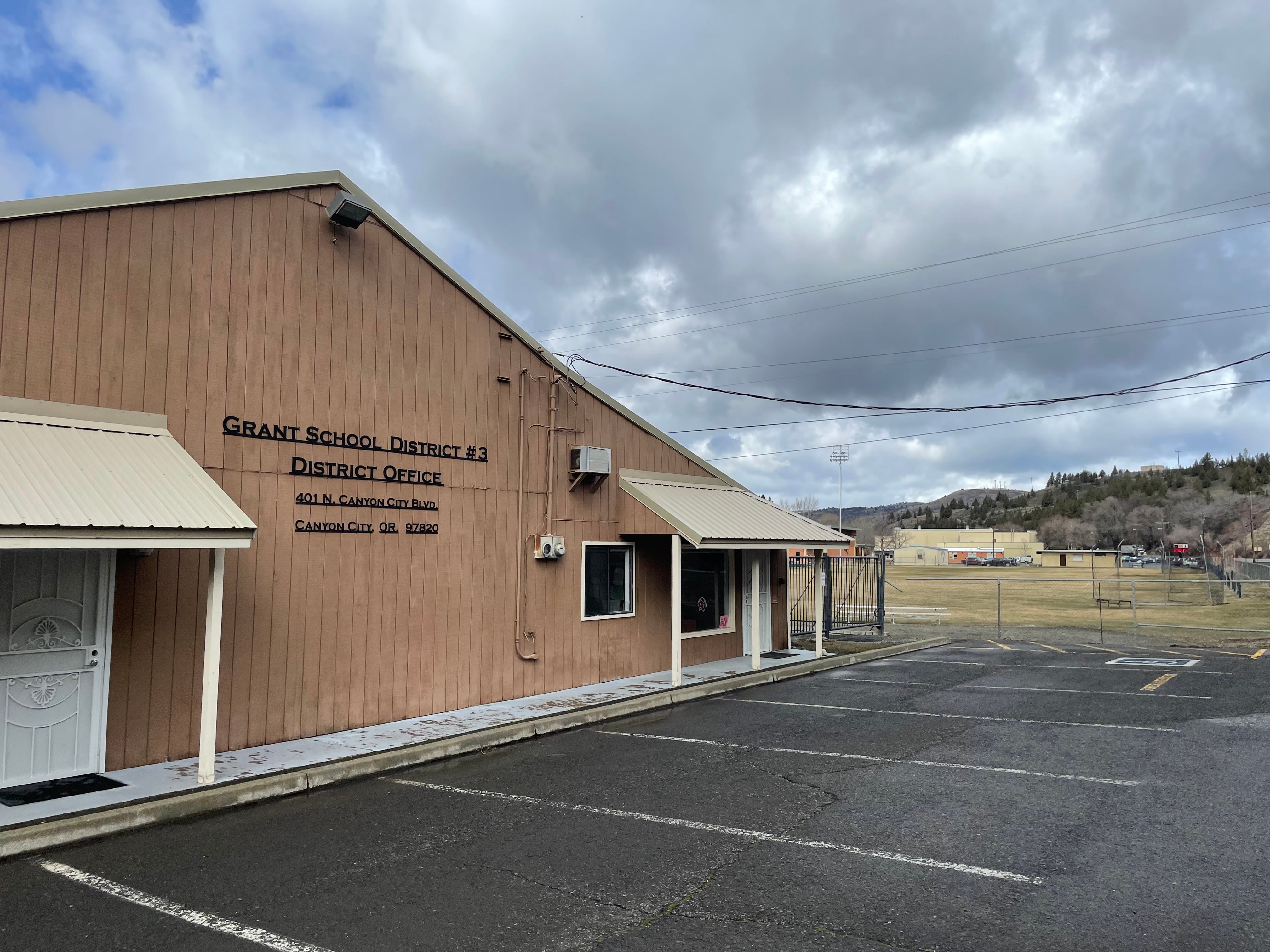
Grant School District in Eastern Oregon faced a critical financial and operational dilemma in March after the U.S. Department of Energy’s 2024 Renew America’s Schools grant program was unexpectedly suspended.
The small, rural school district — which Superintendent Mark Witty said has experienced significant economic hardship and declining enrollment over the years — was promised more than $682,000 for energy efficiency improvements at Grant Union Jr./Sr. High School.
However, recent layoffs at the Department of Energy jeopardized the future of those improvements and the promise of reimbursement.
3. Former students say a St. Helens High teacher abused them in the 1980s. He became a face of child welfare in Oregon (Joni Auden Land, March 24)

For nearly two decades, Gene Evans was the public face of state agencies responsible for protecting Oregon’s children and holding people who abuse them accountable.
In late 2024, OPB received an email about Evans from a woman accusing him of abuse. That email arrived soon after police had arrested one current and one former teacher at St. Helens on multiple allegations of sexual abuse, which spawned citywide protests from students and parents.
For months, OPB conducted interviews with 13 people who had some knowledge of the events, including women who say Evans abused them, family members, students and former St. Helens teachers.
Those conversations painted a picture of a teacher popular with students but whose attentiveness drew whispers that he had crossed lines. They also suggest the St. Helens School District lacked a firm system for protecting students – and holding adults who are accused of abuse accountable – for decades.
Following OPB’s reporting in March, the Oregon Department of Human Services confirmed in April that it had opened an investigation into Gene Evans in relation to the allegations of sexual abuse while he was a teacher at St. Helens.
4. ‘No Kings’ rallies draw thousands across the Pacific Northwest (OPB staff, June 14)

OPB reporters covered “No Kings” protests across Portland, Newberg and Hillsboro on June 14, working in tandem with news partners to provide coverage from across the Pacific Northwest.
An estimated 50,000 people participated in Portland demonstrations, with zero arrests.
Organizers behind the “No Kings” protests were motivated by the massive military parade President Donald Trump scheduled for his 79th birthday.
But by the time protesters around the country and the Northwest showed up to rallies, many were more focused on immigration issues than on the president’s planned display of military power.
5. House passes Trump’s domestic policy bill. Here are 5 ways it will impact Oregon (Amelia Templeton, Dirk VanderHart, Michelle Wiley and Courtney Sherwood, July 3)

Congressional Republicans passed their domestic policy bill — sometimes referred to as the “One Big Beautiful Bill” — on July 3, and it was signed into law on July 4.
The bill made sweeping changes to entitlement programs like Medicaid and SNAP, significantly increased funding for the administration’s immigration enforcement efforts and cut funding for environmental programs.
The story delves into the significant impacts of this legislation on Oregon residents.
An analysis of an earlier version of the bill found the state would be disproportionately hit by the cuts to Medicaid, with more people likely to lose coverage and end up uninsured. It would also cut funds to the state’s timber counties (scroll to story #9 for more details), and could reshape how Oregonian students pay for college and pay back student loans.
6. ‘Daddy, police!’: New video shows masked ICE agents arrest father outside child’s school in Beaverton (Conrad Wilson & Holly Bartholomew, July 21)
A video of masked ICE officials arresting a father outside his child’s Montessori school in Beaverton made waves in July.
The arrest marked the first confirmed immigration enforcement action outside of an Oregon school.
Until earlier this year, federal policy prohibited immigration officials from making arrests near certain locations such as schools, houses of worship and hospitals.
ICE stopped chiropractor Mahdi Khanbabazadeh, 38, while he was driving his child to Guidepost Montessori school.
A clip taken from the car’s dashboard camera shows ICE officers smashing the driver’s side window of the car after the child left the vehicle.
7. Volunteers rebuild historic fire lookout at Mount Rainier after vandalism (Ian McCluskey, July 26)

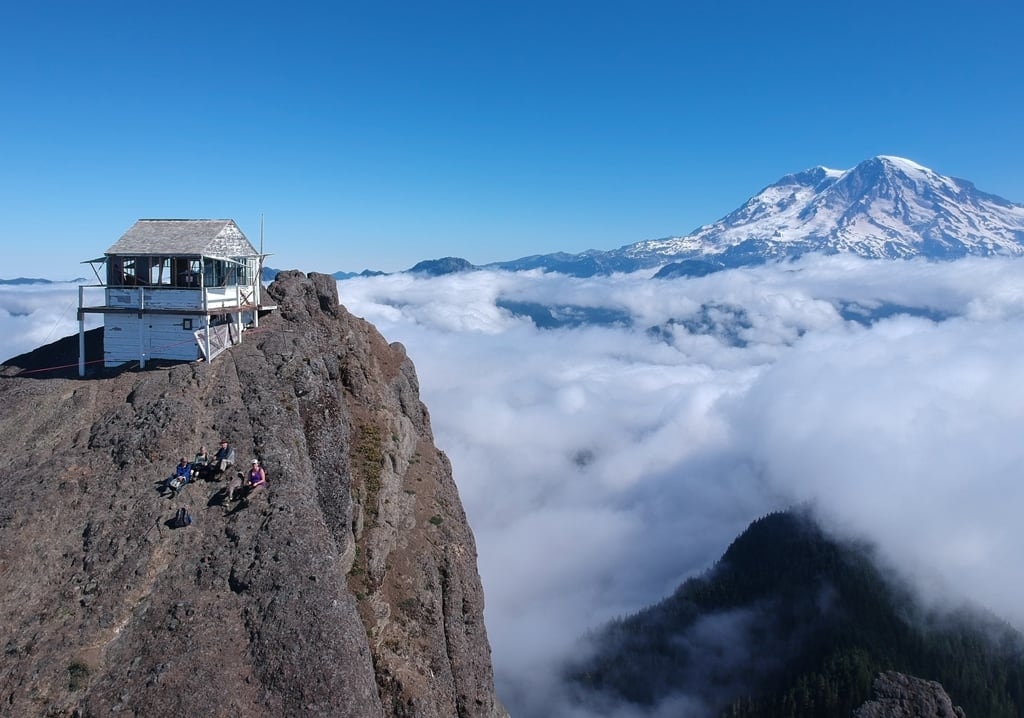
One of Washington state’s most photogenic hikes, the High Rock Trail — known for its dramatic cliffs and panoramic views of Mount Rainier — was temporarily closed this year while the trail’s fire lookout was given a long-awaited new look.
Volunteers worked to rebuild the historic High Rock Lookout, which stood at a 5,685-foot summit for nearly 100 years before it was dismantled in summer 2021 to address extensive vandalism and graffiti. Since then, the base of the lookout structure remained bare and incomplete until September, when the lookout was finally restored.
8. A shopping center’s demise brings frustration to East Portland (Alex Zielinski, Aug. 6)

When grocery store owner Fred Meyer opened the suburban Gateway Shopping Center in 1954, he envisioned a “gateway” to economic development and community growth seven miles east of downtown Portland, complete with a large concrete arch in the parking lot.
It worked, attracting new residential development, businesses and eventually, an active public transit center. But that dream is now a thing of the past, as the center closed in September.
Despite a decades-old city plan to cement the shopping district as Portland’s “second downtown,” years of economic upheaval, land use challenges and perceived political indifference have left Gateway a shell of its past self.
9. ‘We are sinking’: Oregon timber counties flail, awaiting Congress to renew key funding (April Ehrlich, Aug. 18)

A budget crisis 100 years in the making came to a head in August as Oregon’s rural counties waited on Congress to approve funding they’ve long relied on.
The crisis originated with a compromise from President Teddy Roosevelt’s era and was prolonged by piecemeal solutions made during the Timber Wars of the 1990s.
Earlier this year, Trump’s signature “One Big Beautiful Bill” removed a key funding source for Oregon’s timber counties that often rely on the program to pay for sheriff’s departments or other essential needs. Now, all money from new timber sales will go to the federal government.
Many rural Oregon counties once relied on a portion of revenue from logging on federal lands to cover the costs of essential services. That’s particularly important since federal land doesn’t generate local property taxes, which typically pay for public services like roads, law enforcement, health departments and libraries.
As logging revenues declined, federal lawmakers came up with the Secure Rural Schools program to provide funding. At the time this story was written, lawmakers had not renewed Secure Rural Schools funding since 2023, leaving more than a dozen Oregon counties flailing with significant budget holes.
Just a few weeks ago, the U.S. House voted 399-5 in favor of the Secure Rural Schools Reauthorization Act of 2025, which the Senate had approved in June. Now, the measure awaits Trump’s signature.
10. Pacific Northwest cherries boomed this season, but for farmers it was more of a bust (Alejandro Figueroa, Aug. 23)

The Pacific Northwest’s cherry crop was expected to be a boon for farmers this year. The fruit this season was high quality and production was up compared to last year. But with a shortage of migrant workers early in the season and then high prices at the grocery store, it was more of a bust.
This summer, the Trump administration’s aggressive immigration enforcement kept many migrant farmworkers in California, who usually follow the harvest season, from making their way north to Oregon and Washington.
By the time enough people made their way up, the harvest window for some cherries had passed, and some were left to rot in the field.
11. Flat Fire destroys 4 homes, threatens thousands more with no containment in Central Oregon (Emily Cureton Cook and Joni Auden Land, Aug. 24)

Four homes were lost to the Flat Fire in late August as it grew rapidly throughout Deschutes and Jefferson counties. At one point, the fire was estimated to be nearly 22,000 acres with 0% containment.
The blaze also destroyed six other structures — meaning shops, barns, garages, sheds, pump houses or similar buildings — and damaged two structures in Deschutes County.
The fire marked a dramatic turn in Oregon’s wildfire season amid a heat wave that gripped parts of the Pacific Northwest. But it’s worth noting that compared to previous fire years, 2025 was relatively mild.
Forecasters expected high temperatures and severe drought conditions to persist through the summer which, for the most part, they did. But some mid-season rain may have helped tamp down flames, keeping them from growing into the types of disastrous megafires that Oregon has seen in years past.
Overall, fires burned across 339,000 acres in Oregon this year. That’s far less than the 1.9 million acres that burned in 2024, despite significantly more fire starts. About 1,000 more fires sparked in Oregon compared to last year.
12. Oregon, Washington, California form health care alliance to protect vaccine access (Amelia Templeton and Michelle Wiley, Sept. 3)

In September, the democratic governors of Oregon, Washington and California formed the Western Health Alliance: a new public health partnership aimed at preserving access to vaccines.
The partnership will develop its own immunization guidelines “informed by respected national medical organizations,” according to a press release from Oregon Gov. Tina Kotek, Washington Gov. Bob Ferguson and California Gov. Gavin Newsom.
“The CDC has become a political tool that increasingly peddles ideology instead of science, ideology that will lead to severe health consequences. California, Oregon, and Washington will not allow the people of our states to be put at risk.”
13. Portland’s weekend of ICE protests: Tear gas, National Guard restraining orders and false claims of a city burning to the ground (OPB staff, Oct. 6)

Early October brought one of the most whiplash-inducing 48 hours for Portland.
The city was again at the center of national headlines as Trump continued his push to deploy National Guard members into Portland, ignoring objections from city and state elected officials and U.S. District Court Judge Karin Immergut, who ruled in favor of Oregon on Oct. 4.
Around the same time, hundreds marched to the ICE detention facility in Portland in a protest. Soon after, federal law enforcement marched out of the center and fired tear gas, smoke canisters and pepper balls to disperse the crowd. Several people were arrested.
The next morning, Trump turned to the National Guard in California and Texas for hundreds of federal troops he could send to Portland.
Late that evening, Judge Immergut again sided with the state of Oregon, halting the deployment or relocation of any federalized members of any state’s National Guard to Oregon.
14. ‘It’s no longer being covered up and denied’: Discovering Oregon’s hidden Native American boarding school history (Kami Horton, Oct. 13)

While researching Oregon’s Native American boarding school history, a Klamath Tribes woman uncovered her own family’s story.
Afterward, Gabriann “Abby” Hall decided to focus on researching and telling the story of federal Native American boarding school policy.
“I knew my grandma had gone to Canyonville Bible Academy,” Hall said. “I just assumed it was like a camp or a day school.”
Hall had no idea her grandmother and many other students from her tribe lived at religious institutions.
“I didn’t realize that she had been a boarder there, that it was a boarding school where they took in Native Americans,” Hall said.
15. Federal judge permanently blocks Trump from deploying National Guard to Portland (Conrad Wilson and Michelle Wiley, Nov. 7)

President Donald Trump was permanently blocked from sending the National Guard to Portland by U.S. District Court Judge Karin Immergut, who delivered her final order in the case on Nov. 7, marking the end of a monthslong saga.
The litigation centered around whether ongoing protests outside the U.S. Immigration and Customs Enforcement building in the city warranted a National Guard deployment.
In her ruling, Immergut acknowledged “violent protests did occur,” but law enforcement was able to address them.
The decision was a setback in the Trump administration’s effort to send National Guard members to the city, and marks the fourth time the judge blocked the deployment in Portland.
News Source : https://www.opb.org/article/2025/12/31/oregon-washington-stories-news-2025-year-review-pacific-northwest/
Other Related News

12/31/2025
Mohamed Adan killed the mother of his three children in 2022 after a now-defunct activist ...
12/31/2025
The wild surveillance footage captured a car flying over a backyard wall and landing on th...
12/31/2025
Cheers to a Happy New Year from McKays Market Enjoy Prime Grade Chuck Roasts for only 799l...
12/31/2025
Subscribe to OPBs First Look to receive Northwest news in your inbox six days a weekGood m...

12/31/2025
Ready to remove a real Christmas tree from the living room Consider donating it to feed a ...

Follow

Download Our App


Copyright 2022 © EPUERTO. All Rights Reserved