

Published on: 06/15/2026
This news was posted by Oregon Today News


Description

You may think of a river as a winding band of deep water, hemmed in on both sides by tall, rocky banks.
But Eli Tome, the Director of Conservation for McKenzie River Trust, would like to change that perception.
“Part of our work is hopefully showing the community that when somebody says ‘a river,’ that you think of a connected wetland complex,” said Tome. “Really, it’s the whole system, connected to its banks, and thriving little ecosystems that are off to the side, with beaver damming it up.”
McKenzie River Trust, along with the Eugene Water & Electric Board, the McKenzie Watershed Council, and the National Forest Service, has been incrementally converting hundreds of acres of land near the McKenzie River into a wider floodplain.
They’re restoring the area for several reasons: To improve water quality, create better habitat, and build a buffer in case of flooding. Over the past few wildfire seasons, these areas have also proven to serve as fire breaks and places of refuge.
Tome said all of these benefits may help serve a changing climate.
“If we have less snowpack in the mountains, what we can do is we can restore these valley bottoms, and then that creates a wetland that is helping store water later into the year,” Tome said. “These projects are a reservoir, it’s a reservoir that will be upkept by beaver instead of being upkept by engineers and bulldozers and dump trucks and cement.”

McKenzie River tributaries used to extend across wide valleys before people built roads and industries. Several of those waterways, which now flow swiftly in narrow channels, are being restored. The McKenzie itself will continue to be accessible for recreation, and the hope is that fishing and water quality will improve.
Quartz Creek is a 120-acre site that was restored last summer. It’s now a greening expanse of meandering water, with shallow pools and young willows amid a crisscross of intentionally buried logs.
Tome said the project attempts to mimic a natural disturbance, like a flood or a landslide, to help the water find new paths.
Susan Fricke, the Water Resources Supervisor at EWEB, said Quartz Creek was one of the most problematic feeders of Eugene’s drinking water, sending chocolate-colored, sediment-filled water into the McKenzie. This shallower, wider creek now catches sand and sediment, and serves as a filter.
“We do have roads here, we do have land uses upstream that are sending contaminants through,” said Fricke. “And so when you’re settling out that sediment, that also means you’re settling out those contaminants as well, and they’re not going downstream to our communities where people are recreating and using the water, to our utilities that are using it for drinking water, so it’s a win-win for all of our downriver communities.”

Before Quartz Creek became a “braided” stream, it went through some heavy construction. That’s what’s happening now, upriver at Cougar Reservoir, where the work is in its beginning stages.
The 340-acre site is on the South Fork McKenzie River, just off Highway 126 at the start of Aufderheide Drive.
Lara Colley, the Floodplain Restoration Projects Manager with the McKenzie Watershed Council, said in order to create a wider basin, excavators and bulldozers are lowering some riverside areas and filling in other places.
“All these machines have GPS-enabled buckets in their equipment,” she said. “So they know where grade is, and they’re making sure that everything is to grade. At the end, it’ll look more like a riverbed surface would look. Wood is just gonna be everywhere. It’s gonna be great.”
Colley said 7,000 logs will be placed in a lattice here, many buried deeply to help create jams that will become wetlands. Many of the logs were hazard trees, burned in the Holiday Farm Fire, which came through here in 2020. She expects this restoration to be completed by the end of summer, with one more phase in the future.

These projects are funded by a combination of local, state and federal dollars. The South Fork project is estimated at $6.4 million. Quartz Creek was about $10 million, including the cost of a new, longer bridge, which was needed to span the widened creek.
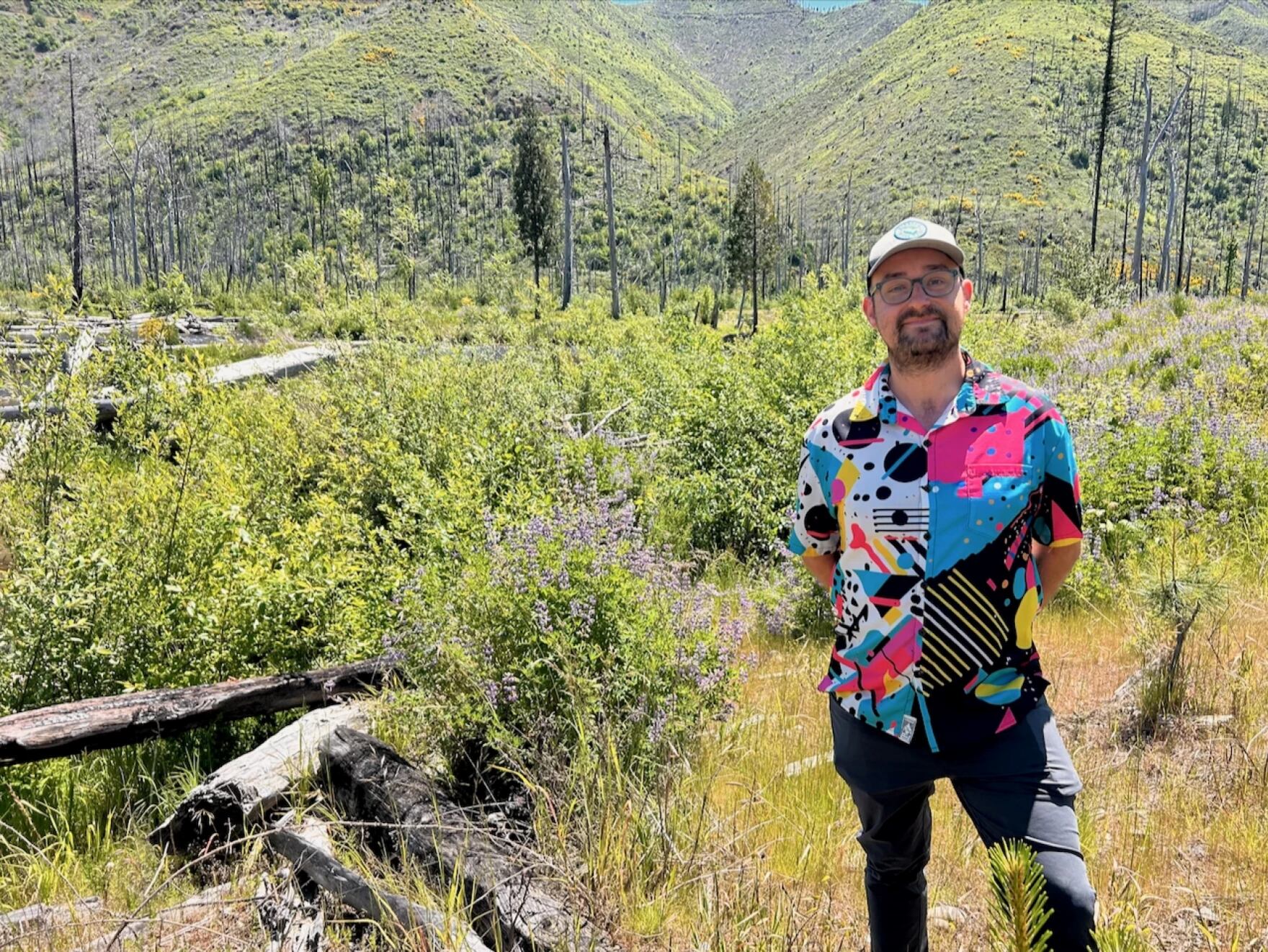
At Finn Rock Reach, where gravel mines used to define the landscape, Tome was excited to see that willows, planted as small stakes three years ago, now tower over him. Fragrant lupine bloomed all around, and there were many other signs of life.
“Right now there’s an osprey overhead, there’s a heron flying over there, there’s a ton of wildlife that’s out here using the project,” Tome said. “There’s western pond turtle here that are all throughout the project site.”

Tome said people sometimes question the use of heavy equipment in restoration. He said they strive to do a destructive job thoughtfully: Biodegradable lubricants are used on the trucks, and as many fish, lamprey, and invertebrates as possible are saved from each site. Any living trees or active beaver dams are left alone.
He said energy needs to go into the system to undo the damage that was done, but the logs they bury, and the subsequent wetlands become a great carbon sink.
“We actually did a rough calculation of carbon, and (at) our Finn Rock project, for example, we think about nine months after machinery left that project, we were carbon neutral,” he said. “We had sequestered enough carbon that we made up for all the diesel that we burned to do the project itself.”
Tome emphasized that although they’re being diligent and heavily monitoring the work to learn as much as possible, they approach each restoration with humility.
“There is no project like this that was done 20 years ago that we can look at,” he said. “The 20-year project is going to be here, and this is kind of a grand experiment.” He added, “I think that this is the kind of work that truly moves the needle.”
Tome said the team believes these wetland restorations are the best chance to give salmon a healthy place to spawn and protect the water supply. He said historic General Land Office surveys of the Pacific Northwest mentioned old-growth trees growing on top of giant log jams on Oregon’s Rivers.
He said he’d like to think they’re setting up similar conditions. “In 400 years, hopefully there’s an old-growth forest growing on top of some of our log jams in Quartz Creek.”
Karen Richards is a reporter with KLCC.
This story comes to you from the Northwest News Network, a collaboration between public media organizations in Oregon and Washington.
It is part of OPB’s broader effort to ensure that everyone in our region has access to quality journalism that informs, entertains and enriches their lives. To learn more, visit our journalism partnerships page.
News Source : https://www.opb.org/article/2026/06/15/mckenzie-river-restoration-projects/
Other Related News

06/19/2026
Check your tickets for Oregon daily lottery draw games here
06/19/2026
From 2024 Philomath-based Patrick Lumber pursues a new hardwood sawmill with help from a 1...

06/19/2026
DEAR ABBY We are grandparents When our son daughter-in-law and grandchildren visit we want...

06/19/2026
Dear Eric Our son got married several years ago and we contributed a nice sum of money tow...

Follow

Download Our App


Copyright 2022 © EPUERTO. All Rights Reserved