

Published on: 06/26/2026
This news was posted by Oregon Today News


Description
Looking for the rest of the Superabundant newsletter?
Subscribe now to get original recipes, PNW food news, and ideas for the kitchen and garden!
(Pivots neck, looks at the camera) Real talk: Food newsletter writers have to develop their recipes several days in advance of when they’ll go live. (Better-organized food newsletter writers probably do this much farther ahead, but ✨vibing with the seasons✨ is more fun than keeping a tight spreadsheet.) The sudden, late Juneuary I see on the weather forecast makes it kind of hard to figure out what recipe will still be appreciated (or relevant) by the time it’s published on Friday, when I’m recipe planning on a 90-degree day.
Noodleheads might disagree, but sōmen, somyeon and saimin are literally (or at least etymologically) synonymous — they all come from the Chinese name xìmiàn (細麵) or sùmiàn (素麵), meaning “small noodle,” which aptly describes the diameter of these noodles. Think angel hair pasta … but the angel has a receding hairline.
In Japan, sōmen is customarily served cold, with a dipping sauce (tsuyu) rather than in a broth of any kind, while Korean somyeon are eaten in hot or cold broth, or as bibim guksu (“mixed noodles”) — with no broth at all, sometimes dressed in the sauce, sometimes with the sauce in a blob on top. Saimin is usually a hot noodle soup (and a staple dish) in Hawaii, where Chinese, Japanese, Korean, Filipino and Portuguese immigrants have been making their culinary marks since the 1850s.
Food is just another piece of human culture, moving through time, evolving like finches’ beaks. It doesn’t matter how far it’s traveled or who brought it there; it remains tied to its roots. This is my favorite thing about culinary history.
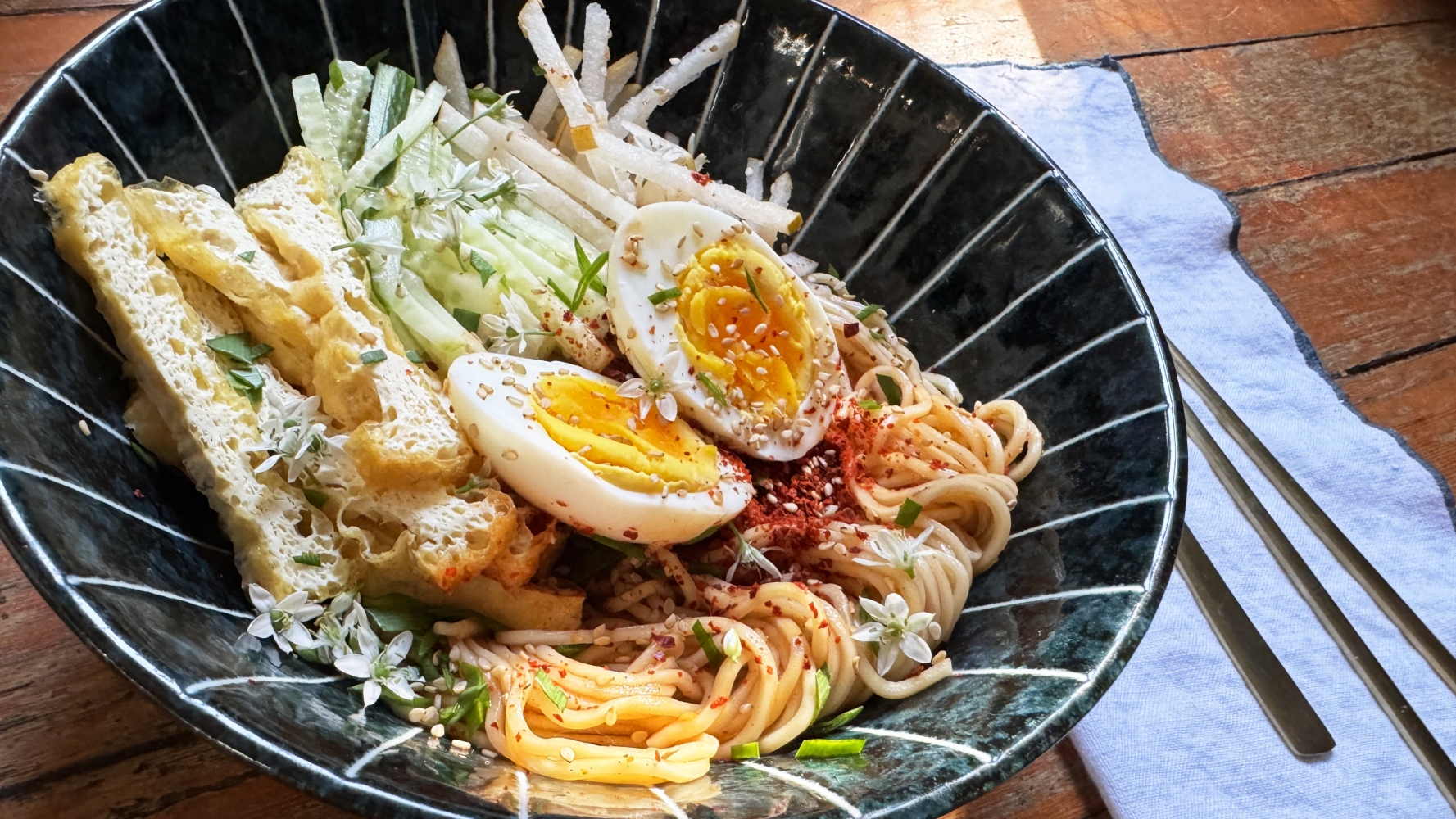
If you find this recipe on a hot day, enjoy it as written (or with your own modifications, as needed). If it’s cool and rainy out, add a nice ladle or two of hot broth instead of chilling the noodles, maybe swap the cucumber and Asian pear for julienned shiitakes and carrots. If you don’t like fried tofu, slide thinly sliced beef or pork across the top instead. This recipe is riffable, so feel free to noodle with it. Serve 2-4.
Ingredients
Sauce
3 tablespoons gochujang
3 tablespoons soy sauce
2 tablespoons sesame oil
¼ cup kimchi brine (you can use white kimchi if you want to cut the heat level) or rice vinegar
1 tablespoon rice syrup
1 tablespoon mirin
1 tablespoon minced ginger
2 cloves garlic, minced
Bibim guksu
2-4 eggs (one per serving)
2 large pieces (one package) fried tofu
2 bundles fresh or 12 ounces dried somyeon noodles (or other long, thin wheat noodle like sōmen)
1 Asian pear, cored and julienned
Half an English cucumber, julienned
4 garlic chives or 2 scallions (and their blossoms, if you have them), thinly sliced
2 teaspoons sesame seeds
Instructions
- In a large mixing bowl, whisk together the sauce ingredients until fully combined and set aside.
- Prepare an ice bath by partially filling another large bowl with water and ice cubes.
- Bring a medium-sized pot of salted water to a boil. Cook the eggs for about 5-6 minutes (depending on how well you like your eggs cooked), then transfer to the ice bath with a slotted spoon until fully cooled, about 5 minutes. Peel and halve the eggs.
- Dunk the fried tofu in the boiling water for 10 or so seconds to remove some of the excess oil, then remove and pat dry. When it’s cooled enough to handle, thinly slice the tofu into strips. Set aside.
- Add the noodles to the same pot of boiling water and cook according to the directions on the package (you want them slightly al dente). Transfer the cooked, strained noodles to the ice bath, then swish them around to stop the cooking and rinse off excess starch.
- Strain the noodles, giving them a few good shakes to really get the water off, and then transfer them to the bowl of sauce. Using your hands (gloved, if that’s your preference), gently mix the noodles with the sauce until they’re thoroughly dressed.
- Serve by dividing the noodles into bowls and then top with the pear, cucumber, tofu, chives and egg, then sprinkle sesame seeds over the top.
Don’t forget to subscribe!
News Source : https://www.opb.org/article/2026/06/26/superabundant-recipe-bibim-guksu-juneuary-pivot/
Other Related News

06/26/2026
Recent escalations near Iran have threatened the already fragile peace agreement the count...

06/26/2026
Whats more fortunate than having 24-hour access to high-end desserts How about actual fort...

06/26/2026
Firefighters rescued two people from a powerful 2-alarm house fire in Hillsboro Thursday a...

06/26/2026
Thousands of older Oregonians could soon pay just 50 a month for popular weight loss drugs...

06/26/2026
The OregonianOregonLive reached out to every Oregon high school in every classification to...

Follow

Download Our App


Copyright 2022 © EPUERTO. All Rights Reserved