

Published on: 06/26/2026
This news was posted by Oregon Today News


Description

At first, Mohammad was thrilled when Iran qualified for the World Cup. What’s more, one of the matches would be in Seattle.
“It doesn’t get any better than this,” he remembers thinking. But then he called his father in Iran.
“I knew that if I told him I would be the first person in our family ever to attend a World Cup match featuring Iran’s national team, he would be overjoyed,” Mohammad said.
(We are only using Mohammad’s first name for safety reasons.) But his father was silent.
Then he told Mohammad: Don’t go.
“He said even if the seats stayed empty it would be better because we do not consider the national team to be our team,” Mohammad said. It’s not uncommon to hear Iranian-Americans say that the national team represents the ruling regime, and not the people.
RELATED: US eases restriction on Iran’s World Cup team, allowing travel 2 days before next match
Today’s World Cup match between Iran and Egypt is both deeply political and intensely personal for many Iranian Americans living in the Puget Sound region. As the teams take the pitch, major events inside Iran earlier this year—prior to the war—are casting a long, dark shadow over the stadium.
With the World Cup in Seattle, many Iranian-American fans say they feel torn between devotion to soccer, love of country, and opposition to the Iranian government. The feelings are especially heightened following widespread and unprecedented massacres of protestors inside Iran in January.
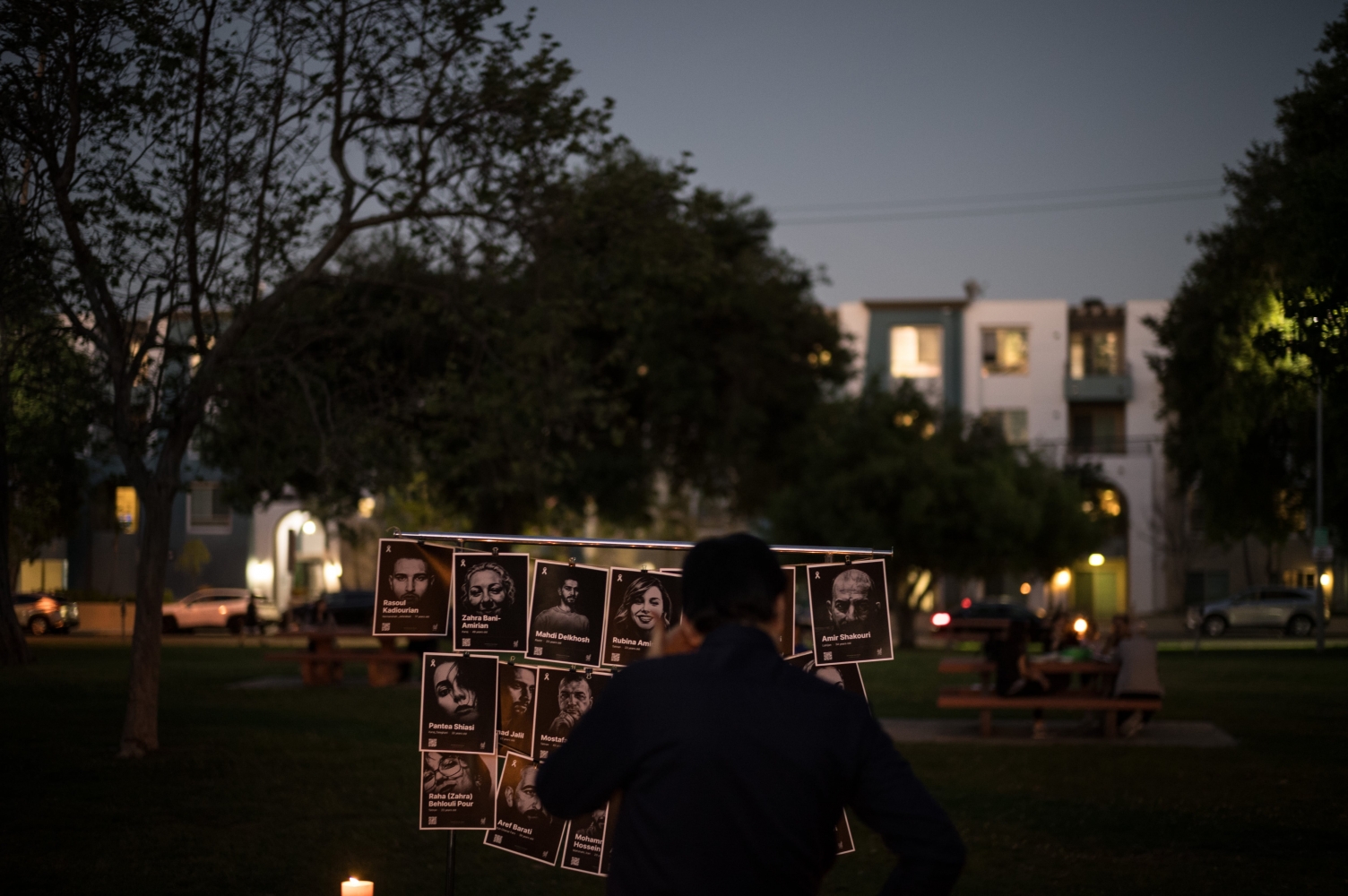
A sign memorializes Ali Karimi Bavalaki and others who were killed by the Iranian government this year, Saturday, May 16, 2026, in Washington.

Many say that in Iran, soccer holds the cultural significance that American football does in the U.S.
“Under normal circumstances, this would feel like a dream come true. But the reality is that our situation is not normal,” said an Iranian-American man who has been in the Seattle area for more than a decade and works in the tech field, but who also asked to remain anonymous for safety reasons.
“Many of the people who lost their lives were football fans themselves. They would have been watching these matches, celebrating these moments, and sharing in the same excitement.”
Soccer after January 8-9
The dates January 8th and 9th have become a shorthand for the massacres. Protests had started in Iran late December 2025 against economic hardships. Initially people took to the streets in a few places, but then the protests grew and grew until they filled the streets across cities and provinces.
Then the Iranian government imposed “digital darkness” over the country, severing the internet and all communication in, out, and within the country, said Human Rights Watch senior researcher Bahar Saba.
“It took some time for people to even understand the scale of (the massacres),” Saba said. “I have spoken to people in Iran who said that it was even after the internet was restored that they realized what the scale of the killings were.”
Across the country security forces posted up on rooftops, some used heavy artillery, and “relentlessly” shot down people in the street. Saba and her colleagues conducted interviews with witness and reviewed on-the-ground videos.
In one verified video lasting several minutes, “you could hear almost nonstop sound of gunfire.” Other videos of morgues were “absolutely harrowing.” “You could see families, distressed, going around looking for their loved ones among a pile of body bags,” she said.

The researchers counted at least 400 bodies, which is almost certainly an undercount, she said, because the bodies were stacked on top of each other and difficult to count. It’s very hard to know just how many people were killed.
Some news reports, citing leaked government records, put the death toll at more than 30,000 people killed over two days.
Some local Iranian-Americans are taking advantage of the opportunity presented by the World Cup to shed light on the recent massacres and voice their opposition of the Iranian government.
On a recent evening at the Bellevue Square Mall, next to athleisure shops and Panda Express, a group recently minted activists sorts out logistics: carpooling, parking, walkie talkies.
Starting at 3 p.m. on match day, they plan to demonstrate outside Lumen Field and hand out hundreds of flags and T-shirts carrying the lion and sun symbol of opposition. Organizer and Bahai religious refugee, Arash Seyfianjoo, wants to show up for the people of Iran, he said.
RELATED: World Cup fans are missing games after their resale tickets fall through
“As a people who lived in the free countries, we try to be their true voice and show people what’s going on in Iran,” he said. “We are not happy with the government. We are not happy with our people getting killed, and we want to show that.”
A caravan of vehicles rides while flying the Lion and Sun flag along Westwood Boulevard, in the so-called “Tehrangeles” neighborhood in the Westwood district of Los Angeles, Monday, May 20, 2024. The Lion and Sun flag was Iran’s official flag for centuries until the 1979 revolution. The ancient Persian flag continues to be used by the Iranian diaspora, monarchists and opposition groups as a symbol of Iran’s pre-Islamic heritage and resistance against the Islamic Republic.

What shirt to wear at the stadium is a seemingly small decision that carries hefty symbolism. Wearing the official team jersey can also be controversial – some who plan to wear it into the stadium said they are prepared to get cursed out by protestors.
For other local Iranian-Americans, sports and politics are separate worlds.
“From my perspective, it’s important to separate national symbols from governments and that applies to any country,” said a young Iranian-American man from Seattle, who also asked to remain anonymous for safety reasons.
“No one should accuse you of supporting the current U.S. administration’s policies for waving the U.S. flag or for supporting the Communist Party of China’s positions if you wave the Chinese flag,” he said.
For this man, the Iranian team does not represent the Iranian government.
“I think the team represents the Iranian spirit,” he said. “They represent our warmth, they represent our hospitality, they represent our lovingness.”
He says it’s a joy to be able to see the team play.
“We should be able to put aside everything else and say we’re Iranian for these 90 minutes, and what we care about is for this team to be successful,” he said.
One criticism of the team is that they didn’t speak out following the massacres in January this year.
“I think that’s an absurd expectation of those players,” he said. “Competing in the World Cup is the culmination of a soccer player’s career, and for them to be expected to speak up in such a way that might jeopardize that is completely unfair.”
The Iranian government has a record of punishing opposition by the country’s soccer players.
For example, the former goalie, Mohammad Rashid Mazaheri, was imprisoned in May after an Instagram post that was critical of the former supreme leader, and the Iranian government has repeatedly seized property owned by former national soccer captain, Ali Karimi, in retaliation of his political stances.
South of Seattle, Mohammad is making his own T-shirt as a symbol of political resistance and memorial to victims of the government massacres.
His shirt will show the face of late body-building champion, Masoud Zatparvar, who became an important figure for people in Mohammad’s hometown of Rasht.
Mohammad shows me a video of a graveside speech by Zatparvar’s grieving father.
“My son was protesting because he wanted a better future and objected to the current situation,” the father says, “and for that, you killed him.”
These emotional remarks made Zatparvar well known, Mohammad said.
And at the same time, Mohammad says he has a strange, mixed feeling about actually seeing the team play. What will he do once the match is underway?
“If Iran scores a goal, I will genuinely be happy in my heart,” but he says he can’t forget how the team didn’t speak out against the massacres.
“I honestly don’t know how I will react in that moment,” he said.
News Source : https://www.opb.org/article/2026/06/26/shadow-of-massacres-darkens-joy-of-world-cup-match-in-seattle-for-some/
Other Related News

06/26/2026
Oregonians will feel the effects of reduced HIV screening and prevention services without ...
06/26/2026
Oregon Highway 22 closed after a crash near Gates just after 2 pm June 26
06/26/2026
Seattles stadium is expected to be brimming with rainbow flags for a World Cup match betwe...
06/26/2026
OHara sued the district last October claiming police officers violated his First Amendment...
06/26/2026
Group H play concludes tonight with group leaders Spain facing off with second-place Urugu...

Follow

Download Our App


Copyright 2022 © EPUERTO. All Rights Reserved