

Published on: 10/21/2026
This news was posted by Oregon Today News


Description

Imagine living all of your adult life behind bars for a murder you didn’t commit and being released at 58. You’re also a fabric artist, and the Smithsonian has acquired one of your quilts. That’s the story of Gary Tyler, and now, the artist has his first solo exhibit.
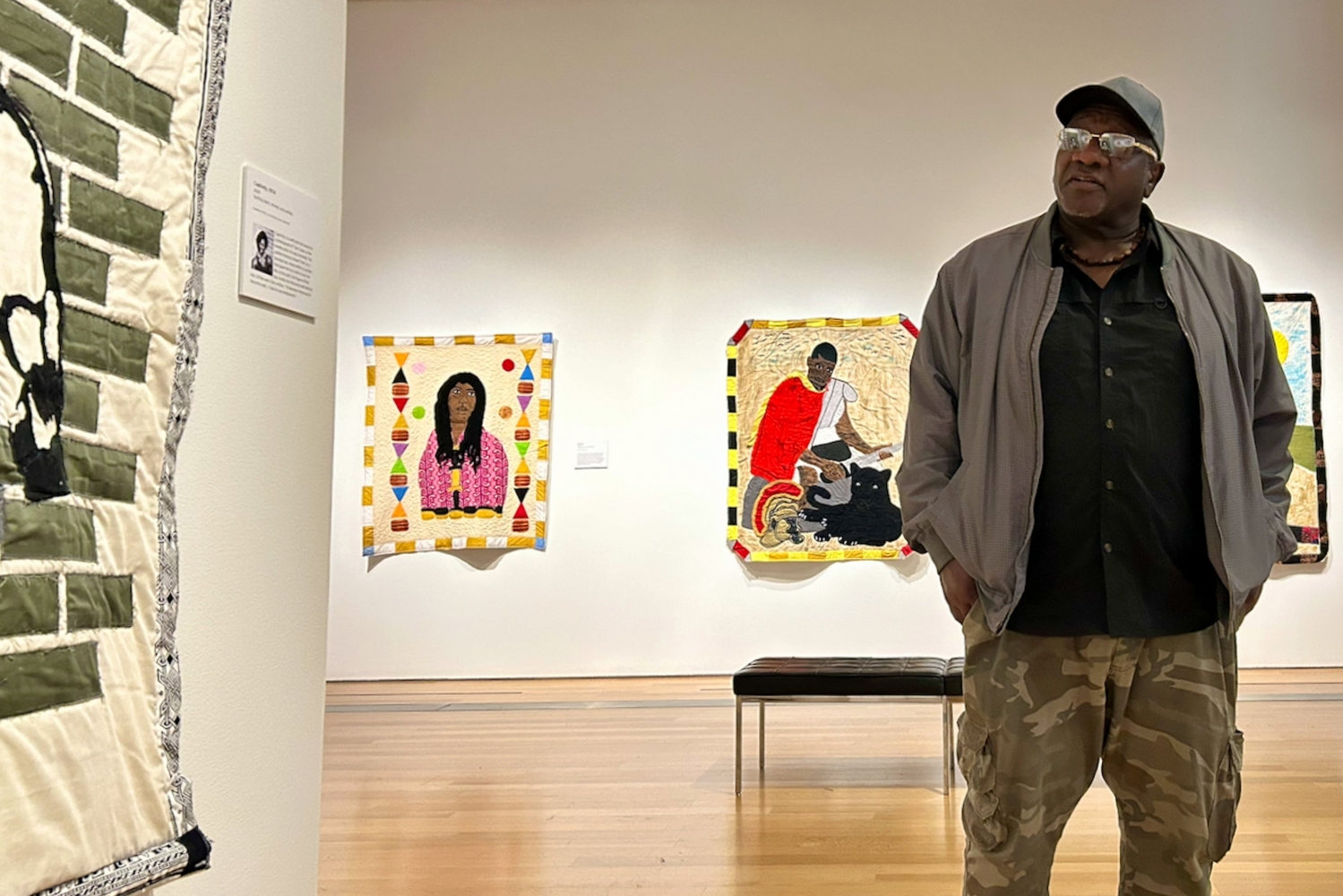
At the Grand Rapids Art Museum in Michigan, Gary Tyler points to a black-and-white quilt that’s based on a photo.
“That’s a picture that was taken by my brother back in [19]74,” he says.
He was a 16-year-old with a flair for fashion, living in Louisiana. One school morning, he dressed in a body shirt with a sweater overtop. Then he added fingerless gloves and a bandana.
“This body shirt was the shirt and bandana that I had the day of the incident,” he said.
By dinnertime, Tyler was arrested. A white 13-year-old had been shot and killed during anti-school-integration violence. Tyler was put in a police car for “mouthing off.” The next thing he knew, local police arrested and charged him with murder. He couldn’t believe the charges would stick. He was still wearing the same clothes a month later, when his brother snapped the photo.
“You’re looking at the innocence of a young, of a teenager, adolescent, you know, and who’s who’s at loss and and not knowing … what’s definitely ahead of him,” he says of the image.

A divorce lawyer incompetently represented him. Four friends testified against him, then recanted their testimony. The judge instructed an all-white jury to assume the 16-year-old meant to kill multiple people. It then convicted and sentenced him to death. Tyler maintained his innocence.
At the time, he was the youngest person on death row. He was sent to the Louisiana State Penitentiary, also known as Angola, and placed in a form of solitary confinement. His story isn’t unique, says Wanda Bertram with the Prison Policy Initiative.
“There are a ton of people in prison who have shocking stories to tell about the defense they received, especially if they were indigent, the coercion they experienced from police and prosecutors,” Bertram says.
Louisiana has the highest rate of incarceration in the U.S. Globally, it’s second only to El Salvador. It also has one of the lowest parole rates.
The Louisiana Board of Pardons and Committee on Parole recommended Tyler be pardoned three times. Each time, the state’s governor refused.
Eric Seiferth says sentences are often extremely long, especially at Angola. Seiferth is a senior curator at the Historic New Orleans Collection, in the French Quarter. He’s also one of the authors of Captive State: Louisiana and the Making of Mass Incarceration.
“There are just more and more and more people than ever before in the history of the state who have received life sentences … that have no option to ever come home. They’re convicted to die,” he says.
Tyler was at Angola, watching other men die behind bars. In the late ’80s, he and others created a hospice program.
“Men in prison, taking care [of] terminally ill men to, you know, end of life, it had the way of really transforming you, changing you,” Tyler says.
The group raised money for coffins by making and selling quilts. That’s how Tyler learned the craft. One of his quilts was raffled off at the Angola Prison Rodeo, a biannual public event, and raised $30,000 for the hospice program. Seiferth’s museum has one of them, The Tree of Life.
“It has the names and people, you know, it’s basically made of people. Essentially, of human forms,” Seiferth says.


Tyler never received a pardon. A 2016 U.S. Supreme Court ruling required states to resentence all people who had been given life without parole as juveniles. As a result, the St. Charles Parish District Attorney proposed resentencing Tyler for manslaughter. Tyler was desperate to get out of Angola, so he agreed and was released soon after. The St. Charles Parish District Attorney declined to comment for this story.
For Tyler, the terms of his release were another injustice. “The [criminal justice] system is unfairly administered, especially to the people of color and poor people in the United States. There are better ways of being able to adjudicate, or punish a person in prison humanely,” he says.
Now Tyler’s art honors those still locked up. He points to portrait quilts featuring the incarcerated men and women he met behind bars.
“Because when you see Sandra Stall, Trinidad, Big Toe, Mary, and Bertha, that’s my way of showing moral and spiritual support,” Tyler says.
Only Mary and Bertha have been released.
At the opening reception of the exhibit, Caton Vance is admiring Tyler’s work.
“I think it mostly has to do with dealing with consequences that are beyond imagining and somehow, despite the environment, finding hope,” Vance says.
The exhibit, “Gary Tyler: Rebirth,” runs through Jan. 3.

News Source : https://www.opb.org/article/2026/10/21/sentenced-to-death-at-17-at-68-quilt-artist-receives-solo-museum-exhibition/
Other Related News

10/21/2026
The top Democrats on the House and Senate intelligence committees say they are operating u...
10/21/2026
The company sent a WARN notice that it will be laying off 134 workers across six locations...
10/21/2026
President Trump boasted this weekend of his growing power in his second term and all the ...
10/21/2026
A KGW investigation found most letters were postmarked a day or two after mailing raising ...

10/21/2026
PacificSource plans to cut another 134 jobs in Oregon as the Springfield-based health insu...

Follow

Download Our App


Copyright 2022 © EPUERTO. All Rights Reserved