

Published on: 10/27/2026
This news was posted by Oregon Today News


Description

Hundreds of returning salmon don’t understand that the Oregon Department of Fish & Wildlife closed the Salmon River Hatchery last November.
The 3- to 5-year-old salmon know only one thing: they need to head upriver from the ocean each fall to spawn.
The hatchery closed in an ODFW budget-cutting move, but had to be pressed into service in June to finish raising 1 million coho salmon that had to be moved from a hatchery in Estacada. That resulted in two to three ODFW staff coming from other hatcheries this summer to care for the fish.
The annual fall migration of Chinook salmon is a different story.
Because the big fish will continue to return to the Salmon River for up to five years after they are released and the agency has a fish-tracking treaty with Canada and rearing agreements with the Siletz tribe, it simply can’t lock the hatchery’s gate and walk away.

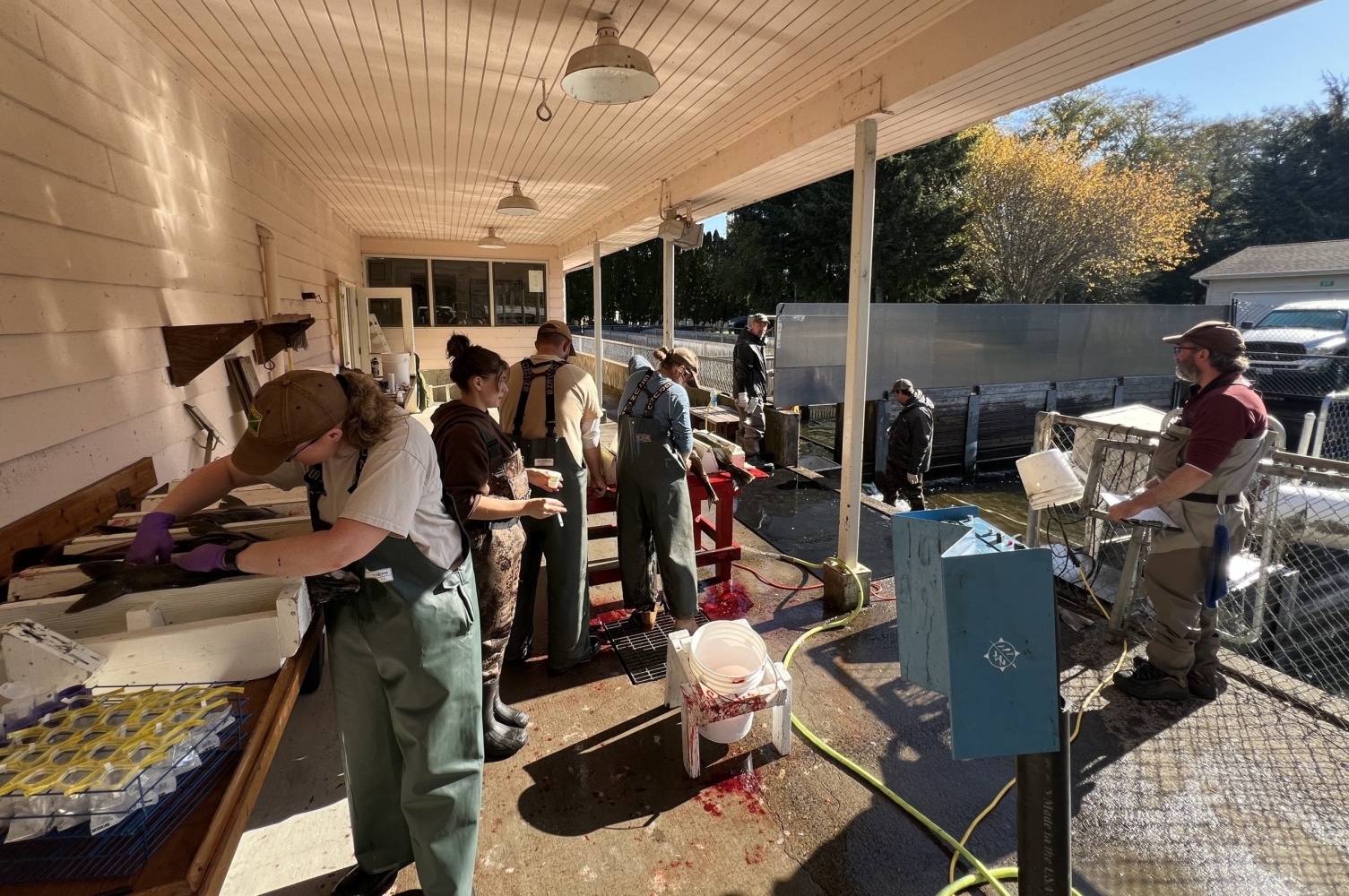
That means for three Wednesdays in October, ODFW staff from around the state descend on the 50-year-old hatchery in Otis to help trap, sort, collect eggs and sperm, and send some back on their way upriver.
Last Wednesday was one of those days; the last harvest of the year will be this week.
Led by Connor Boolen, who normally works at a hatchery near LaGrande, and Brent Hinners, who oversees 11 hatcheries in northwest Oregon, six other ODFW staff and one volunteer collected eggs from 70 female fall Chinook before collecting sperm — milt to biologists — from 70 males.
The females are killed during the collection process; wild males are put into a 100-yard-long chute to continue their upstream journey.
It’s a very exacting, and well-practiced, process.
The crew keeps meticulous records of what they do, including taking samples of flesh, egg serum and wild fish scales to test for diseases or track DNA.

Harvesting the past two Wednesdays involved moving salmon from the traps that attract the fish heading upriver into long pens for several weeks to mature, then sorting by sex and sorting again on whether they are of wild or hatchery origin.
So far this year the hatchery has had fewer fish return — likely due to very low water conditions that are affecting salmon returns all along the coast. Boolen said the hatchery has collected 1,043 Chinook — 823 of hatchery origin and 220 wild fish. That’s less than half of the returning Chinook last year. There have been 211 wild coho salmon, one wild steelhead and one wild chum salmon, Boolen said.

The wild fish are passed upstream except for 45 wild Chinook kept for ODFW’s broodstock spawning program.
The females are taken first, slit open and eggs poured into buckets that are put on ice in the back of a pickup to go to ODFW’s Trask River Hatchery 45 minutes to the north.
Male Chinook are held and bellies squeezed to squirt milt into a small plastic envelope marked as wild or hatchery, date and place. Wild male salmon are slid into the pipe leading back to the river; hatchery males are killed for streambank enhancement programs.
The milt is so concentrated, the staff needs only to collect a small amount in each envelope to fertilize the thousands of female eggs.
An ODFW pathologist from Corvallis watches over the whole process, taking samples from fish to test for disease. If a problem is detected later, the batch of eggs from that salmon is destroyed.

Property still in use
The 50-year-old hatchery sits on 23 acres seven miles northeast of Lincoln City. It has houses for three employees, an office building, large holding and rearing ponds, raceways where fish live before their release, and a hatch house where, until last year, eggs are grown into tiny fish called fry.
The ODFW closed the Otis hatchery — one of 30 it owns or operates — because it had to cut its 2025-26 budget. The hatchery was expensive to operate and has struggled with rising Salmon River water temperatures that exacerbate fish-killing diseases. It was only the second such hatchery closure in three decades.
The hatchery typically raised 200,000 fall Chinook smolts to release in the Salmon River, 300,000 coho for the lower Columbia River, 50,000 summer steelhead for the Siletz River, and 40,000 rainbow trout for coastal and Willamette Valley lakes.

The Chinook eggs and male salmon milt collected the past two Wednesdays now go to ODFW’s Trask River Hatchery to be fertilized and incubated. They’ll then move to the agency’s Cedar Creek Hatchery in Hebo to be raised into fingerlings. The Hebo hatchery now also rears the 50,000 summer steelhead the Salmon River Hatchery had been raising and releasing into the Siletz River.
Parts of the hatchery property remain open to the public, including access for fishermen. Hinners said the three houses on the property were also reopened this year to ODFW employees working on the central coast.
Jacob Reddecopp, a longtime volunteer who grew up next door, spent the past year in a travel trailer as the hatchery’s host to help keep watch over the property, mowing the grass and making daily rounds of the property.
“It’s been great,” Reddecopp said Wednesday as he helped with the fish processing. “I like it a lot.”
The offspring of the salmon spawned last year were brought back to the Salmon River Hatchery in July and then released into the river in mid-August, Hinners said.
Still, parts of the hatchery were pressed into service this summer when construction issues at a hatchery in Estacada meant ODFW needed to find a home for 1 million coho salmon fingerlings. That resulted in Boolens coming from Lookingglass and Heather Sparks from the Trask and Cedar Creek hatcheries in June to help care for them.
Those coho are now being moved in truckloads of 50,000 fish each to net pens and hatcheries in the lower Columbia River.
Used in different ways
Not all of the returning salmon go to hatcheries.
More than 700 salmon collected in early October when they were in good shape went to food banks, the Grand Ronde tribe and gleaner organizations as far away as the Willamette Valley. The Central Coast Food Web in Newport filleted and processed 1,140 pounds of salmon — enough for 4,500 meals — and gave the meat to Food Share of Lincoln County to distribute to local food banks.
Most of the female salmon this week were in too poor of condition for food banks, so after their eggs were harvested, they were put into totes and their carcasses will be placed along coastal streambeds to help mimic the natural cycle of dead and decaying fish.
Hinners said the fall Chinook fingerlings that originated from last October’s harvest seemed to thrive at Trask and Cedar Creek and 200,000 came back to Otis and were released Aug. 12 into the Salmon River.
“The Salmon River fall Chinook had a really good year,” he said. “They were really healthy and should do well in the ocean.”
Well enough to have hundreds return in three to five years and also have ODFW staff return to Otis.
Quinton Smith is the editor of Lincoln Chronicle and can be reached at [email protected]
This republished story is part of OPB’s broader effort to ensure that everyone in our region has access to quality journalism that informs, entertains and enriches their lives. To learn more, visit opb.org/partnerships.
News Source : https://www.opb.org/article/2026/10/27/salmon-otis-fish-hatchery-odfw-staff-annual-harvest/
Other Related News
10/27/2026
Oregon DEQ says chemicals from Precision Castparts likely caused the mass fish die-off The...

10/27/2026
Donald Trump cant run for president in 2028 heres why

10/27/2026
With a week to go before Election Day Oregon voter turnout is slightly higher than the las...
10/27/2026
As Americans prepare for the pivotal 2026 midterm elections on Nov 3 the balance of power ...


Follow

Download Our App


Copyright 2022 © EPUERTO. All Rights Reserved