

Published on: 04/13/2026
This news was posted by Oregon Today News


Description

Which Republican challenger will move on to face Gov. Tina Kotek in November is the most intriguing question of Oregon’s primary election. But with ballots headed out in less than three weeks, the state of that race has been hard to parse.
No public polls have emerged, candidates only recently started airing television ads, and there’s an open debate over whether grassroots enthusiasm or cold, hard cash will win the day.
What’s an Oregon political obsessive, or even just a casually interested voter, to do? You could look to gamblers for guidance.
Prediction markets – where bettors can plunk down money on whether an event is likely to occur – leave few corners of life untouched these days. Major sites like Kalshi and Polymarket allow bets on the daily high temperature in Helsinki, the likelihood of Christ’s return and everything in between.
Research has shown the markets can be prescient when it comes to elections. And in Oregon, they’ve homed in on the GOP gubernatorial primary, which has attracted more than $100,000 in wagers across platforms.
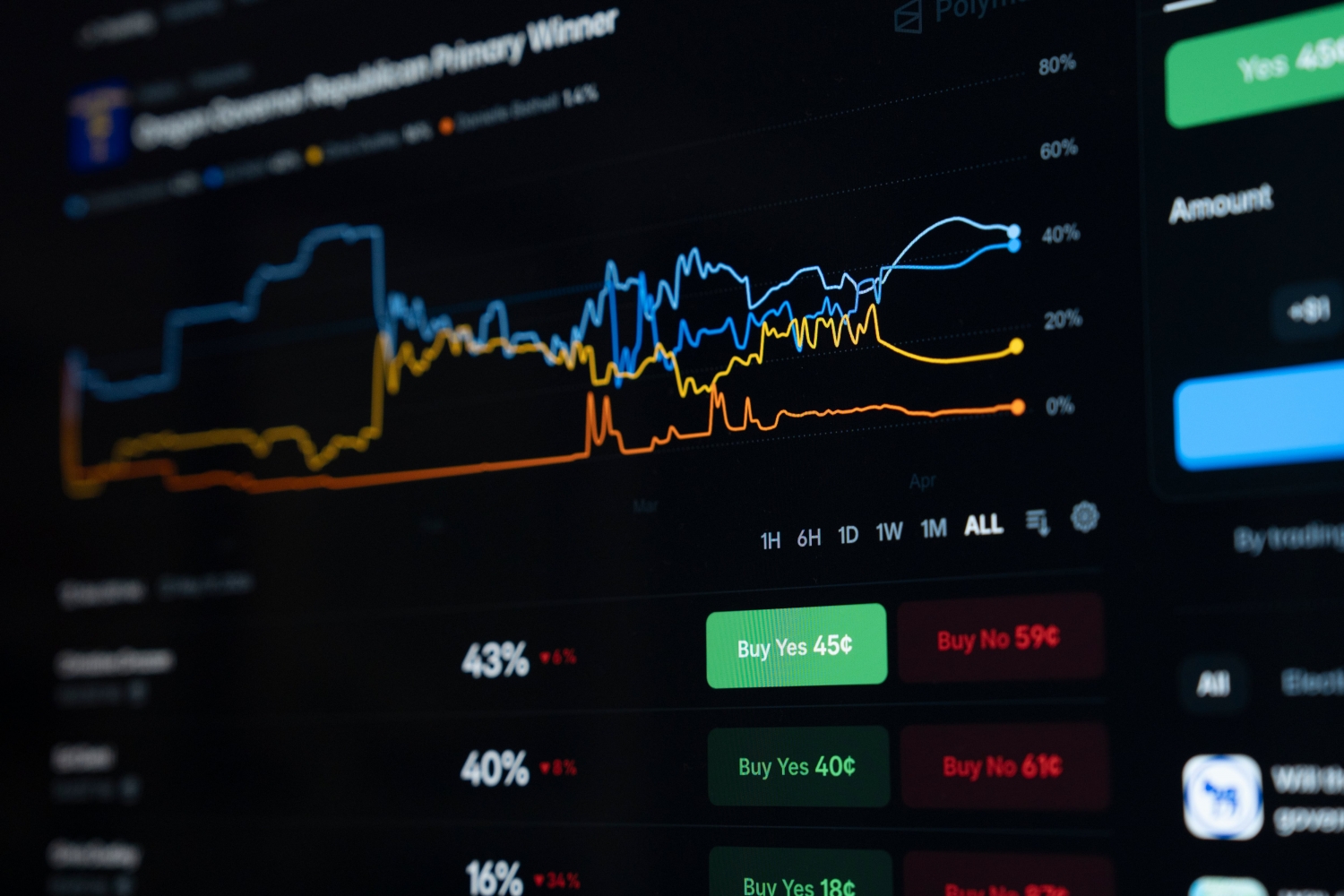
Three large prediction markets – Polymarket, Kalshi and Robinhood – differed only slightly on primary sits as of Sunday morning. Their current guesses may surprise you.
State Sen. Christine Drazan, with broad name recognition from her 2022 gubernatorial run and more than $1 million in the bank, is one leading candidate. As of Sunday all three markets gave her a 44% chance of being the GOP nominee.
Also in the mix is state Rep. Ed Diehl, who is hoping to ride a surge of grassroots enthusiasm from his role in dismantling a Democratic gas tax increase. The markets on Kalshi and Robinhood had Diehl at 48% on Sunday, despite the fact that he has raised far less cash than other top candidates. Polymarket have deal a 40% chance of victory.
Not so high in bettors’ estimation? Chris Dudley, the former Trail Blazer who came closer to the governor’s office than any Republican in decades when he ran against Democrat John Kitzhaber in 2010.
With lingering familiarity among voters and a more than $2 million bankroll supplied in part by Nike co-founder Phil Knight, Dudley is often viewed as a top contender in the race. But prediction markets gave him just a 15% chance of victory as of Sunday morning, far below Drazan and Diehl.
Marion County Commissioner Danielle Bethell and 10 other registered candidates are long shots, according to bettors.

It might be tempting to write off these estimations as the blind guesses of a gambling-addled public, and in fact many Oregon political observers OPB asked about the markets initially offered that take.
“I would have doubts about those markets,” said Chandler James, an assistant professor of political science at the University of Oregon who studies public opinion and believes prediction markets can be telling. “If Phil Knight gave a million bucks to Dudley, he knows something about the state of the race.”
But a half dozen political consultants watching the race – both Republican and Democrat – also told OPB they agree with some of what the markets are predicting.

Drazan, her party’s most recent gubernatorial nominee, is a natural frontrunner. And observers on both sides of the aisle said they currently see little to be hopeful about for Dudley, whose ads have seemed more geared toward a general election than a Republican primary, and whose history running as a pro-choice candidate may put him at odds with the GOP base of 2026.
Most said Diehl’s close connection with his party’s grassroots make him a threat, but that a lack of money makes him unlikely to get his message across.
“The problem is when other people have megaphones and you’re in the back of the room shouting with your voice,” said Bryan Iverson, a GOP political consultant who is not working with any gubernatorial candidates. “The conventional wisdom is you’re going to have a two-way race [between Dudley and Drazan].”
As they’ve exploded in use in recent years, the question of whether prediction markets offer an accurate view of an event’s likelihood is getting more study.
Researchers have concluded that markets for the 2024 presidential race – for which Polymarket alone had nearly $3.7 billion in wagers – were more accurate than polling at determining where things would end up.
Fans say markets’ knack for instantly taking new developments into account, and their ability to combine a huge range of opinions – including those of knowledgeable insiders – can give them an edge over polling alone.
And since participants are actually putting down money, they have an incentive to be right.
“If you’re betting on it, you follow the race a lot more closely,” said Christopher Stout, a political science professor at the University of California, San Diego. “You might have more knowledge than the average person who’s picking up a phone call [from a polling firm] and making an on-the-spot decision when they don’t have a strong preference.”
But presidential elections are a far cry from a little-watched Oregon primary for a party that hasn’t held the governor’s office in four decades. Laurie Cutting, a Vanderbilt University professor who has studied prediction markets, told OPB that more research is needed to determine how large a market needs to be in order to offer reliable odds.
Skeptics say smaller markets are susceptible to manipulation – either by people who might put money down to make a candidate appear more viable than they actually are, or by true insiders who have undisclosed information.

“If you were Phil Knight or you were Phil Knight’s people, why not put $20,000 on Dudley and move the market?” said John Horvick, a pollster at DHM Research, who has kept an eye on the prediction markets this year.
Horvick said he’s been puzzled to see Dudley’s chances in the markets slump in recent weeks, despite no obvious developments in the race. At the same time, Diehl’s numbers have trended upward.
“When I see a move like that in a really thin market, I just can’t help but wonder,” he said last week. “There’s been no big spending, there’s been no polls that have dropped, there’s been no big news stories that I can see.”
Horvick found more reason to question the markets in March, when he noticed that an AI-generated blurb describing the GOP primary on Polymarket had hallucinated a poll that DHM Research never performed. The same “market context” box described Diehl self-funding his campaign with millions of dollars, which has not occurred. Diehl did loan his campaign $100,000 on April 8, weeks after Horvick spied the misinformation.
So are candidates paying attention to the market odds?
Diehl told OPB that a supporter pointed him to the Kalshi market a few weeks ago, and he came across the odds on Polymarket more recently. He compared the prediction markets to polling from February that attempted to show how he, Drazan and Dudley might perform in the head-to-head race against Kotek.

The Democratic governor came out ahead in all three matchups, but the polling – performed immediately after Dudley entered the race – suggested Diehl could perform better than the former NBA center. Drazan had the highest support of all three Republicans.
“It is consistent with the other data I’ve seen,” Diehl said of the prediction markets. “What’s striking to me is I have half the name recognition of Drazan, but we’re really neck and neck.”
Drazan’s team, meanwhile, isn’t sold.
“Prediction markets are a fun way for people to bring politics into the gaming and prediction industry,” campaign manager Jim Dornan said in a statement to OPB. “They have zero impact on this race and will have no effect on our strategy to fire Tina Kotek in November.”
Dudley’s campaign did not respond to repeated inquiries.
Political consultants working in other races noted that, even if the prediction markets do offer a reasonable picture of the race, they are far less useful to candidates than traditional polling.
“The least interesting part of polling is the horse race,” said Mark Wiener, a Democratic strategist. “It’s all the other polling that is the tool for how to move the top lines on Election Day. Even if we had confidence in the prediction markets as a snapshot in time, that does not govern your work or activity as a campaigner.”
Prediction markets, like financial markets, can change quickly – and brutally.
With ballots headed out to voters beginning April 29, the candidates who can afford it have only just begun to blitz voters’ TVs, devices, and mailboxes. And the field won’t see its first debate until Thursday, when Drazan, Diehl, Dudley and Bethell will attend an event hosted by the Oregon Republican Party.
That performance is likely to change the odds – and it may give way to the race’s first public poll. Iverson, the GOP political consultant, says he’s planning to commission one on his own and announce the results on his podcast, “Crosstabs.”
“Nobody is really doing any polling that matters,” he said, explaining the move. “The campaigns aren’t telling us anything.”
News Source : https://www.opb.org/article/2026/04/13/oregon-governor-primary-race-predictions-polls/
Other Related News

04/13/2026
The US military will block ships from entering or exiting Iranian ports on Monday after th...
04/13/2026
ABOARD THE PAPAL PLANE US-born Pope Leo XIV pushed back Monday on President Trumps broads...
04/13/2026
CRAFTSBURY COMMON Vt More than a dozen newborn lambs cavorted around a fenced-in yard ben...
04/13/2026
Phil Rombach and his family were ready to move home

04/13/2026
I use a wheelchair and getting from one place to another requires planning most people nev...

Follow

Download Our App


Copyright 2022 © EPUERTO. All Rights Reserved