

Published on: 01/08/2026
This news was posted by Oregon Today News


Description
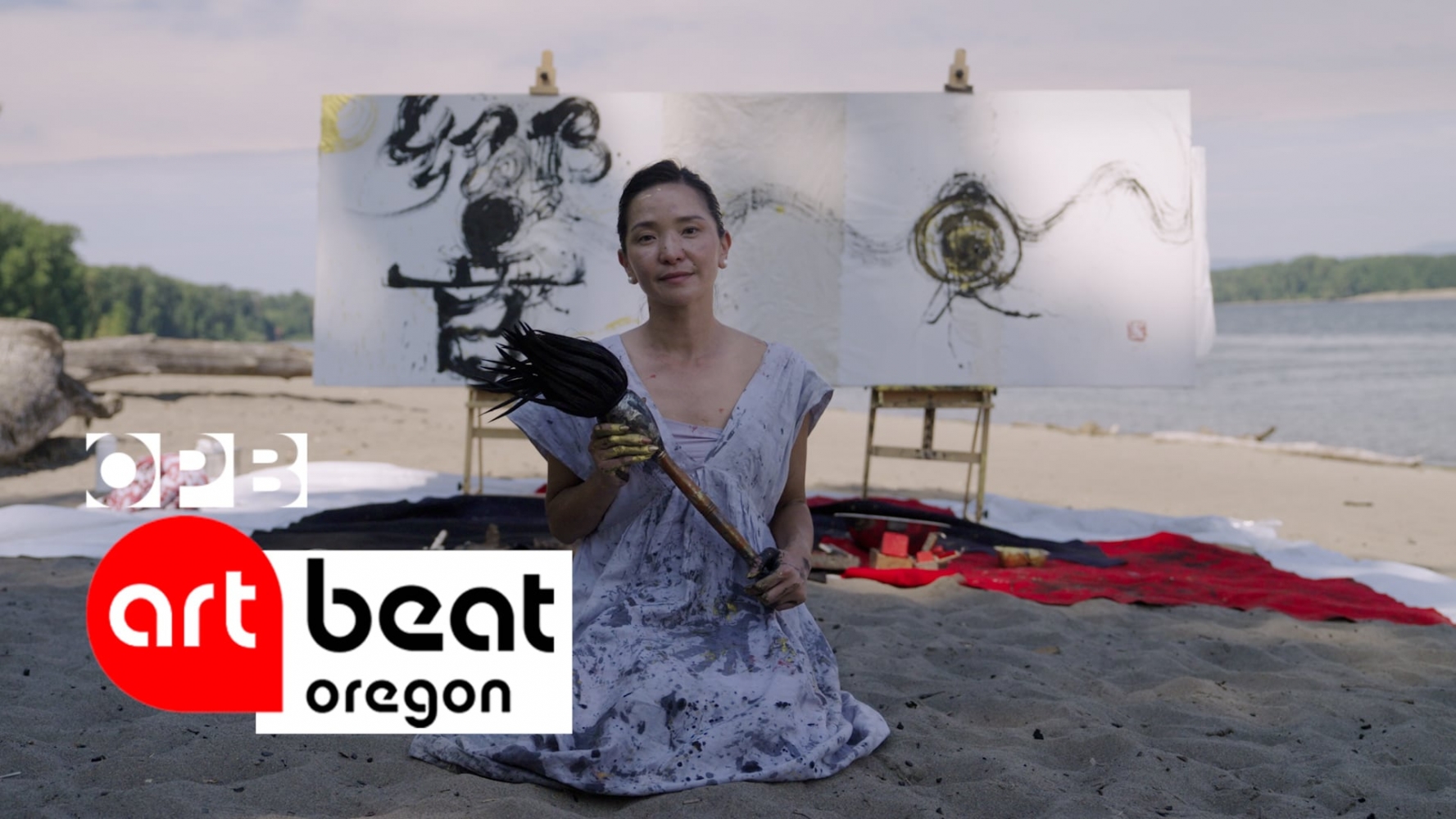
Japanese calligraphy artist SORA doesn’t plan anything when she writes her calligraphy.
“I just go with the moment. And that becomes art,” she said.
Instead, she sits quietly, feels the earth under her feet, breathes in the air, and lets inspiration come naturally to her.
From there she moves with grace and precision, using a collection of calligraphy brushes, ranging from small one-handed brushes to large two-handed ones.
Her canvas ranges from a small 8x11 piece of paper, to a large 10-foot canvas. All of these tools inform her art.
Traditional Japanese calligraphy, known as shodo, involves taking a calligraphy brush, dipping it in a special black ink called sumi ink, and writing out a specific Japanese character, or kanji. The idea is that through shodo, one learns concentration, patience and mindfulness.
SORA takes those traditional shodo methods, and expands upon them to create her own art.
“My style is not only using brush technique. My energy is what I want to put into the art. This art is pretty strong but soft. My style is the strong part, but there’s a softness that is also created in that space,” she said.
Traditional shodo rules include principles like writing horizontal strokes before intersecting vertical ones, and prioritizing the overall piece instead of focusing on an individual stroke.
“Traditional rules are, you’re copying the script and writing the same thing over and over again. For me, breaking the rules means that I don’t have any script, but I have the same materials, brushes, ink and paper,” she said.
SORA lives her life and art by a simple Japanese concept: shuhari.
The concept comes from martial arts and describes the stages of learning something to becoming a master.
Once someone initially learns the rules, they are then free to break those rules and truly transcend to the next level of mastery.
SORA applies those concepts to her own calligraphy art.
Instead of black sumi ink, she may use gold ink. Instead of focusing on overall harmony, she may instead want her audience to focus on a single line stroke.
Now, she paints beautifully intricate, large pieces of Japanese kanji that express more than just the characters.
“So that comes from my soul, my emotions, my everyday life or this world that creates my art,” she said.
SORA, whose legal name is Rie O’Doherty, didn’t think calligraphy would be her way of expressing herself through art.
She learned calligraphy at school, in the Usuki Ota prefecture in Japan.
“When I was little, like 3 years old, my dad was grinding sumi ink for the local people, writing for local people. And then I smelled that and I was playing with it with a brush. And then that’s how my calligraphy journey started,” she said.
Throughout her early school days, she learned, practiced and won dozens of calligraphy awards. But as life went on, her attention turned to other interests, and the hobby quickly faded.
She moved to Portland in 2003 and, after starting a family, began experimenting with calligraphy again.
“When I was 36 I met a Japanese friend who had a big calligraphy art in his room,” she said. “I saw that and I asked him, is there anyone who teaches this? And he said yes.”
That’s when she met her eventual mentor, Sekko Daigo.
“I met Sekko Daigo and as soon as I saw her art, it was really authentic and so I just kept learning in class,” SORA said. “And then she said, do you want to do a competition? And I said yes. So I decided to do competition and then go down that path.”
Under Daigo’s tutelage, SORA continued to grow as a calligrapher and as an artist. Daigo even inspired her to become a performance artist.
From there, she took the opportunity to learn, grow and share her love of Japanese culture with her community in Portland.
“When I was growing up, I followed Japanese calligraphy rules. And as I learned, I couldn’t break a rule. And now that I’m an artist in Portland, I am breaking those rules and making my own art,” she said.
In fact, Sekko Daigo gave SORA her artist name.
“My name is SORA, which means sky. The sky is my canvas. And when I see the cloud, sometimes it tells me that it shows character in the sky,” she said.
In 2017, SORA decided to transition to becoming a full-time artist under the brand SORA Shodo, a combination of her artist name and shodo, the term used to describe Japanese calligraphy.
Since becoming a full-time artist, SORA has showcased her work locally at a variety of exhibits and public spaces, like coffee shops and restaurants like the sushi restaurant Nimblefish.
Accompanied by a musician, SORA puts on clinical demonstrations and public performances where people can enjoy seeing her perform with a large canvases.
In 2025, she spent a few weeks in Milan, Italy, where she shared her culture and love of shodo.
“If it’s a live performance, there’s audience, atmosphere, there’s a process of collaboration with other artists or a curator. So those people and atmosphere make my art. And that energy comes together in one art at that moment,” she said.
As much as she loves being a full-time artist, she admits that it hasn’t been easy. Not only does she have to continue to promote her work, the biggest hurdle she generally faces is the expensive materials for her art.
“I import materials from Japan. My materials, I am not able to buy here. So I applied for grants and grants helped,” she said.

Whenever she needs a break, or needs time to find inspiration, she leans into nature. She’ll go on long walks in the mountains or maybe spend some time on Sauvie Island.
“You can just concentrate your breath, your body, your warmness in the hand, and standing, walking. I think in nature you can concentrate just on yourself. There’s nothing to compare, there’s nothing to bother,” she said.
SORA’s work can be seen at the Lake Oswego Arts Council, where she is a part of their current rotation of artists in the gallery.
In 2023, she also took over teaching Japanese calligraphy from Sekko Daigo, who then died in 2024.
Brent Miller assists SORA whenever she teaches classes and also when she paints any big pieces of art. He says that SORA’s art inspires people to think beyond the boundaries of what they think is art and really look into the meaning of each stroke.
“She’s really about crossing the cultural boundaries and bridging the gap between humans,” Miller said. “We live in a very polarized society now, more than we’ve seen in a very long time. And the more we dig into that, the worse it’s going to get. We need something else. And I think she’s trying to provide some of that to something else.”
Nicole Nathan runs the Arts Council of Lake Oswego and selected SORA’s art for the gallery because of its multifaceted layers.
“It’s painting, it’s dance, it’s movement. And I think what is really intriguing about SORA’s work is that it’s all of those things combined. There’s this physical aspect to it of the performance,” she said.
At the end of 2025, SORA announced the launch of SORA Shodo Studio, an art space in Northwest Portland.
The space is dedicated to showing her calligraphy, and also a space where she can teach classes and hold workshops.
With her career on the rise, SORA hopes to continue to share her love of calligraphy with the public and show that while times are challenging, it’s OK to break the rules and showcase your authentic self.
“Society is becoming complicated but with my art, I’d like people to feel it’s OK, everything is going to be OK,” she said. “It’s not perfect, but being you will make you happy. You will make people around you happy, and you can give love.”
News Source : https://www.opb.org/article/2026/01/08/sora-shodo-calligraphy-portland/
Other Related News

01/09/2026
A beach hazards statement was released by the National Weather Service on Friday at 1246 a...

01/09/2026
Whooping cough cases in Oregon are at the highest that they have been in decades with Jack...
01/09/2026
Dear Eric I recently pet sat for somewhat new friends I had been invited on a weekend trip...

01/09/2026
DEAR ABBY Ive been with my boyfriend for 12 years We have two children and a third on the ...
01/09/2026
Lawmakers will return to Salem in February for a short legislative session

Follow

Download Our App


Copyright 2022 © EPUERTO. All Rights Reserved