

Published on: 07/03/2026
This news was posted by Oregon Today News


Description
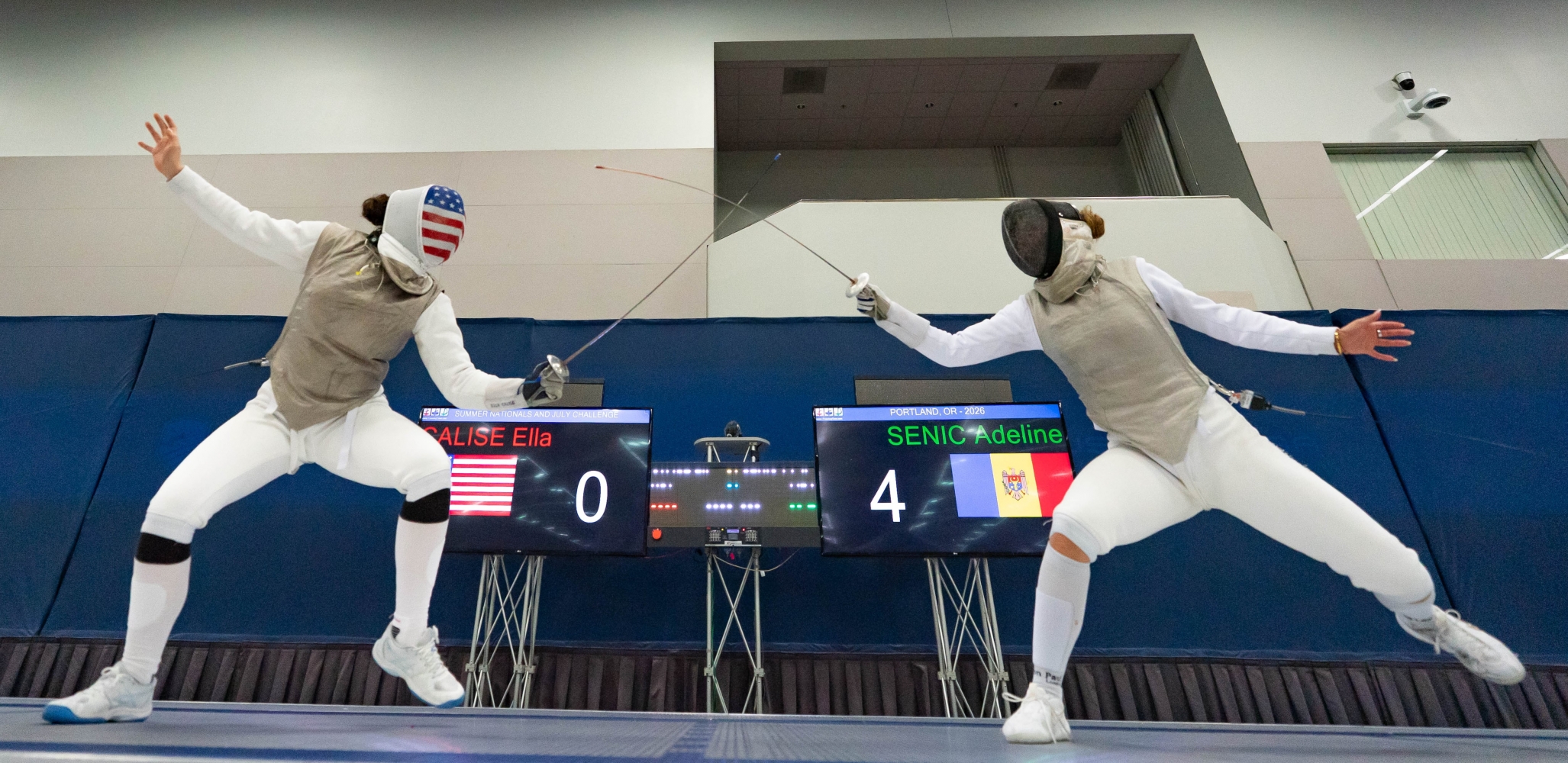
On the enormous main floor of the Oregon Convention Center, more than 100 metal strips have been laid out, each about 5 feet wide by 46 feet long. And on each one, two fighters thrust, lunge and scream in victory or in defeat.
The steely excitement of a fight bubbles around the space. The violence here is controlled, with protective clothing and tight rules. But emotions are running high.
“I was in tears because I lost the previous bout by one point,” said 17-year-old Ilinca Fetecau, from Canada, after crying in frustration on her mother’s shoulder. “It’s very hard to reset yourself after things like this, especially when you think the referee made a mistake.”
She’s not exactly blaming the referee. When fighting with a foil, athletes have to clearly telegraph their intentions as they thrust and parry.

It’s not just about completing an electrical circuit by touching your opponent’s body with the blade.
“It’s not the referee’s fault. It’s on me that I didn’t make my action clear,” she said. “I had to kind of let that go… but it was very difficult.”
More than 6,100 fencers from 46 states will take part in the 2026 USA Fencing National Championships at the Oregon Convention Center. It’s one of thousands of events celebrating America’s 250th anniversary.
For 10 straight days, through July 6, people like Fetecau are competing for national titles in each of the three weapon categories: foil, saber and epee. Participants are between 7 and 89 years old, and they come from all over the nation.
Patricio Moreno is a coach at Northwest Fencing in Tigard, which sent 89 competitors to the tournament.

“It’s the only combat sport without body contact,” said Moreno, who is competing in the men’s 40-plus foil event. “You have the feeling that you’re in a fight with someone and you’re thinking, ‘It’s me or him.’”
Speaking a few days before the tournament, Moreno said he had been eating light, carb-loading and working out every morning to prevent injury.
“I feel like when I fence, I empower myself to do what I want to do.”
Portland’s a big fencing town
Many Oregonians don’t know it, but Portland is one of America’s most prominent fencing towns.
Two-time Olympic gold medalist Mariel Zagunis and 2024 Olympian Magda Skarbonkiewicz grew up fencing in the Rose City.
“Portland has a big fencing history,” said Northwest Fencing’s head coach, Simon Abram. The club has more than 200 fencers, most are young, in part because the sport has a reputation for leveraging youngsters into Ivy League schools.
“It’s not cheap to compete,” said Abram. “Once you get good at fencing, there’s a lot of travel involved.”

With beginner lessons starting at $200 a month and $1,000 for the foil, mask, jacket, gloves, chest protector, etc., the sport can be prohibitively expensive.
But, Abram said, it’s good for participants and there are scholarships.
“Speed is necessary. Flexibility is necessary. Endurance is necessary,” Abram said. “There is the mental and tactical aspect of the game, similar to tennis, where you have to deal with an opponent and you don’t always know what the opponent is going to do.”
The tournament’s economic impact
Bryan Wendell with USA Fencing said the yearly national championship is the largest fencing tournament in the world. So selecting Portland to host it this year was a big deal.
“Even some of the big fencing nations like China, France and Italy, don’t hold fencing tournaments nearly this large,” said Wendell.
He estimates it will generate about $10 million for the city as thousands of coaches, officials, athletes and family members fill hotels, restaurants and shops.
“A lot of these families will make a vacation out of it,” said Wendell. “The tournament is 10 days, but they’ll come to the tournament for three or four days and then explore the mountains or go to the ocean.”
Sfinteseo Livio is the father of 15-year-old athlete Emma Livio. They’re from the Boston area and will spend about $6,000 on flights, hotels and food for the competition.
“We will make a small holiday out of it,” he said. “Like, we’ll stay a couple of days after the competition.”
How fencing competitions work


During older competitions, judges would watch a bout to decide whether someone was struck by a blade. But nowadays competitors are wired and they stand on a metallic surface called a strip, or a piste. When one’s blade touches an opponent, the contact completes a circuit and a light goes on.
“All that has to happen is that even a single electron has to travel from your blade to the other person’s metallic vest and then it’ll light up and give you a point,” said Wendell.
Sometimes, the touch is so light a competitor might not realize they’ve been struck.
Fencers have three-minute bouts in which they thrust and stab at an opponent, trying to make contact. Because of the protective equipment, serious injuries are very rare. But sprains and twisted ankles can happen.
While a beginner might be lucky to get 20 minutes of fighting during the competition, a top player will win multiple bouts and end up fighting for maybe an hour-and-a-half over a 12-hour day.
And for the really serious fencers, the Portland tournament is a direct path to getting into the 2028 Olympics in Los Angeles.
News Source : https://www.opb.org/article/2026/07/03/portland-usa-fencing-national-championships/
Other Related News

07/03/2026
Seven states had all of their counties placed under an extreme heat warning on Friday as a...

07/03/2026
Oregons largest transit agency announced a large service reduction and more staff layoffs ...

07/03/2026
As rain pounded the Oregon State Capitol hundreds stood in lines that snaked around the hi...

07/03/2026
The Supreme Court seemed on the verge of barring Oregon Washington and other vote-by-mail ...

07/03/2026
The online show Americas Best Restaurants stopped by the Eugene eatery known as Lox Stocks...

Follow

Download Our App


Copyright 2022 © EPUERTO. All Rights Reserved