

Published on: 03/14/2026
This news was posted by Oregon Today News


Description

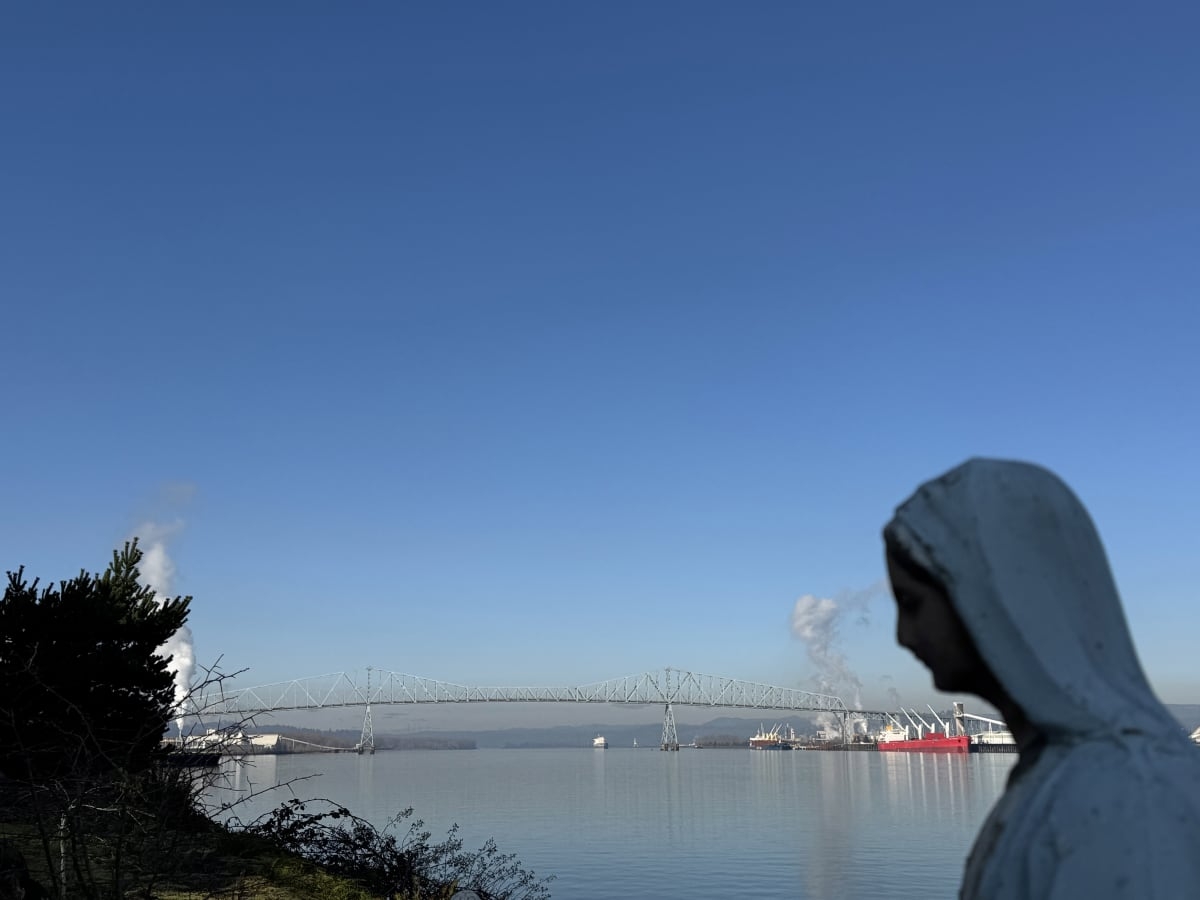
Columbia River shipping industry leaders say there is a growing risk that a large ship will strike the Lewis and Clark Bridge between Rainier and Longview, potentially causing the 95-year-old bridge to collapse.
In the years since the modern shipping channel was completed next to the bridge’s unprotected east support pier, ships have doubled in size. Pilots must calculate clearance margins with imprecise or nonexistent sensors.
The first weekend of February, a ship headed to the Pacific from the Port of Longview lost power right beside the Lewis and Clark Bridge. Tugboats made sure the situation didn’t go awry, but they’re not always on hand, said Capt. Jeremy Nielsen, president of the Columbia River Pilots, which guides ships from Astoria to ports along the river. Roughly two dozen ships experience engine failures while navigating the entire Columbia River each year.
“It’s a single-point failure bridge,” Nielsen said. “If a ship hits any part of that bridge, it is coming down — the whole thing, just like the Francis Scott Key Bridge.”
That Baltimore bridge collapsed in March 2024 after a container ship experiencing a power outage struck one of its piers.
The Columbia River’s shipping industry has spent the past decade trying to get legislators to take the risk of a bridge collapse here seriously — and to then fund measures to reduce the chances of a disaster.
“It is extremely frustrating for us as pilots, because our safety margins have just decreased tremendously,” Nielsen said. “And we’re doing what we do — we’re professionals, and our job is to protect all this infrastructure — but, at some point, we need the technology there to assist.”
Cutting it close
In one 2022 incident, pilots later discovered that what they thought was 4.1 feet of clearance for the 1,041-foot-long Celebrity Eclipse passing under the bridge could have been as little as 13.2 inches after factoring in bridge sag and water-level variation.
“There goes our safety margin,” Nielsen said.
A 2025 National Transportation Safety Board report found the Lewis and Clark and Astoria-Megler bridges are the only “critical/essential” spans in the Pacific Northwest that cross a waterway frequented by ocean-going vessels which also have an “unknown levels of risk of collapse from a vessel collision.”
A Wall Street Journal investigation the year before had less reserved findings, concluding that the Longview bridge was one of eight around the country that are most similarly vulnerable to collapse as the Baltimore bridge.
In fact, the Longview bridge is at greater risk because it doesn’t have concrete buffers surrounding piers to prevent direct impacts. Even with the structures, the Baltimore bridge still collapsed after being struck.
Engine failures
That 2024 Baltimore disaster started when the Dali container ship experienced a power outage near the bridge, making it impossible for the captain to operate the vessel before it hit the bridge.
The accident ended up killing six people, closing a global shipping artery for 11 weeks and causing the region to need to spend an estimated $5 billion on a new bridge.
“If that situation had happened one minute later or one minute sooner, there’s a good chance the bridge wouldn’t have come down,” Nielsen said.
He and the 45 other Columbia River Pilots continued to reflect on that disaster because they experience an average of two engine failures each month over the entire river system.
The engine propulsion and rudder failures mean they can’t control the sometimes more than 1,000-foot vessels.
“Through the work we do as pilots, we keep those from becoming catastrophes,” Nielsen said. “But we can’t control everything.”
Many of the failures are short-lived, and the pilot gets control back in “a minute or two,” he said. The incidents are reported to and investigated by the U.S. Coast Guard.
“But it’s the one that occurs right above the bridge or right below the bridge when we’re making our approach on it that is really concerning to us,” Nielsen said. “We will run the ship aground if we have to before we hit that bridge column, because we all know what’s going to happen.”
The early February engine failure was at the Port of Longview, next to the bridge.
Skilled pilots
Becoming a Columbia River pilot requires years of experience before even beginning additional years of training, tests and certifications.
“They are the best of the best,” said Neil Maunu, executive director of the Pacific Northwest Waterways Association. “They know every turn, literally. They have to memorize the entire river system.”
Pilots must safely move tens of billions of dollars of goods each year through a difficult-to-navigate river.
The shipping channel on which those goods move largely follows the run of the river’s deepest parts, said Capt. Nick Ritter, vice president of the Columbia River Pilots.
But that means when pilots navigate the bend in the river at Longview, they must pass near a dock on the Oregon side and within about 80 feet of the Lewis and Clark Bridge’s Washington-side support piling, models of the channel show.

Growing challenges
The challenge the pilots face as they navigate through Longview each day is growing.
When the Longview bridge was completed in 1930, the shipping channel was authorized at 500 feet wide, documents from the U.S. Army Corps of Engineers’ show. Nearly a century later, the channel is about 600 feet wide.
Vessel size has grown much faster. Shippers must move immense volumes of goods to make the profits needed to stay afloat in the notoriously low-margin industry.
That’s the case for bulk goods like grain or fertilizer — both of which the Columbia moves at large scale. It’s true for the enormous container ships that occasionally arrive at the Port of Portland. And it’s true for the increasingly giant Portland-bound cruise ships that Ritter said pose the largest challenge.
“These days, ships are getting so big, the pace in vessel growth is outpacing infrastructure,” Nielsen said. “All our infrastructure was designed a long time ago for ships that were 600 feet long — and we’re bringing ships that are twice that size in now.”
These ships bring a host of new problems. For example, because many have tall points at both the front and back, pilots must calculate their angle of approach more precisely than ever to make sure both ends avoid not only the bridge’s pier but also lower points of its deck.
The issues have combined to create an increasingly challenging gauntlet the pilots must run 3,000 times a year.
That has led the industry to wage a decadelong lobbying effort to get the government to fund safety measures to reduce the risk of catastrophe.
Now, the state and federal governments are considering changes to address the issues.
Proposed fixes
State lawmakers are currently deciding in Olympia whether to keep funding in the transportation budget for sensors that would take the guesswork out of piloting giant ships under the Lewis and Clark and Astoria-Megler bridges.
At the federal level, the Coast Guard is evaluating a plan to move the federal deep-water navigation channel away from the Longview bridge’s east piling into the center of the river to keep large vessels farther away from the bridge.
The Columbia River shipping industry started an advocacy push to address these problems with air gap sensors and other options about a decade ago, said Kate Mickelson, executive director of the Columbia River Steamship Operators’ Association, which represents the shipping industry.
The efforts to work with state and federal agencies intensified around 2020 after the pilots discovered three ships in the Columbia had actually been taller than reported, said Nielsen of the Columbia River Pilots.
“So once we found out that,” he said, “what we did is we started making this push for the air gap sensors.”
The sensors would be mounted under the bridge to measure the exact distance from the bottom of the bridge’s deck down to the water, providing the pilots precise information for their calculations.
At least 18 bridges across the country have the sensors, according to the National Oceanic and Atmospheric Administration.
“The estimated cost to install the air gap sensors is about $300,000 total ($150,000 for Washington), plus ongoing maintenance,” state Department of Transportation spokesperson Sarah Hannon-Nein said in an email.
After the pilots discovered three ships in the Columbia had been taller than reported, they instituted a policy requiring any vessel that is projected to be within about 10 feet of the underside of the bridge to keep marine surveyors on board to give the pilots reliable data.
But surveyors alone won’t solve the issue, because over time, age, heat, vehicle load and other factors affect the bridge, sometimes causing it to sag below its reported height, Nielsen said.
‘Past the pinky promise’
Washington’s 2025-27 enacted transportation budget includes a little over $1 million for the sensors and other safety measures for the bridges.
The money is “for Washington’s share of efforts to mitigate collision risk at the Lewis and Clark and Astoria-Megler bridges, including a vessel collision risk assessment, installation of an air gap sensor, and expansion of the virtual coordination center,” the budget states.
The most recent supplemental transportation budget for the next year still contains that funding. Whether the funding will make it into the final transportation budget that Gov. Bob Ferguson eventually signs, however, is still an open question in the shipping industry.
“I’ve been assured … that those air gap sensors are essentially a done deal,” said state Sen. Jeff Wilson, R-Longview. “It’s just a matter of them getting installed.
“And it’s a long time coming, any form of improvement to keep a bridge from falling down or being injured,” he added. “Obviously, the Keys Bridge in Baltimore should have been a chilling wake-up call.”
After years of work on the issue, Wilson said, things are “well past the pinky promise.”
Ryan Overton, deputy communications director for the Washington transportation department, emphasized “the air gap sensors were funded in the 2025 legislative session and the agency is committed to funding them with our (Oregon Department of Transportation) partners through the completion of the project.”
Wilson said he expects the Washington funding will remain safe both because the budget is specific in its language and because items in transportation budgets generally survive the second year of the biennium. But he cautioned that Oregon’s funding for the project may fall apart given that the state, especially its department of transportation, is in budget turmoil.
A spokesperson for the Oregon Department of Transportation confirmed that the state still is planning to fund its half of the project.
Feds set example
In January, the Coast Guard also sought approval to move the navigation channel as it passes through Longview to stay farther away from the bridge’s Washington-side support pier.
The U.S. Army Corps of Engineers already studied and approved the project, giving it the green light in July, said Kerry Solan, a local spokesperson for the agency.
“We ran ship simulations with the Coast Guard and the Columbia River Pilots, and that study confirmed the safest place to cross under the Longview Bridge is at its highest point,” she said.
The U.S. Coast Guard did not return requests for comment on the project timeline. But once a new channel is approved, the Corps will chart its route, and it will be dredged.
The new channel location would buy pilots about 8 feet of additional clearance under the bridge because of its arch.
But, as ships in the river routinely surpass 1,000 feet long and pass near the bridge’s underside, the pilots are in a business of inches now.
Frustration and hope
For all the talk of ways to lower the risk of a ship bringing down the Lewis and Clark Bridge, the potential impacts still are unthinkable to many.
“A bridge outage in this corridor would result in significant public safety and economic impacts,” read a November letter to Washington’s Legislature from a dozen shipping groups. “Loss of the span would force long detours for commuters, freight, and emergency services — delaying access to hospitals and critical resources.”
The bridge supports an average daily traffic of roughly 20,000 vehicles, according to the Washington State Department of Transportation.
Many people in Oregon use the bridge to commute to the large base of industrial jobs in Longview. During a 2023 closure of the bridge, a 160-person company shuttled its staff across the river with helicopters rather than have people commute four hours each way.
Those large commuter volumes were part of the reason a 1991 legislative study said the bridge would need to be replaced by 2010.
Wilson said that while the current bridge deserves maintenance, the region does indeed need a new bridge to solve the issues in the long term.
“We need to get to that bridge, sooner or later, into the capital projects list,” Wilson said. “Not duct tape, not repairs once in a while — because, quite frankly, how long do you think a two-lane bridge was designed for?”
Henry Brannan is a reporter with The Columbian through the Murrow News Fellowship program. This republished story is part of OPB’s broader effort to ensure that everyone in our region has access to quality journalism that informs, entertains and enriches their lives. To learn more, visit opb.org/partnerships.
News Source : https://www.opb.org/article/2026/03/14/big-ships-increase-risk-lewis-and-clark-bridge-disaster/
Other Related News
03/14/2026
Some coffee tools dont change much because they never really needed to The Bialetti Moka E...
03/14/2026
Dear Liz I have a savings account and a revocable trust money market account with an onlin...
03/14/2026
At only 7 years old Harris Zafar was already saving up his spare change to help his parent...

03/14/2026
MegaBonanza has been operating throughout most of the US since 2024 and has firmly establi...
03/14/2026
California Gov Gavin Newsom criticized the move saying restarting the pipeline would viola...

Follow

Download Our App


Copyright 2022 © EPUERTO. All Rights Reserved