

Published on: 04/12/2026
This news was posted by Oregon Today News


Description

Scaling up the side of Mt. Hood in a snowcat, Allison Mariner points out an 8-foot-tall rock jutting out of a thin layer of snow. Normally, it would be completely covered in snow.
The park and slope groom manager at Mt. Hood Meadows Ski Resort, it’s Mariner’s job to make sure snow conditions are safe for the thousands of skiers and snowboarders that visit the resort each year. In a season that’s seen record-low snowfall, that’s been tougher than ever.
“It’s something that you know any industry would want to keep an eye on and figure out how to adapt to,” Mariner said. “It’s crazy.”
And that rock is a stark reminder of the difficulties her staff has faced. Ski resorts in Oregon and across the country are closing early this year, amid abnormally warm winter temperatures and a low snowpack. Oregon tied its record for its warmest winter ever, according to the National Oceanic and Atmospheric Administration.

That includes Mt. Hood Meadows, which announced recently it would shut down its ski lift on Sunday, weeks ahead of schedule. Snow levels on Mt. Hood are less than half their normal amount, according to the U.S. Department of Agriculture.
Mariner has had the unenviable task of spreading that thin layer of snow across the resort’s large slopes. That typically involves hauling several dump-trucks worth of snow to critical pinch points, so crews don’t lose access to parts of the mountain.
“This is definitely a rough season,” Mariner said. “Some of the old timers said it’s probably the most challenging season they’ve had.”
‘A tough decision’
For many resorts, an early closure has been inevitable. Mt. Bachelor Ski Resort near Bend recently announced it would close April 19. Mt. Hood SkiBowl hasn’t been operational since February. It’s a problem facing resorts across the West, as dozens of resorts in places like Utah and Colorado have made similarly tough choices.
Mt. Hood Meadows President Greg Pack said that, based on how quickly the snow melted at lower elevations, he knew their season didn’t have much time.

“It was a tough decision, but we could see it and we wanted to give our guests as much notice as possible,” Pack said.
It was also to give the resort’s seasonal staff time to find other jobs. Many will find work in rafting, wildland firefighting and other outdoor industries, Pack said.
It also creates a financial burden. Ski resorts are often low-margin industries at the best of times. Pack said Mt. Hood Meadows saw a more than 25% decline in attendance this season. While finances remain stable overall, he said they will have to postpone large capital projects for this year, such as purchasing a new snowcat or constructing a new Nordic center.
To be sure, the impacts of a low snowpack extend far beyond Oregonians’ ability to ski. Forecasters predict the state will have increased risk of drought and wildfires this summer. The state typically relies on a healthy snowpack for much of its water supply.

Gov. Tina Kotek has already declared drought emergencies in three counties — Baker, Deschutes and Umatilla — freeing up funds and resources for those communities.
Oregon’s state climatologist, Larry O’Neill, said that, while the region received a decent amount of precipitation, temperatures were simply too warm for any meaningful amount of snow.
“Unfortunately all of Oregon was almost equally as abysmal, and so it’s pretty widespread,” O’Neill said. “For most of winter, Oregon was pretty much the worst.”
Feeling the heat
On April 4, those conditions were on full display, with temperatures hovering around the mid-50s. A couple of inches of fresh snow had fallen days earlier, but by 9 a.m., the snow began to feel slushy under a glaring sun. Drew Brey of Portland completed his first run wearing just a long sleeve shirt and a baseball jersey.
“I would normally have my huge jacket on and bigger gloves right now,” Brey said. “I would easily take all this stuff off.”
Ashley “Hock” Hockersmith, a regular at Mt. Hood Meadows, said the groomers have done a good job keeping conditions decent despite the heat. Still, she was concerned about the long-term implications of such little snow.

“Seeing all the rock this early is really disconcerting,” Hockersmith said. “Just the realities of how it’s going to change the way we have access to recreating. Day-to-day, you kind of just do your best and be happy with what we can get.”
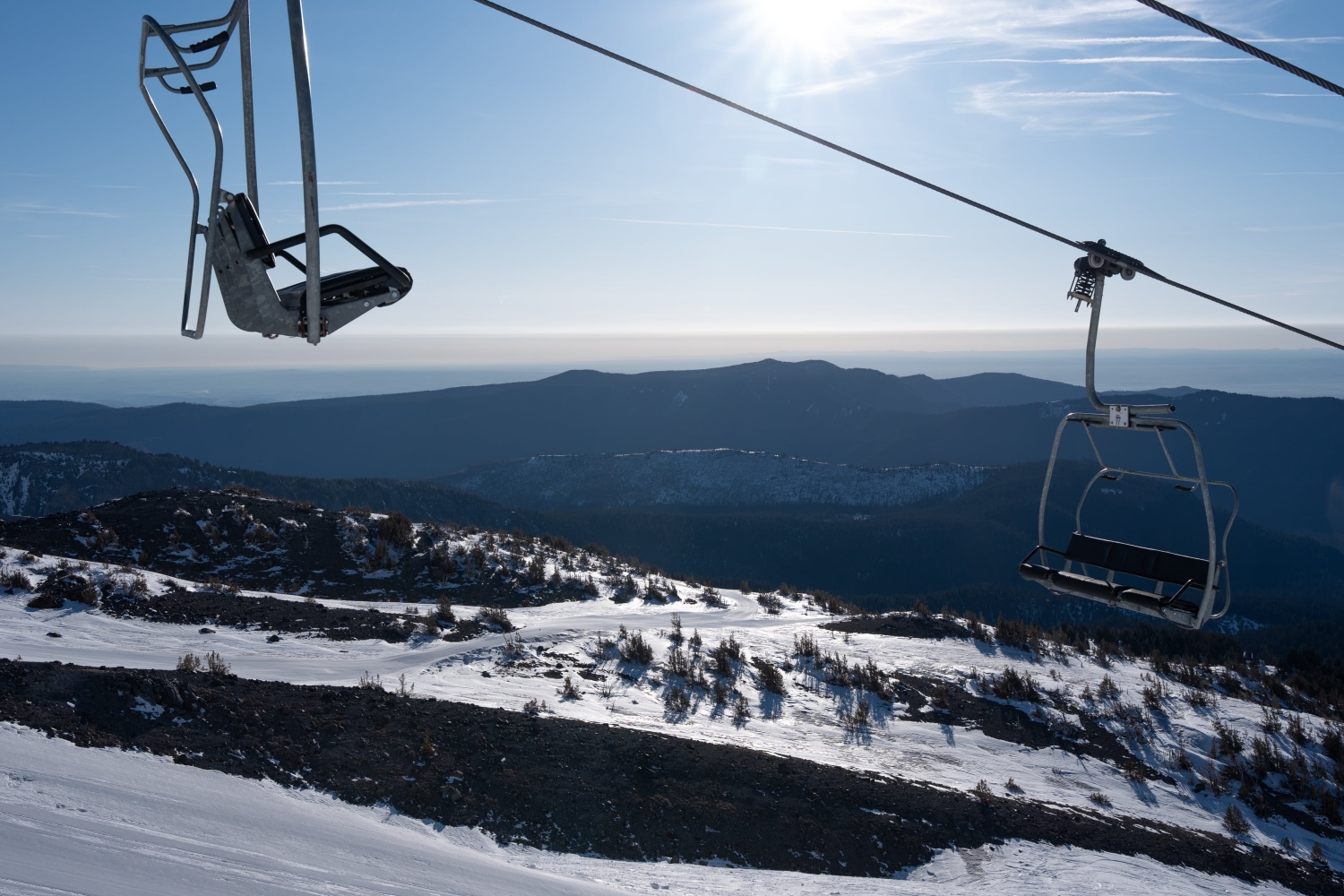
Allison Mariner stood next to the Cascade Express, the resort’s highest lift at more than 7,000 feet above sea level. It’s a beautiful view, with a sea of trees and the peak of Mt. Jefferson looming on the horizon.
Yet, even at this altitude, snow levels are thin and large patches of rock and dirt are visible.
Mariner said this is her place to gather herself and reflect, something she found herself doing a lot this season. She’s worked at ski resorts in multiple states, even designed Olympic courses in South Korea. But this year has been especially challenging.
Crews work through the night to pile snow for all of the guests. But they can lose up to a foot of snow per day when temperatures are warm.
“It’s just exhausting — two steps forward, one step back,” she said. “But we still love what we do. Still satisfied when it’s done.”
Even with such disappointing conditions, there’s an optimism that permeates staff members and resort guests: Next year will be — has to be — better.

OPB reporter April Ehrlich contributed reporting to this story.
News Source : https://www.opb.org/article/2026/04/12/oregon-ski-resorts-shrinking-snowpack/
Other Related News

04/12/2026
Editors note The OregonianOregonLive Editorial Board rounds up hits and misses in state an...

04/12/2026
About 105 new Oregonians are born each day on average Welcome Happy birthday to all 105 of...

04/12/2026
Editors note The OregonianOregonLive Editorial Board rounds up hits and misses in state an...

04/12/2026
Dear Liz I read in a recent column that you mentioned qualified longevity annuity contract...

04/12/2026
As a Tigard resident with emergency response training I strongly support building a new pu...

Follow

Download Our App


Copyright 2022 © EPUERTO. All Rights Reserved