

Published on: 01/28/2026
This news was posted by Oregon Today News


Description
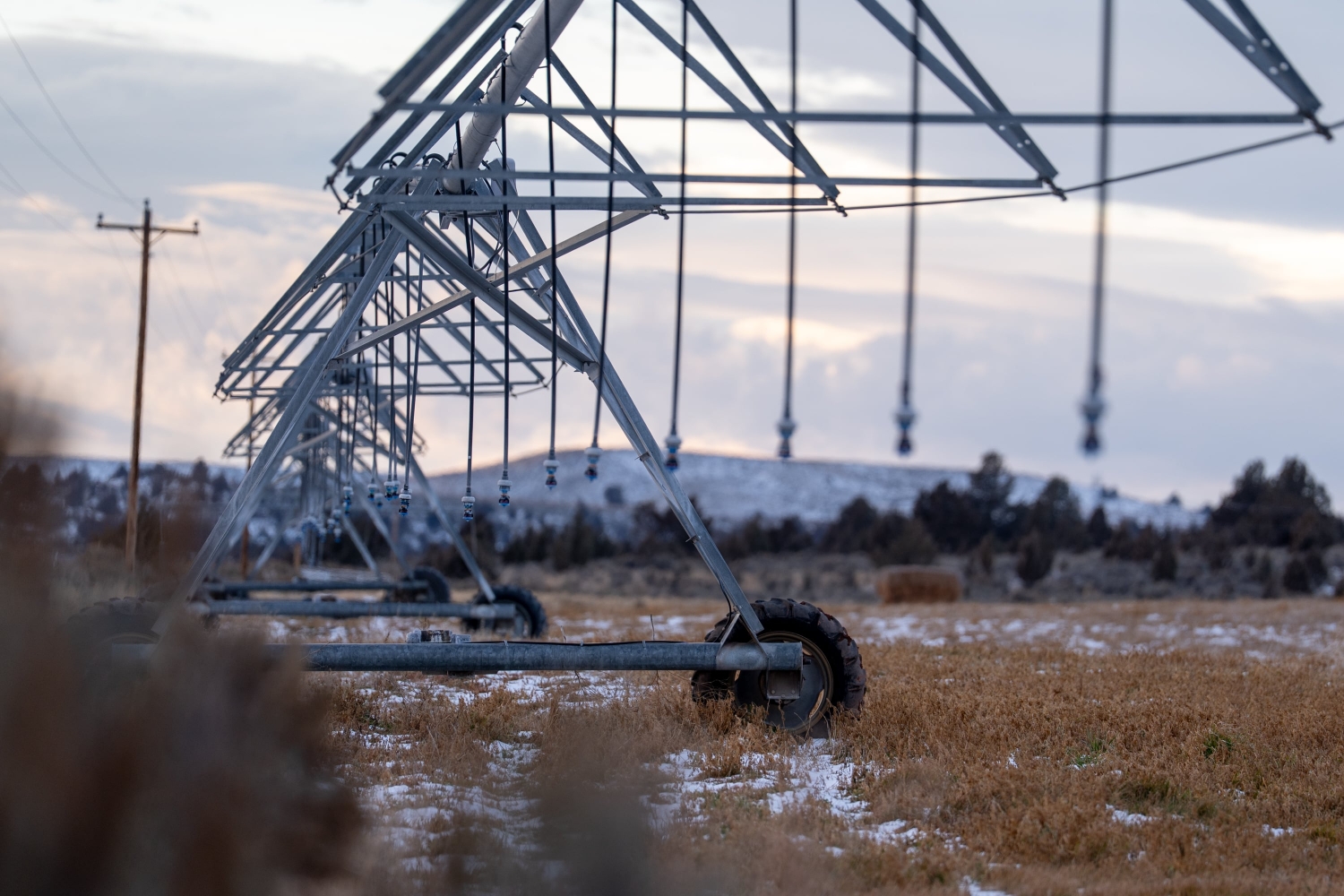
It’s January, fields of water-hungry hay are dormant, and a layer of hoarfrost and fog blankets the sagebrush for miles in Oregon’s remote southeast corner.
But as fields lie frozen, the seeds of an impending crisis continue to grow in Harney County.
It’s sure to force many farmers into a tough financial spot. Some say it could put them out of business. And now, some farmers are trying to navigate a problem that’s both about the economy, and the environment.

The Harney Basin does not have enough groundwater to allow the current pace of irrigation to continue.
In December, water regulators adopted a plan to address the issue.
But many locals feel that the plan ignores their needs and could devastate a region whose economy largely revolves around agriculture.
Some have come to distrust the very agency in charge of managing the state’s water. They’re now forging a partnership with the governor’s office with the hope they can avoid, or at least delay, costly litigation.
“There’s a lot of animosity. And some of it is valid, and some of it’s not,” said state Rep. Mark Owens — a Republican from Harney County and a farmer. “Right now, if the state wants to work with this community, there needs to be a different face leading this instead of the water resource department, and the other option is the governor’s office.”
A disagreement over water management
Last month, the Oregon Water Resources Commission unanimously voted to designate much of the Harney Basin in southeast Oregon a critical groundwater area.
This designation will give the state more authority to reduce how much water irrigators can pump out of the aquifer, with the goal to stabilize it by 2058.
The Harney Basin spans 5,240 square miles of southeast Oregon’s high desert.
Almost all of the groundwater that’s used each year, about 97%, is pumped out to irrigate fields of hay that feed beef and dairy cattle.
For the last three decades, there’s been a problem: The water is drying up.

For decades, the state’s water resources department – overseen by the commission – enabled developers to drill new wells and pump out more water from the aquifer than what can naturally be replenished by rain and snowmelt.
That continued long after the department knew it wasn’t sustainable.
Irrigators in the basin acknowledge the problem – but many disagree with the state’s “critical groundwater area” designation and with how the state has interpreted the science that underpins it.
In one area of the basin north of Malheur Lake, groundwater levels have declined by more than 140 feet below the water table and, since 2016, have continued to drop by as much as eight feet per year.
But groundwater levels in other parts of the basin have not dropped as drastically – falling by less than a foot per year in some places.
As it stands, the water resources department’s plan to cut how much water irrigators can use in the basin doesn’t go into effect until 2028. That plan outlines how some water users will have to cut back their use by up to 70% over the next 30 years.
Before the plan takes effect, water users will have the opportunity to contest the restrictions they might face – a process that would require an attorney and an administrative law judge. It could be costly and take years to resolve.
But many farmers disagree with this plan.
Some feel they’re being punished for the water resources department’s failure. Some say the plan treats all irrigators the same, even though groundwater declines are not uniform across the basin.
Meanwhile, other people in the basin, residents who have domestic or livestock wells but are not irrigators, say the state is not acting fast enough to regulate water users.
In September, a coalition of residents, irrigators, tribes and local governments organized under Owens filed a petition asking the water resources commission to consider a different plan that diverged from the state’s own proposals to cut water use in the region.
In a memo, the water resources department determined the petition’s proposal would result in “continued long-term groundwater level declines” in most areas of the basin.
The commission rejected the petition and adopted the state’s plan instead.
Lost trust, and a different approach
Now, Owens is advocating for a different approach.
If the water resources department proceeds with its plan, many irrigators are likely to contest the restrictions they face.
Owens would like to give them more time to work on what’s called a “voluntary water conservation agreement” – a binding agreement to reduce water use, but one that irrigators would have a say in writing.
That’s where the governor’s office could come in, he said.
“There is some trust that needs to be gained again if we have a desire to work with the [water resources] commission on voluntary actions, because it’s not there right now,” Owens said. “The governor’s office can weigh in with the agencies, specifically the water resource department, and give direction on, ‘You have regulatory sideboards now, but slow down.’”

That doesn’t mean the governor’s office plans to take over for the water resource department, according to Anca Matica, a spokesperson for Gov. Tina Kotek.
“We trust our agency. We know we monitor the agency’s work and implementation, but we also want to hear from community members to figure out are there ways we can do better,” Matica said. “Are there ways that we can help provide guidance to that agency that maybe they didn’t have?”
Geoff Huntington, a senior natural resources advisor for the governor, was at a meeting last week in Burns when irrigators met with Owens and state officials to discuss their options.
He acknowledged the lack of trust.
“We have a trust issue, right? Let’s call it what it is. It’s a trust issue,” Huntington said. “That’s a legitimate thing that has to be overcome if we’re going to be moving forward, and I say that on behalf of the department and the governor’s office.”

Chandra Ferrari, also a natural resources advisor for the governor, told irrigators at the meeting that developing voluntary water conservation agreements would require a joint effort between the governor and the water resources department.
“Part of the trust building is us resetting right now and recognizing that we have an opportunity for a better pathway,” Ferrari said. “There is potential right now for this agreement, but ideally, we’re coming with you, right? The [Kotek] administration is coming with you to the [water resources] commission and saying we have a good path here.”
To date, no voluntary water conservation agreements have succeeded or even been proposed in Oregon, though.

“Voluntary agreements are a tool that’s available, but has not been used,” said a spokesperson with Oregon’s Water Resources Department. “There has not been one proposed to the department in regards to the Harney Basin.”
Owens said he’s optimistic the approach can work in the Harney Basin, but it will take time.
“These community members would like to try to take some of the fate in their own hands,” he said. “I am optimistic that our farmers will come together for the benefit of the community, for the benefit of themselves, and for the benefit of the state. And work toward reasonable reductions to hit reasonably stable [water levels] within a time frame that can work.”
News Source : https://www.opb.org/article/2026/01/28/policymakers-irrigators-chart-path-forward-for-harney-basin/
Other Related News

01/28/2026
Subscribe to OPBs First Look to receive Northwest news in your inbox six days a weekGood m...
01/28/2026
Portlanders gathered on a cold Tuesday night on the road across from the entrance to the P...
01/28/2026
Enjoy Natures candy with this weeks deals on Cara Cara or Blood Oranges for only 399 each...
01/28/2026
One of the highlights of the new lineup includes two special solar eclipse cruises

01/28/2026
Writing an accurate and understandable ballot title in just 15 words is a challenge but it...

Follow

Download Our App


Copyright 2022 © EPUERTO. All Rights Reserved