


Published on: 10/18/2026
This news was posted by Oregon Today News


Description

So far this year, UW researchers have documented 356 immigration-related detentions and arrests in Washington state where federal agencies have been provided records by state agencies.
“ Those are just the ones where we were able to confirm it with ‘smoking-gun’ evidence connecting a given plate search to a known immigration arrest,” Angelina Godoy said.
Godoy is the director for the UW Center for Human Rights which recently published a report analyzing four different avenues that immigration enforcement have at their disposal to access driver and vehicle information – in violation of state laws.
- State DMV records, like the Washington State Department of Licensing, where state driver and vehicle records are housed
- Nlets or the National Law Enforcement Telecommunications Systems, an international public safety information network with nodes throughout all law enforcement, and entryways into state driver data
- Data brokers, where states sell their Department of Licensing records to private businesses
- Local and state agencies, a potential backchannel for feds attempting to access state records
Researchers analyzed how Washington, New York, Maryland, and Minnesota navigate shoring up priorities outlined in their state laws, so called “sanctuary” laws. They’ve found each currently has varying gaps in consistency, a result of selective enforcement and other supplemental laws that work to uphold the priorities laid out in each state.
Among the four states UW researchers focused on, Washington was the first to make it easy for undocumented immigrants to get a driver’s license through its Department of Licensing.
But now immigration agents are using that same licensing data to arrest undocumented people who have Washington drivers licenses.
Guillermo Rivera is a community organizer who helped UW researchers put together this report showing Washington driver records have been used to make arrests, a practice he said goes directly against state law.
“ Communities are being hurt,” Rivera said, “whole communities all around the Washington state. This is unacceptable. This is inhuman, what is happening.”
He said the children of immigrants who are U.S. citizens have watched their phones in shock as the tracked locations of their parents show them being taken to the Northwest ICE Processing Center in Tacoma.
Others, he said, will look for the last location of their parents after not hearing from them, only to find a smashed window of a parent’s work vehicle. People are afraid to go to work, doctors appointments, and participate in daily life, Rivera said.
When immigration enforcement makes a vehicle arrest, they use a variety of factors to identify someone to deport, including racial profiling.
When they think they’ve found someone they can arrest, they look up their license plate, accessing non-public records state agencies collect. It’s a core component of mass deportation efforts that have in some cases ensnared U.S. citizens, and tattered many mixed immigration status communities.
Compared to those other states, Washington doesn’t require a judicial warrant for federal immigration enforcement to access state-held driver and vehicle data. But UW researchers say, given what is happening, the state should require warrants, along with a combination of other requirements.
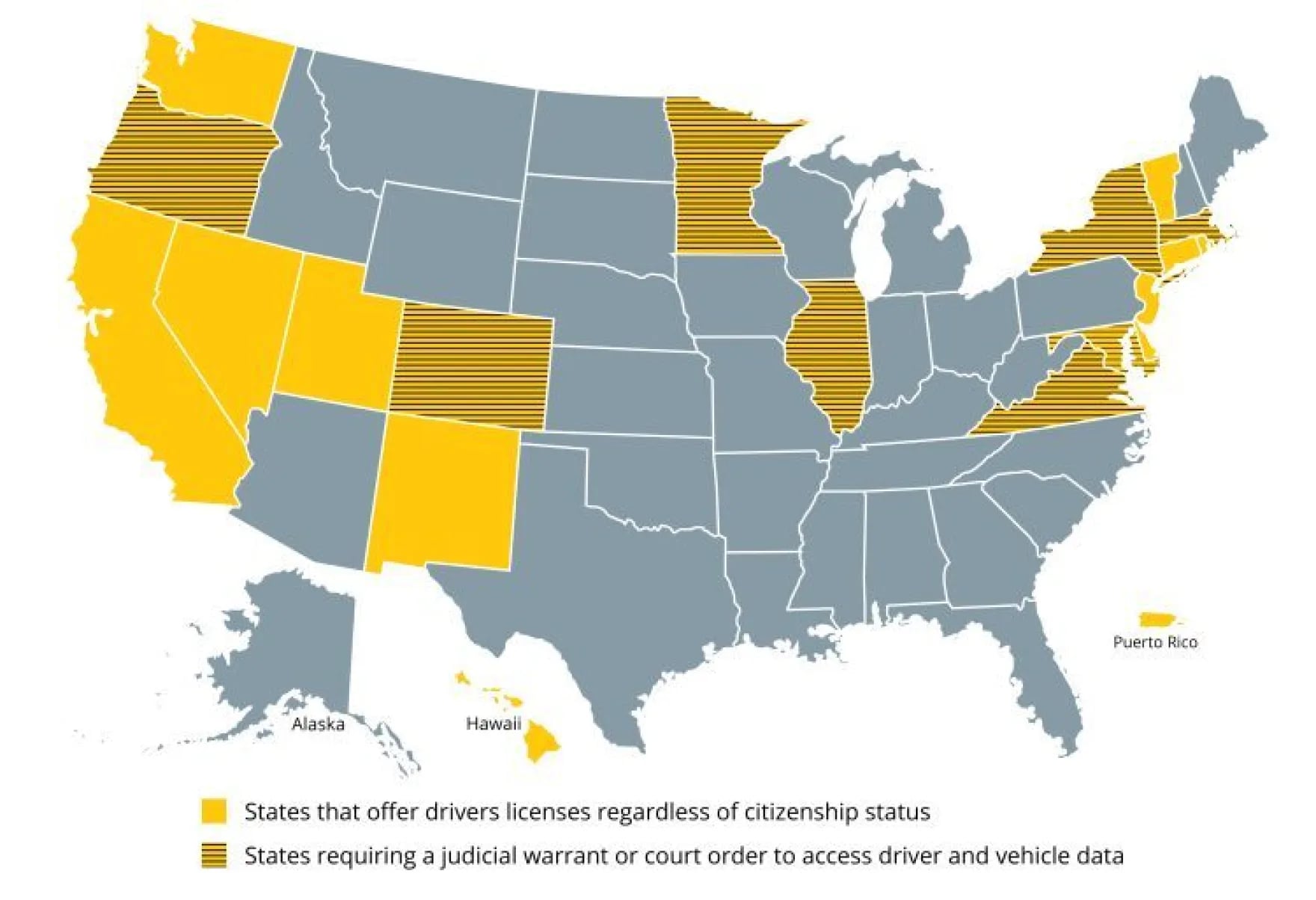
Requiring judicial warrants is an avenue the Washington governor’s office is considering.
“As far as we know – no state requires judicial warrants for all federal inquiries involving driver data. However, as part of our ongoing effort to protect public safety and limit access to state data for civil immigration enforcement, our team is reviewing what other states have done, and what is lawful, to require judicial warrants for civil immigration-related requests,“ the governor’s office wrote to KUOW.
In so-called “sanctuary” states like Washington, federal immigration enforcement is barred from direct access to Department of Licensing records. The state’s Keep Washington Working Act prohibits state agencies from sharing data for civil immigration enforcement purposes. But federal agencies have found other avenues to access these records, like through Nlets.
“Where you cut off one pathway, you squeeze a balloon, and another bubbles out,” Godoy said.
Tracking this practice, researchers have been able to verify the use of Washington driving information in 356 arrests in 2026.
The National Law Enforcement Telecommunications Systems (Nlets), allows federal law enforcement to request information on a driver from a system Washington state uses called ACCESS, managed by Washington State Patrol. Nearly 20,000 other users across 500 agencies also use this platform, according to the report.
“Nlets allows law enforcement at all levels to query databases, such as a state’s driver and vehicle records, criminal records, and corrections records,” the governor’s office wrote in a statement to KUOW.
“My team has worked to limit Customs and Border Protection access for immigration enforcement, while maintaining access necessary to protect public safety… to protect vulnerable Washingtonians,” Gov. Bob Ferguson wrote in the press statement.
It remains unclear the percentage of arrests in Washington using Nlets are of people with civil immigration violations as opposed to criminal charges. But nationwide an estimated 70% of people in immigrant lockup have no criminal history.
Through these systems researchers say federal immigration enforcement will make repeated requests for driver information, linked to a license plate number, until a successful search gets them what they’re looking for, resulting in an immigration arrest. The governor’s office said they’ve blocked nearly 2,000 requests for information largely by Customs and Border Patrol, and banned 16 Originating Agency Identifiers because they’re for civil immigration enforcement, and therefore violate state law.
The researchers applaud the banning efforts, but Godoys said it doesn’t compare with the more than 1,000,000 successful searches by immigration enforcement they’ve found. The UW researchers have also found that if one agent’s account is banned, they’ll often switch to another agent to regain access to the system.
This game of whack-a-mole isn’t going to provide a complete resolution to the issue of protecting immigrants who live in sanctuary states, according to researchers.
“That’s the reason why in our report we emphasize the need to tackle all four of the pathways,” Godoy said.
The UW report raises questions of transparency when data brokers re-sell driver records to others. Documents show that when these records are re-sold, Washington state requires that they not be allowed to be used for civil immigration enforcement. Private data brokers have their own accountability system to fulfill these requirements. But contracts between ICE and data brokers like LexisNexis, which buys Washington state records, show that ICE is allowed to conduct all their searches of LexiNexis anonymously.
“Such contract agreements hinder the ability of audits to ensure that recipients and subrecipients of DMV data are adhering to permissible use requirements and state laws,” the report says.
There’s also the fourth way researchers have identified that allows immigration enforcement to access drivers’ records, via local and state agencies, such as law enforcement.
“ We know that collaboration still happens,” Godoy said. “We need to envision it and tackle it if we are to cut down on this type of data sharing.”
For Rivera’s part, he wants the governor to act, and soon.
”Do an executive order now and to close these gaps,” Rivera said. “Do something.”
Gustavo Sagrero Álvarez is a reporter with KUOW. This story comes to you from the Northwest News Network, a collaboration between public media organizations in Oregon and Washington.
It is part of OPB’s broader effort to ensure that everyone in our region has access to quality journalism that informs, entertains and enriches their lives. To learn more, visit our journalism partnerships page.
News Source : https://www.opb.org/article/2026/10/18/university-washington-ice-driver-data-immigration/
Other Related News

10/18/2026
An Air Force service member died after being injured during a pregame ceremony at a Univer...
10/18/2026
If you dig the best in slot game entertainment and high-profile tournaments but want a dif...

10/18/2026
Luke Fahey arrived at Ohio State as a freshman quarterback without nearly as much attentio...
10/18/2026
Baker Mayfield will miss another game for the Tampa Bay Buccaneers but there is growing ho...

10/18/2026
Spend your Saturday exploring five social casino games from spooky slots to blackjack and ...

Follow

Download Our App


Copyright 2022 © EPUERTO. All Rights Reserved