

Published on: 03/19/2026
This news was posted by Oregon Today News


Description
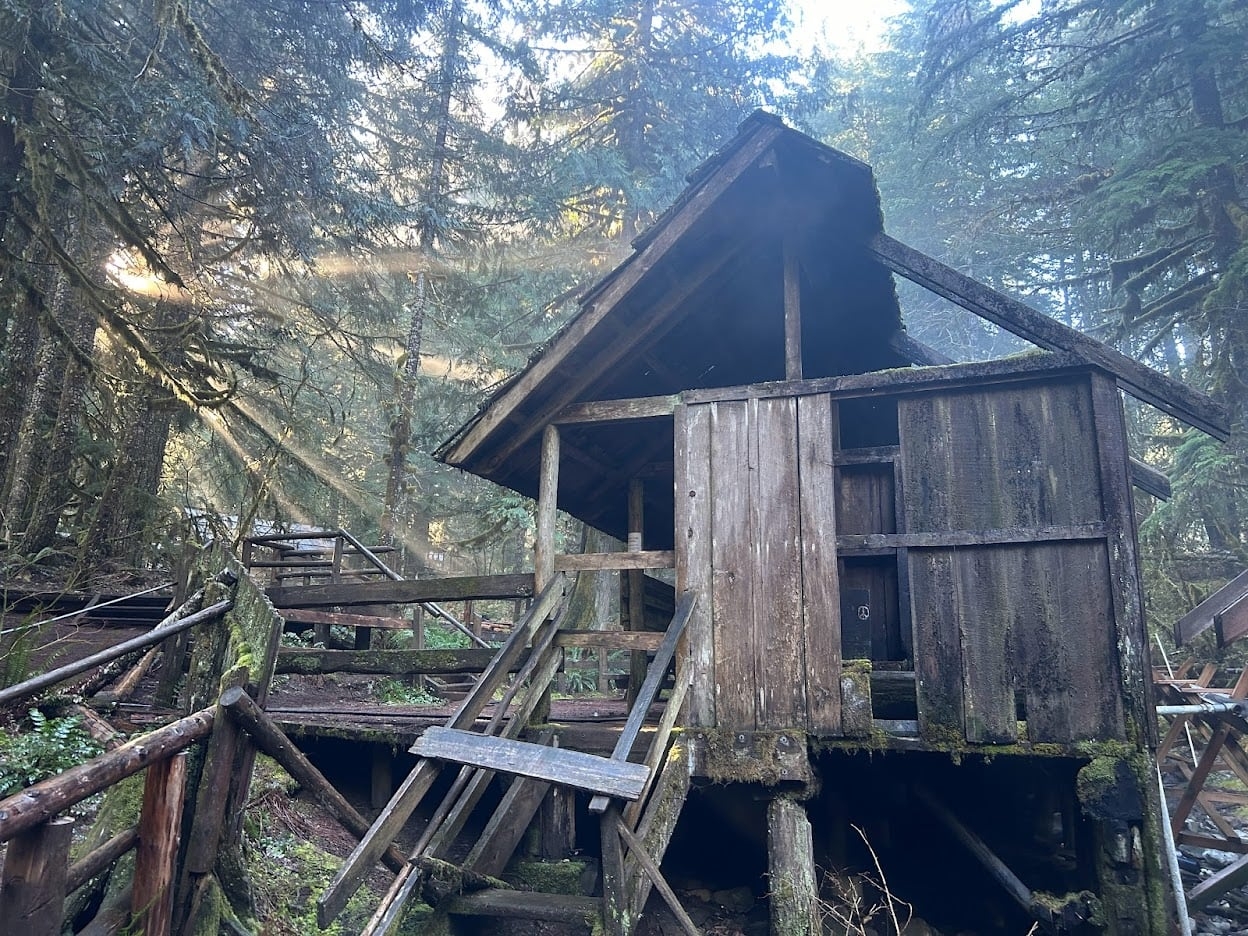
The trail to Bagby Hot Springs weaves through towering old-growth trees alongside a rushing river, crosses a log bridge, then crests at a weathered cabin and a cluster of cedar soaking tubs.
In this small pocket of the Mount Hood National Forest, mineral water burbles from the earth as it has since time immemorial. Steam rises, mixing with forest mist, and mingles with the musky scent of damp soil, moss and mushrooms. The early rays of sunrise filter through the towering Douglas firs, illuminating hemlock saplings sprouting from soggy nurse logs. Birdsong warbles just above the distant rush of the river below.
In these moments, the place feels almost untouched — like it exists outside of time.
Then the voices begin to carry through the trees. A group appears, towels slung over their shoulders, phones already out, playing music. By midday there may be a hundred people here, or more. The line to soak can stretch for hours.
“Depending on the moment, it’s either sacred or profane,” wrote Eric Mortenson in a 2011 story for The Oregonian about the Bagby experience. “It’s fair to say Bagby is valued for what people wish it was, and the reality is a bit rougher.”
All around the springs are the signs of use that have hit hard: the main bathhouse is boarded up, log tubs are broken and empty, the wooden walls are layered with graffiti, and strewn about are food scraps, beer cans, discarded underwear and wads of toilet paper.
For Mike Rysavy, watching the crowds arrive is both encouraging and unsettling.
More than 30 years ago, he first hiked this same trail as a teenager and discovered what felt like a hidden sanctuary deep in the forest. Now he and his wife Tamarah, who first met at Bagby, hold the permit from the U.S. Forest Service to manage the hot springs.
With the help of new staff and volunteers, they are rolling up their sleeves to bring the facilities back from the brink of ruin.
Their job is simple in theory and nearly impossible in practice: repair Bagby Hot Springs and keep it from being loved to death.
The broken cycle of Bagby
For decades, Bagby Hot Springs has been one of the most troubled recreation sites in the Mount Hood National Forest — an epicenter of vandalism, destruction, and at times even violent crime.
Volunteers and land managers have repeatedly repaired the springs only to watch them fall into disrepair again. And for decades, journalists have reported on Bagby’s ups and downs.
In my role of reporter for “Oregon Field Guide,” the new management under the Rysavys in 2023 prompted me to follow up on OPB journalism from decades past. It also offered an opportunity to return to a place of my childhood and ground-truth the Bagby of my memories against the gritty reputation it had gained over the decades.
I first experienced Bagby with my parents in the late 1970s and early 80s, during a movement known as “back to the land.” I recall the soft focus blur of steam rising in misty rain as a small assortment of folksy folks silently soaked nude. Earth-mamas and men with wizard beards and little kids. Voices in a low murmur, just over the burble of the water flowing into hollow log tubs.
To my young imagination, not even the grandest cathedrals of Europe equaled this sublime spot in an Oregon forest. And in the decades since, I have always wondered why such an Oregon treasure has been so broken for so long.

Everyone I spoke with who remembers Bagby from that era speaks with glowing nostalgia. Like Larry Miller, a longtime volunteer who first encountered the springs in 1974.
“It was all still complete then, and the buildings were all very usable back then, and it was a much simpler time. You didn’t have to worry about vandalism and things like that. If five people a day were there it was busy,” he recalled.
But through the 1970s, the spring’s popularity grew. In 1979, a candle left burning in the bathhouse sparked a fire that destroyed much of the building.
Volunteers formed a group known as the Friends of Bagby and began restoring the historic 1930s bathhouse by hand, using the traditional woodworking tools of the original Civilian Conservation Corps builders during the Great Depression — axes, adzes, and drawknives — carving massive cedar logs into soaking tubs like dugout canoes.
Bagby, freshly restored by the early 1980s, had hit a high water mark.
But over the three decades that followed, Bagby would soon fall into a dysfunctional pattern that has repeated ever since: break, repair, break again. Drug use, vandalism, assaults, and theft gave Bagby a reputation as one of the more troubled recreation sites in the Northwest.
For the love of Bagby
Volunteers rallied to try to take Bagby back. One was young Mike Rysavy.
Mike had first come to Bagby as a teenager in the early ‘90s; in his 20s, he started volunteering to fix it up. One work day, he met a young woman, Tamarah, who had come with some of her friends to enjoy soaking.
“He just strips down and jumps in the tub and starts talking,” Tamarah recalls. “I’m not going to say I was in love with him right at that moment, but there was definitely a strong connection. I had found someone else that loved hot springs as much as I did.”
The springs became an unexpected first date.
When Mike and Tamarah hiked down the 1.5 mile trail to the parking lot, he discovered his car had been stolen. It was later found along a forest road, burned.
The moment embodied the contradiction surrounding Bagby — a place capable of producing both connection and chaos.
Despite Mike’s car getting torched at Bagby, or perhaps partly because of it, Mike and Tamarah clinched their relationship and set to work trying to save Bagby.
By 2008, their efforts had affected such a positive change that “Oregon Field Guide” reported on their success.

A 10-year hiatus and homecoming
Their progress came to an abrupt halt in 2012 when the Forest Service folded the management of Bagby into a contract to run all the campgrounds on the Mount Hood National Forest, and outsourced it to California Land Management, a for-profit company that managed hundreds of campgrounds in the West.
The new management banned clothing-optional bathing and issued a $5 per person soaking fee, The Oregonian reported.
“They didn’t have a sense of what Bagby was about,” said longtime volunteer Larry Miller who took a job working for the new management company. “They just wanted to make it a cash cow.”
After only a few weeks of working under the new leadership, he quit.
Mike and Tamarah felt discouraged and disempowered to help Bagby any more. They took their love of hot springs and restoration skills and moved to Eastern Oregon, pouring their time, energy and money into the Lodge at Hot Lake Springs, a historic 19th century hot springs sanatorium.
As the 10-year permit to manage Bagby was coming up for renewal, it was clear that things had not worked out. The hot springs were suffering from the same ills: trash, graffiti, and deferred maintenance.
By 2018, the historic bathhouse had been condemned as unsafe and set for demolition.
When the Forest Service sought new management for Bagby in 2020, Mike and Tamarah stepped forward.
In 2023 the Rysavys received a 20-year special permit to operate the site.
I hiked up to the springs with Mike in 2023 to assess the extent of the damage. “It’s like an explosion of destruction,” Mike described. “There’s almost nothing left that’s salvageable.”

The hand-carved hollow logs that had been Bagby’s signature feature had been so badly battered that they could no longer hold water. The rustic log flumes that had carried the steaming hot water were gone, replaced over the years by piecemeal lengths of PVC pipe.
Setting to work, Mike and Tamarah hauled out more than two tons of trash and then installed roughly 2,400 feet of new plumbing. “We’re basically trying to get back to zero,” he told me.
Their work also focuses on the small but constant problems that shape the visitor experience: graffiti removal, trash removal, and maintaining a consistent presence of staff on site.
Every morning camp host Mona Pearson hikes the 1.5-mile trail up to the springs, picking up trash. I joined her one early morning last spring.
Although she had cleaned the trail the evening before, it was strewn with empty bottles and food wrappers. By the time we reached the springs, she had filled three plastic bags.

Full tubs, long lines
The Mount Hood National Forest receives more than 4 million visitors each year, making it one of the most visited national forests in the United States, and Bagby, often less than a two-hour drive from Portland, is a popular destination.
“A lot of times we have 100 people up here and we have only five working tubs,” Mona said. “One day I had 247 people up here.”
The demand has grown in part through social media posts highlighting Oregon’s “hidden” destinations, and influencers looking to leverage Bagby’s scenic side into likes and subscriptions for their own visibility.
Each video post brings another wave of new visitors. The exposure is “demonstrably bad for the hot springs,” Mike Rysavy said. “We can’t have more and more people show up.”
The result is an unavoidable bottleneck.
“We’ve been waiting here like two hours,” said one young first-time visitor, on a brisk, but sunny Saturday morning last November. “That’s the part they don’t show online.”

What is appropriate hot springs behavior?
With a generator and pressure washer, Mike and his volunteers attempt to blast off the layers of graffiti. It has gotten increasingly worse over the years, he notes
He points to a rainbow-colored message painted on the wood wall of the soaking area that reads: “Leave it better than you found it.”
“There’s a number of tags around here that talk about respecting the springs, all the while they’re tagging it with multicolored paint,” he said, shaking his head.
The writing on the wall reveals a deeper disagreement about what places like Bagby are meant to be and how users should behave.
“In the United States, we really do have a problem of hot springs being viewed as recreation based, and then going further than that: a party place — a view that, especially in the Northwest, that these hot springs are unmanaged free-for-alls,” said Mike.
It shows up in names carved into wood, tossed beer cans, food scraps, scattered glitter, discarded dog poop baggies, and abandoned soggy underwear. And, now, people are adding a newer form of pollution: noise pollution. More visitors are bringing bluetooth speakers to have a soundtrack to their soak.
“It can be like entering a library and finding that someone is talking at full voice and it just seems like they’re breaking the social contract,” said Catherine McNeur, professor of environmental history at Portland State University. “But for the person talking at full voice who maybe doesn’t know any better, they’re just seeing what they see as the rightful use of the space.”
One visitor I spoke with said: “Having music out here, you can have it loud. No one’s out here telling you no. You can just listen to music and just laugh and have a good time. And we have laughed so hard!”
That’s the difference right there,” said volunteer Larry Miller. “Are you coming up here to party or are you coming up to renew your soul?”

Lessons from other hot springs
Bagby is far from the only hot spring facing this pressure.
To the south in the Cascades east of Eugene, popular Cougar (Terwilliger) Hot Springs in the Willamette National Forest have had a painfully parallel past. Increasing crowds at Cougar Hot Springs brought challenges to these rustic, undeveloped springs 1990s, including parties, littering, drugs, and even a murder in 1996.
In response, the Forest Service implemented a use fee and set restrictions, including an alcohol ban and night closure.
In recent years, several western hot springs have also implemented night closures after surges in visitation, and the resulting issues of trash, vandalism, and pressure on the natural resources.
In 2016, after facing a blight of feces, fights and drug use, Umpqua hot springs — in the Umpqua National Forest east of Roseburg — banned overnight camping.
It’s a similar story at hot springs in Idaho.
Kirkham Hot Springs became so popular during the COVID-19 pandemic that the natural riverside springs were being vandalized and trashed. The Boise National Forest closed the area in 2021. They reopened the following year, but as a day-use only area to try to remedy issues with late night drinking and partying at the hot springs.
At two hot springs along the Lochsa River in the Nez Perce-Clearwater National Forests — Jerry Johnson, and Weir Creek Hot Springs — increases in littering, vandalism, human waste, and serious crimes, prompted the US Forest Service to enact overnight closures.
Other springs reached a breaking point.
Idaho’s Skinny Dipper hot springs were permanently closed in 2016 due to excessive trash, human waste, drug use and three fatalities.
“You can’t go there any more — period,” said Mike. “We don’t want to see that happen for Bagby.”
Complete closure may never happen at Bagby because too many people don’t want to see Bagby go away; the problem is they can’t really agree where it goes next.
“Whether it’s about camera use or nudity or tagging or litter, there’s going to be rules that where people believe that they’re doing it the right way and that other people are doing it the wrong way, and there’ll be people butting up against each other,” said PSU Professor Catherine McNeur. “And hopefully that ultimately can be refined in a set of rules and understandings can be created for these spaces.”

‘The way it needs to be seen’
With his management permit extending through 2043, Mike says the goal is long-term stewardship rather than quick fixes.
He hopes eventually to restore the historic bathhouse, which has remained condemned since 2018. Last year, Mike commissioned an engineering assessment that found the structure may still be salvageable, though any restoration would require environmental review and Forest Service approval.
In the meantime, he hopes to add additional soaking tubs to increase capacity and relieve some of the pressure of demand. But the spring itself produces only a limited amount of hot water. It’s a water tap that is already turned all the way on.
He also hopes to add yurts to the campground. But the larger question may not be facilities or structural. Ultimately, the future of Bagby may depend less on infrastructure than on the people who visit it.
Camp host Mona Pearson believes the springs can still thrive — if visitors treat the place with respect.
“It’s important if you can stay within those lines and love being here enough to care for it so people can see it the way it needs to be seen,” she said. “Then yeah, this place could really make it.”
Beneath the graffiti and broken boards, the springs themselves remain unchanged. The mineral water still flows from deep underground. Steam still rises and mixes with the forest air. Sunlight filters through the cedar boughs in rays, just as I remembered as a kid.
The pieces are all still here, and at these rare and quiet moments — Bagby can still feel the way it always has: primeval, peaceful, and worth protecting.
News Source : https://www.opb.org/article/2026/03/19/inside-the-struggles-to-save-bagby-hot-springs-from-ruin/
Other Related News

03/19/2026
We wish peace and healing to the survivors and commend their courage to come forward the C...
03/19/2026
Leaders say the center will help address a growing need for detox and sobering services in...
03/19/2026
Marc-Olivier Frappier developed this coleslaw recipe for Rtisserie La Lune in Montreal hop...
03/19/2026
The Astoria Column one of the Oregon coasts best-known landmarks will celebrate the 100th ...
03/19/2026
Federal Communications Commission Chair Brendan Carr is weaponizing the agencys power over...

Follow

Download Our App


Copyright 2022 © EPUERTO. All Rights Reserved