

Published on: 02/26/2026
This news was posted by Oregon Today News


Description
The Pacific Northwest is an apple-growing powerhouse. About 80% of the United States’ fresh apple crop is grown in Oregon and Washington.

But farms have been experiencing worker shortages for various reasons, including the impacts of immigration crackdowns, an aging domestic workforce and challenges getting temporary international workers approved through the federal guest worker visa (H-2A) program.
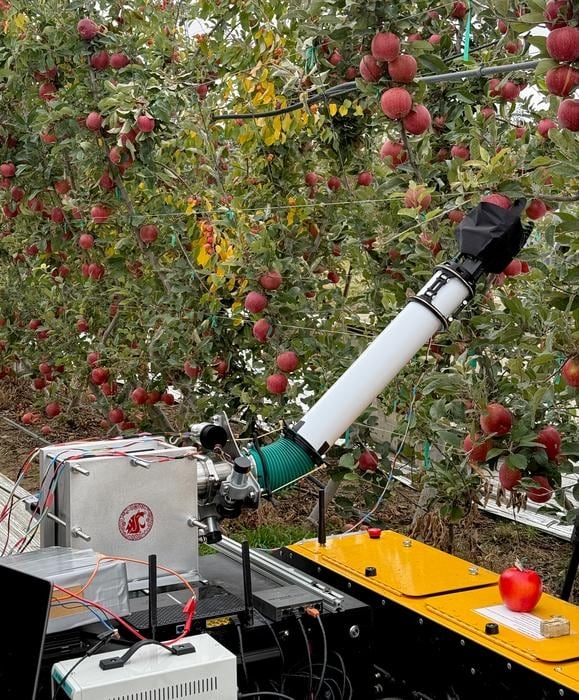
Now engineers at Washington State University are working on ways to make sure fruit doesn’t rot on the trees by developing robots that can pick apples as gently and efficiently as humans do.
The new innovation from WSU is a soft robotic arm that inflates to extend a claw towards the target fruit. It then deflates to retract. The inflatable arm is made of a heavy-duty but pliable fabric that can bend and flex if the arm accidentally contacts a branch while extending toward the target fruit.
The advantage of the soft inflatable arm is that it’s less likely to damage the trees as it maneuvers in. It’s also less likely to injure someone if they get too close.
The arm can support a little over 2 pounds — enough to accommodate the apple-grabbing claw and a single ripe apple.
So far, the inflatable robot arm isn’t very fast — extending and retracting at a rate of about one foot per second, plus time to locate the apple, position itself and pluck the fruit. That amounts to one apple every 25 seconds. Humans can pick an apple about every three seconds, according to the university.
The arm is designed to be used in modern apple orchards, where trellis systems are used to train trees into shapes that are more productive and easier to access.
“The design is capable of reaching the roughly 60% of apples that our collaborator growers estimate to be the cheapest and quickest to pick,” the engineers say in the resulting research paper.
With this kind of capability, an automated apple picker like this won’t be replacing human workers any time soon, but it could help bridge the gap in farm worker availability.

The research is published in the journal Smart Agricultural Technology here.
In these All Science Snapshots, “All Science. No Fiction.” creator Jes Burns features the most interesting, wondrous and hopeful science coming out of the Pacific Northwest.
Find full episodes of “All Science. No Fiction.” here.
News Source : https://www.opb.org/article/2026/02/26/robot-washington-state-university-apples-farmworker-shortage/
Other Related News

02/26/2026
Theres still time to earn recognition as a Top Workplace in Oregon and southwest Washingto...
02/26/2026
Three wrestlers have a chance this weekend to join the exclusive club of four-time Oregon ...
02/26/2026
Just before 10 am on Monday Feb 23 Oregon State Police responded to a two-vehicle crash on...

02/26/2026
The closed-door depositions come after months of tense back-and-forth between the Clintons...

02/26/2026
American businesses and shoppers paid the vast majority of the billions of dollars collect...

Follow

Download Our App


Copyright 2022 © EPUERTO. All Rights Reserved