

Published on: 11/22/2026
This news was posted by Oregon Today News


Description
In a remote northeastern Oregon forest, Jamie Dawson’s tent glowed under a dark blue sky.
She needed to rise before the sun if she was going to catch a wild turkey.
“No matter how early you get up, it’s still not early enough,” she whispered, pouring steaming water into a thermos for instant coffee.
Dawson stepped out into a meadow she calls “no tell ‘em,” a name hunters use jokingly to keep good spots secret.
“We’re in the Wallowa-Whitman National Forest,” she said. “That’s all I’m at liberty to say.”
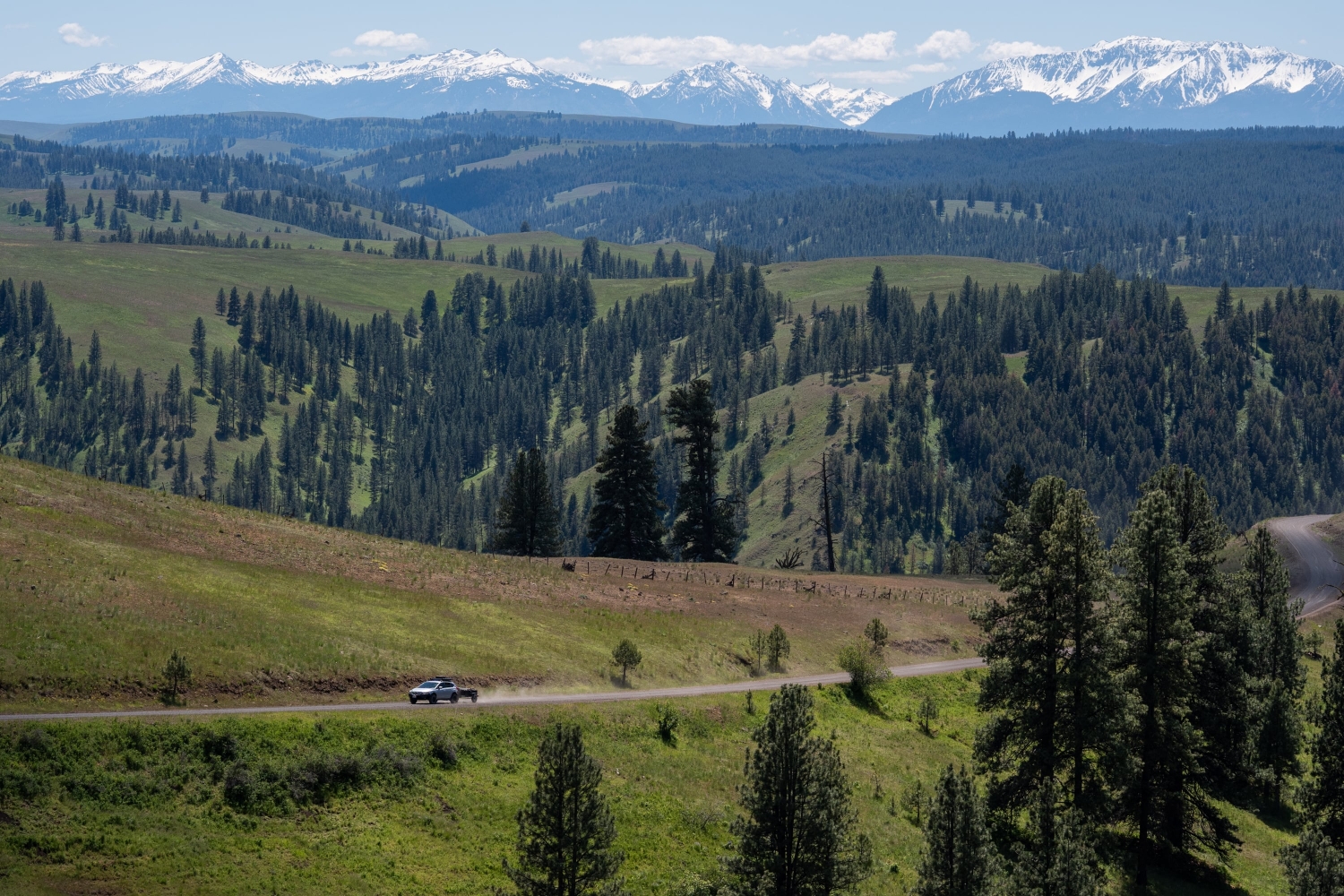
Dawson stumbled onto her secret spot while driving down an isolated dirt road, one of 23,200 miles of roads that cut through the Blue Mountains forests.
The Trump administration wants more of those roads.
For just over a year, the administration has tried to rescind a rule that prohibits forest roadbuilding in an effort to increase public lands logging and mining. It has also sought to loosen restrictions on motor vehicle access for existing roads and change the plans governing the Blue Mountains. This slate of policy changes has reignited a debate in this corner of Oregon over what national forests are for and who gets to use them.
The Wallowa-Whitman, Umatilla and Malheur national forests — collectively known as the Blue Mountains forests — are prized by hunters and recreationists across the West for their beauty and wildness. These sprawling 5.5 million acres include a diverse mosaic of landscapes: pine and mixed-conifer forests, juniper woodlands, shrublands, rolling grasslands and colossal, glacially carved mountains nicknamed the “Alps of Oregon.”


Roads are an existential question for these forests. They are symbols of freedom, offering access to the remote solace of a “no tell ‘em” meadow. They also enable more people and industries to damage the landscapes and wildlife that make the forests so treasured.
As a hunter and conservationist, Dawson thinks the Blue Mountains have too many roads already.
Don George, who leads a local, pro-roads group called Forest Access For All, wants more.
“Everybody should have access to public lands,” George said. “When the government starts designating anything, you’re granting special permissions to certain groups and taking freedoms away from other groups.”
Although a road helped Dawson find her favorite place to hunt turkeys, she says there are too many former logging roads running through these forests. In addition to being a hunter, Dawson is the conservation director for the environmental nonprofit Greater Hells Canyon Council.
Her concern is that roads can interrupt wildlife migration, introduce invasive plants and increase wildfire risk. Here in the Blue Mountains, cars and trucks barreling down old logging roads can scare deer and elk away from public lands and onto private lands, where they damage crops and property.
That also diminishes chances for big-game hunting on public lands, a tourism attraction that fills local hotels and restaurants.
“I don’t think we need all of the roads that we currently have on the landscape,” Dawson said. “I think that we could have some rational conversations to figure out which ones we really need.”
‘This is what we do’

On a sunny spring morning earlier this year, George, who leads the roads access group, hopped out of his truck while driving through the Wallowa-Whitman National Forest.
He crouched down to the ground and plucked a spongy, pinecone-shaped mushroom.
“So, these are morel mushrooms,” he said. “They grow pretty much anywhere that has loose soil.”
George learned how to forage for mushrooms from his family, who have lived in Union for five generations.
“My grandparents loved them,” he recalled. “They’d come up here and they’d just spend all day picking.”
That’s how he knew to look for morels in an area that recently burned in a prescribed fire, because flames can activate underground morel spores.


George visits these woods often. When he’s had a hard day, he likes to pack up his Jeep with his two dogs and find solace somewhere far from people. He said the quiet forest eases his social anxiety.
If you see someone in the forest, George said, it’s customary to wave, but otherwise leave them alone.
Many of his neighbors, friends and family also enjoy the benefit of driving out to the woods at a moment’s notice and finding a secluded camping spot.
“Some people can go do activities in the city: work out, hike Mount Tabor, things like that,” George said. “But this is what we do.”
Until 2005, forest roads were considered open to drivers unless marked otherwise. Then the U.S. Forest Service adopted a policy known as the “travel management rule,” which reversed that policy. It required national forests to have maps that designated where people could drive, prohibiting off-road traffic in many areas.
Travel management came on the heels of another road-limiting policy, called the “roadless rule,” that prohibited roadbuilding and logging within 45 million acres of national forests, including 977,000 acres in the Blue Mountains forests.
Some people in the region saw these changes as the government closing in on their livelihoods.
In this region, roads can be symbols of a once-robust timber industry that provided jobs and supported families in the small towns surrounding these forests.
Not only did the road policies restrict a logging industry that had fueled their towns’ economies and helped pay for schools and other public services, they also limited where people could camp, collect firewood and hunt by vehicle.
“Travel management goes beyond roads,” George said. “It limits dispersed camping. It limits firewood gathering. You just condense everybody into smaller areas.”
As the U.S. Forest Service started drawing up travel management maps for the Blue Mountains forests, George’s family and friends rallied against them and organized into the group Forest Access For All.
Timber advocates, many county leaders and Forest Access For All filled public meetings to challenge the potential maps.


Over the years, Forest Access For All has gained a reputation for filling local town parades with protestors driving dozens of all-terrain vehicles. They carry signs that read, “Stand up and fight or lose your campsite.”
The procession usually features a former “tumbleweed wagon” — a cage on a trailer bed that was once used as a mobile jail — with a sign that says, “Locked up and locked out.” There’s a mannequin inside that George says represents people who are “locked out” of the forest due to road closures.
“It’s the prison of no access,” George said, adding that the group recently retired the jail wagon because it’s too heavy.
After receiving public pushback, the Forest Service never created travel management maps for the Wallowa-Whitman and Malheur national forests, leaving those forests largely open to motorized traffic. They’re among the few national forests without maps designating where drivers can, and can’t, go.
Big changes could be on the horizon, most of them favorable to road access advocates like George. In an effort to increase mining and logging on public lands, the Trump administration has proposed rescinding the roadless rule that prohibits roadbuilding within about 45 million acres of national forests.
And earlier this year, the Forest Service announced it intends to change travel management policies governing all national forests. The change would expand road access in national forests by reverting back to when all forest roads were considered open unless marked otherwise. It would also give more discretion to local forestry officials in deciding when to close roads, and when to leave them open to the public.

‘Wild places have an intrinsic right to exist’
Back in “no tell ‘em” meadow, Jamie Dawson treaded carefully behind trees encircling a grassy field as the sky transitioned from blue to pink.
She gripped an empty wooden box with one hand, and scraped its lid against the rim. Its screech mimicked a hen’s call.
In the distance, a tom gobbled back.
“There’s a lot of action,” she whispered.
She continued the process for another two hours: using a box call, listening for gobbles, then quietly treading toward them. Eventually, the sun blazed high above, and she had to call it a day. She would be going home without a turkey.
Still, she considered the day a win.
“It’s just a really nice moment to reflect and think about how incredibly lucky we are to have this place available to us to go out and enjoy,” she said.
As a resident of nearby Enterprise, Dawson spends a lot of time in the Blue Mountains forests, whether for hunting, hiking or rafting. But she also wants portions of these forests protected from human activities.
“I think the wild places have an intrinsic right to exist, and I think that’s important that we speak up for that,” she said.

That’s been harder for Dawson to do lately, as the Forest Service under President Donald Trump pursues policies that increase logging, mining and other extractive uses in national forests, including the Blue Mountains forests.
In June, the agency released draft revisions of the Blue Mountains Forest Plans, which are guidelines that will set goals for logging, recreation, foraging and conservation for the next decade or more.
The agency’s most recent proposal includes tripling logging levels.
This is the Forest Service’s third attempt at updating these forest plans, which haven’t been updated since the 1990s. Forest plans are usually updated every 10 or 15 years to account for changing landscapes and scientific understanding.
The agency withdrew two previous drafts because of public pushback. No one seemed happy with them, from conservationists like Dawson to road access advocates like George.
Dawson says the Forest Service didn’t adequately engage the public to understand the complexities of these lands and what they mean for the people who value them. She fears the agency is repeating that process with its most recent proposal.
“It doesn’t feel like they’ve been putting an honest effort into trying to find resolutions,” she said. “It feels like they want to sweep stuff under the rug and say, ‘We did the plan. Sorry if you don’t like it. We have to move on to other things.’”


George is also unhappy with the most recent draft. Although it increases logging, something he and other Forest Access For All members support, it doesn’t include the guaranteed road access he was hoping for.
Still, like Dawson, he believes there is a way to balance all the ways people enjoy these public lands.
“There’s a lot of land up here,” he said. “There’s no reason that everybody can’t do what they want to do up here.”
Now it’s up to the Forest Service to balance all of those different wants and needs on paper. The agency is finalizing its draft for the Blue Mountains Forest Plans. In an emailed statement, the agency said it plans to publish a final version in spring 2027.
News Source : https://www.opb.org/article/2026/11/22/oregon-blue-mountains-roads-ignited-debate-over-public-lands-access/
Other Related News
11/22/2026
A free weekend and a healthy coin balance can disappear quickly when the first game you op...
11/22/2026
Photographer KB Dixon continues his series of Oregon cultural profiles with portraits of e...
11/22/2026
Oregons commercial Dungeness crab season has been delayed until at least Dec 16th
11/22/2026
Inspired by the diaries of Washington County settler AT Smith my wife and I walked from Hi...
11/22/2026
Dear Mayo Clinic I was told that my pancreatic cancer cant be removed with surgery because...

Follow

Download Our App


Copyright 2022 © EPUERTO. All Rights Reserved