

Published on: 05/13/2026
This news was posted by Oregon Today News


Description

Daria Loy-Goto has been a lawyer for more than three decades and now serves as the deputy auditor for the state of Hawaii. She still remembers her first-ever part-time job at her father’s business in Oregon, work that had nothing to do with law or accounting.
“Dad said I was maybe five or six years old. They would put me on a stool, and my job was to push the button that would turn the conveyor belt on and off. At one point, somebody said: ‘Boy, you’re really good at that.’ And I reportedly said: ‘Great, now I’m gonna have to do this for the rest of my life,’” said Loy-Goto, 60. “Dad just thought that was really delightful.”
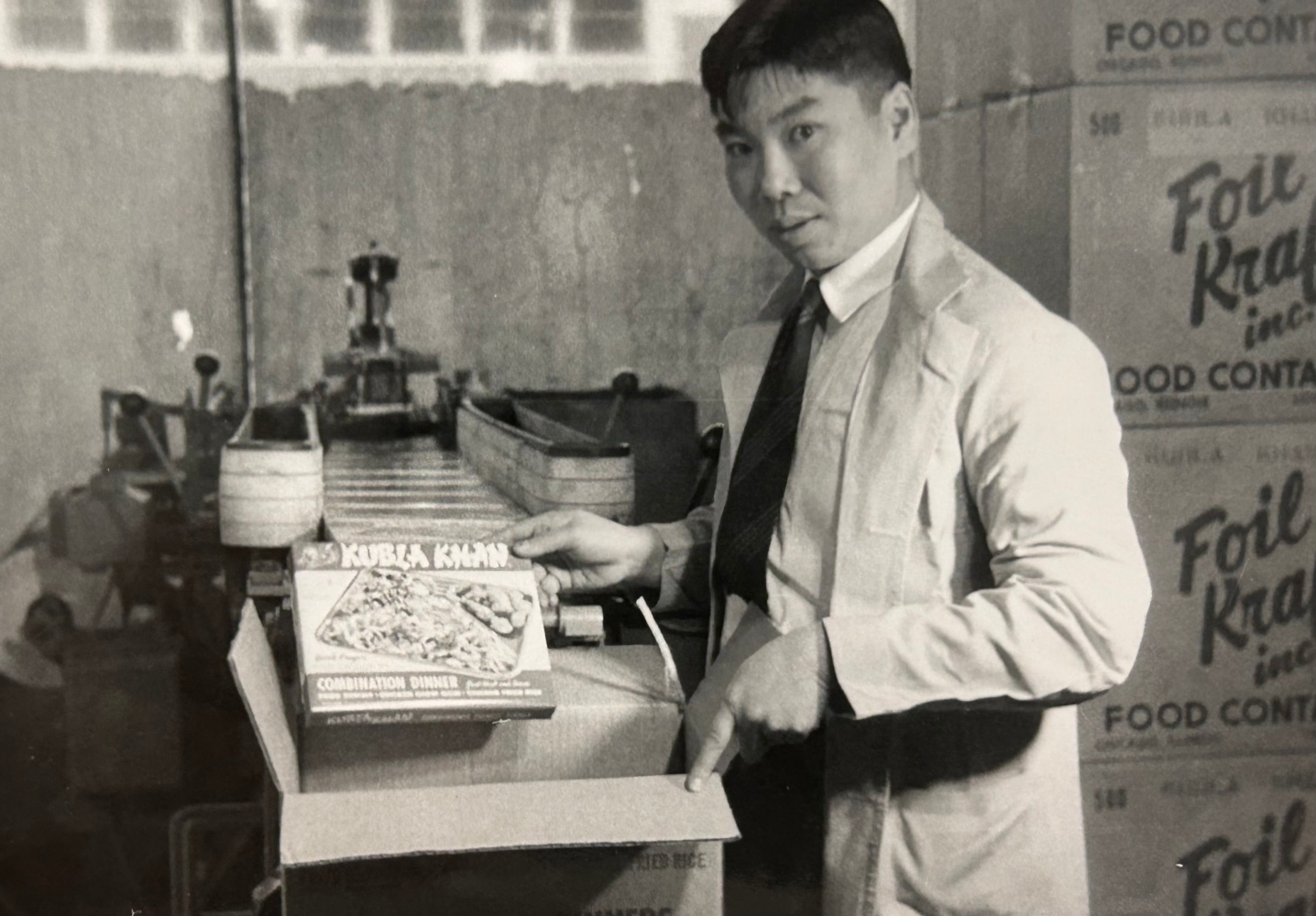
Her father, Percy Loy, was the co-founder of the now-defunct frozen food manufacturer Kubla Khan. The company’s food processing plant, located at 3617 SE 17th Ave. in Portland, was sold in 2001 as the business wound down. At its peak, however, the plant produced thousands of frozen meals — such as chicken fried rice, chop suey and sukiyaki — that revolutionized how millions of Americans ate and thought about Asian cuisines.
Kubla Khan became so popular that its legacy is preserved in institutions including the Oregon Historical Society in Portland, the Wing Luke Museum in Seattle and the National Museum of American History in Washington, D.C., all of which still display its packaging. The Smithsonian Institution also holds company records and archived materials donated by the Loy family.

Son of a Vancouver dairy farmer
Percy Wallace Loy (顏盛榮) was born Dec. 11, 1920, in Vancouver, Washington, one of four children of Kong Loy (顏廣禮), a railroad laborer-turned-entrepreneur who immigrated from Taishan, China, around 1880.
Kong Loy began vegetable gardening and delivering produce to Portland around 1912, then entered the dairy industry in 1931, raising 100 cows to produce Grade A milk for Vancouver Barracks, schools, hospitals and private homes. Despite widespread anti-Chinese racism, he built a strong reputation for producing clean milk and formed connections with prominent figures such as Gen. George Marshall.
Kong Loy raised his children in a trilingual household, speaking Cantonese, Mandarin and English. As a young man, Percy Loy traveled to Guangzhou to attend university, where he witnessed the Japanese invasion in 1938. That experience inspired him to enlist in the U.S. Army in 1942. Over five years, he served as a navigator, bombardier, pilot and intelligence officer, eventually retiring as a lieutenant colonel.

After World War II, unable to secure a commercial pilot job, Loy turned to food entrepreneurship. He first operated a small Japanese restaurant in Portland, then in 1950 co-founded Kubla Khan Food Company with his brother-in-law Robert Wong, husband of his sister Pearl Loy, in the basement of a Chinese restaurant on Southeast Stark Street.
Authentic Asian flavors won over customers
Gloria Lee Wong — sister of Loy’s wife, Irene — recalled the company’s early days. Before Kubla Khan became a frozen food business at its Southeast 17th Avenue location, it operated as a takeout service. The sisters worked evening shifts with chefs who had immigrated from China, taking phone orders for dishes like chow mein and fried rice for customers — mostly white and often regulars — to pick up.
Later, as the company transitioned into frozen foods, Wong helped promote the products through in-store demonstrations during the 1960s. She and other Asian American women served samples, especially fried rice, to a largely white clientele.

Now 94, she described Percy Loy as both a good brother-in-law and a strong businessman: “Percy was very receptive [to] the groceries because … he had a lot of friends in all the different grocery stores. He must have been very cordial because they had a good business with all of them.”
As frozen meals grew in popularity in the 1950s, Kubla Khan expanded widely, supplying grocery chains like Safeway and Fred Meyer, as well as locations such as Portland International Airport. It became one of Portland’s most recognized frozen dinner brands.
A 1957–58 survey conducted by The Oregonian ranked Kubla Khan third among frozen dinner brands. Of nearly 44,000 Portland households purchasing frozen meals, 4.5% chose Kubla Khan — behind Swanson (68.6%) and Chet’s (9.9%), but ahead of Birds Eye (2.9%).
The company’s advertising, featuring billboards that promised authentic Asian dining experiences, appeared across highways and city buildings in the Pacific Northwest during the 1960s. It was even featured on the television show “KOIN Kitchen” that ran from 1953 to 1973. In 1990, Safeway celebrated Kubla Khan as a “Northwest success story.”

Industry leader with sharp political instincts
As the company grew, Loy took on leadership roles in the industry, serving in multiple positions within the Frozen Food Council of Oregon and later as a liaison to the National Frozen Food Association.
Loy-Goto said her father helped expand the frozen food industry and improve access to diverse cuisines in Oregon.
“Now when you walk into an Oregon store … there are rows and rows of refrigeration, and that is in part due to people like dad who believed in the technology, who made the drive down to Salem to testify before the Oregon State Legislature, to lobby the governor, to make it easier for refrigerated trucks to drive on Oregon roads,” she said. “That is really dad’s legacy.”
Loy’s influence extended beyond the U.S. He traveled throughout Asia sourcing ingredients and exporting products. In 1979, he led an Oregon trade delegation to the People’s Republic of China, the same year the U.S. established diplomatic relations with the country.

Mae Yih (鄧稚鳳), 97, served in both houses of the Oregon Legislature from 1977 to 2003. She credited Loy with helping her successfully persuade Gov. Victor Atiyeh to establish a sister-state relationship with China’s Fujian province in 1984.
“Gov. Atiyeh said to me China trade [was] no big deal … and I was rather disappointed,” Yih said. “And Percy Loy said to me: ‘Be persistent, and keep determined in asking Atiyeh to go [to China].’”
Born and raised in Shanghai, Yih immigrated to the United States in 1948, fleeing China’s communist revolution. She described Percy Loy as a forward-thinking and politically engaged businessman who supported her early career.
“He was the very first person in the Chinese community to support me,” she said. “Most of the people in the Chinese community didn’t think I had any chance because I was an immigrant, I was a senior citizen and a woman … but Percy could see that I was a very involved citizen.”
Education for all Oregon kids
Beyond business and politics, Loy was deeply involved in education, serving on advisory councils for University of Oregon, Willamette University and Lewis & Clark College from 1966 to 1987. All four of his children attended Willamette University.
Loy-Goto, the youngest, earned both her undergraduate and law degrees there. She remembers her father always showing up for important moments, despite working seven days a week, and expressing love through small gestures like leaving notes or cooking Cantonese meals for Sunday family gatherings.
She believes he did not want his children to take over the business because of its physical demands.
“It would snow and he’d have to go up the roof of the building and make sure that the air conditioning ducts were clear,” she said. “At certain times in our lives … the kids would all be down there, and you could see how hard he had to work.”

Now living in Honolulu, 20 years after her father’s death, Loy-Goto describes him as a lifelong learner and a “renaissance man” dedicated to helping others.
“[He] was really making sure that any ceiling, glass or not, would be lifted for folks — that was really his drive,” she said. “He made the long drive down to Willamette for board of trustee meetings … not just for his children and for future generations of his children who might wanna go to Willamette, but really for all kids in Oregon who wanted an opportunity to go to college.”

Learn more about Chinese American history in Oregon:
- Watch: Recent investigations have linked Chinese Americans with more than 30 historic ranches in Eastern Oregon, including one south of Dayville in Grant County.
- Watch: Meet Hazel Ying Lee, the first Chinese American woman to fly for the U.S. military.
- Watch: Yat Sing Music Club preserves Cantonese opera in Portland through ongoing rehearsals and community outreach.
News Source : https://www.opb.org/article/2026/05/13/percy-loy-kubla-khan-frozen-meals/
Other Related News

05/13/2026
MOSCOW Russia on Tuesday test-fired a new intercontinental ballistic missile as part of e...

05/13/2026
With nine international games eight stadiums seven cities and four continents this year wi...

05/13/2026
Prosecutors played video in court showing the theft from the famed singers car Evans was a...

05/13/2026
An Oregon man is in isolation after testing positive for hantavirus he told CNN on Tuesday

05/13/2026
The latest from the weekly-plus chamber music collective presented music by Ryan Francis S...

Follow

Download Our App


Copyright 2022 © EPUERTO. All Rights Reserved