

Published on: 10/04/2026
This news was posted by Oregon Today News


Description
William Murphy wears sunglasses and a woven cedar baseball cap over his long gray hair as he stands beside the charcoal pit he’s helped man for 19 years. The tribal elder says the Ko-Kwel Salmon Celebration is his chance to share Coquille Indian culture with the broader community.
“We’re highlighting our gift of the magnificent way we can produce cooked fish, and we’re trying to share that with the public,” Murphy said.

Traditional canoes, the Miluk language, Native crafts, songs and acorn mush connect the celebration to the Coquille homeland. The tribe describes the nearby Coquille River as a focal point of its life since time immemorial.
One of the few things not from the Coquille River is the salmon.
“We kind of don’t have the opportunity to provide our own fish, or we would,” Murphy said.
The festival requires roughly half a ton of salmon — more than the struggling Coquille River run can provide. Instead, the tribe purchased fish from tribes along the Columbia River.
‘We are now memories and thoughts’
Commercial salmon fishing had been declining for decades before the Coquille’s Chinook returns crashed. Coos Bay was once a major salmon port. In 1970, it handled more than half of Oregon’s South Coast salmon landings.
“It used to be hundreds and hundreds and hundreds of these wooden plank boats,” Murphy said.

The fleet shrank over the following decades as salmon runs and fishing opportunities declined.
“We disappeared. We went away,” Murphy said. “We are now memories and thoughts.”
The salmon troll fleet dwindled slowly. The Coquille River’s Chinook run collapsed much more quickly.
Starting around 2018, salmon returns in many of Oregon’s coastal rivers crashed.
“There was a sharp drop-off, kind of coast wide, and over the next couple of years, other coastal basins recovered,” said Ed Hughes, the Oregon Department of Fish and Wildlife’s acting fish district biologist in Charleston. “But in the Coquille here, they didn’t bounce back.”

Hughes said the Coquille’s failure to rebound helped biologists connect the decline to invasive smallmouth bass, which prey on young salmon. Warmer river temperatures, low flows and changing ocean conditions have also hurt salmon survival.
The state wildlife agency brought its concerns to the tribal council, said Brenda Meade, chair of the Coquille Indian Tribe.
“We talked a lot about what the issues were and how we were going to fix it,” Meade said.
In 2022, the tribe and the state formalized a co-management agreement covering fish and wildlife across five southwest Oregon counties.
Their work has included removing invasive bass, improving the collection of adult salmon for breeding and expanding hatchery efforts. In 2022, they also developed a conservation hatchery program to rebuild the Coquille’s wild fall Chinook population.
Tribal co-management
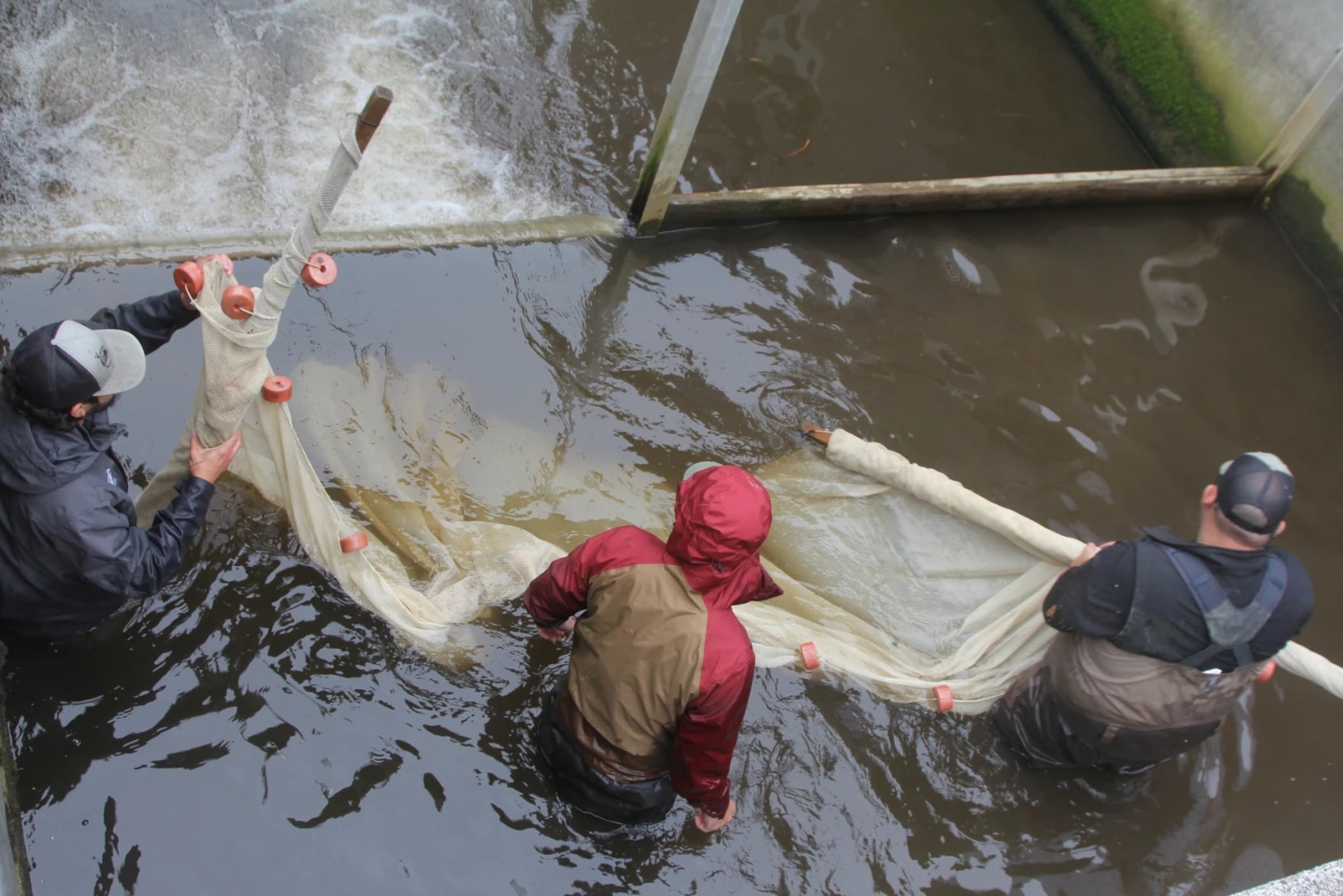
A few days after the celebration, tribal fisheries workers gathered at Ferry Creek in Bandon. They waded into the creek and stretched a seine net across the water, pushing hundreds of finger-sized salmon smolts downstream.
Jesse Rodriguez, a fisheries technician with the tribe’s natural resources department, had been standing in the creek in rubber waders all day.
The fish are spawned at Bandon Hatchery, raised at Cole Rivers Hatchery and then brought back to Ferry Creek to acclimate.
“They get the scent of the river, and then they’re ready to go out to the ocean,” Rodriguez said. “So we’re trying to just kind of make sure we can get as much out to the ocean without any harm.”

The goal is for the young salmon to imprint on Ferry Creek and return as adults after spending a few years in the ocean. Some can then be collected for breeding to produce another generation.
“I definitely think that the work that we’re doing here is going to make a difference. We’re putting a lot of fish into the river,” Rodriguez said. “We’re just trying to basically jump-start this whole population of salmon.”
And now, there are signs of progress.
Meade said fish from the tribe’s earlier releases are beginning to return.
“This year is so important because that four-year rotation of the smolt that we were a part of releasing for the first time are now the fish that are coming back into the river,” Meade said.

That doesn’t mean Coquille River salmon have recovered. The tribe is still trying to rebuild a run from near extinction.
For Meade, the work underscores the importance of traditional knowledge and Indigenous stewardship.
“The salmon were not going to be able to be healthy again without the Coquille Tribe in the water with them,” Meade said. “Those are our salmon.”
Restoring the run also means protecting the salmon at the heart of the tribe’s ceremonies, traditions and teachings.
“I couldn’t live in a world that there were no salmon in the Coquille River,” she said.
Theo Greenly is a reporter with Jefferson Public Radio. This story comes to you from the Northwest News Network, a collaboration between public media organizations in Oregon and Washington.
It is part of OPB’s broader effort to ensure that everyone in our region has access to quality journalism that informs, entertains and enriches their lives. To learn more, visit our journalism partnerships page.
Other Related News

10/04/2026
This fall Portland Public Schools will decide whether to close up to 20 schools - a decisi...
10/04/2026
While the future of daylight saving time is in the hands of Congress theres little doubt w...
10/04/2026
The three candidates running for Multnomah County chair all offer their own prescriptions ...
10/04/2026
Dear Liz Id like to add to the conversation about where to store estate documents Having l...
10/04/2026
Would you live in a haunted house or a home where violence occurred Many people choose to ...

Follow

Download Our App


Copyright 2022 © EPUERTO. All Rights Reserved