

Published on: 03/25/2026
This news was posted by Oregon Today News


Description
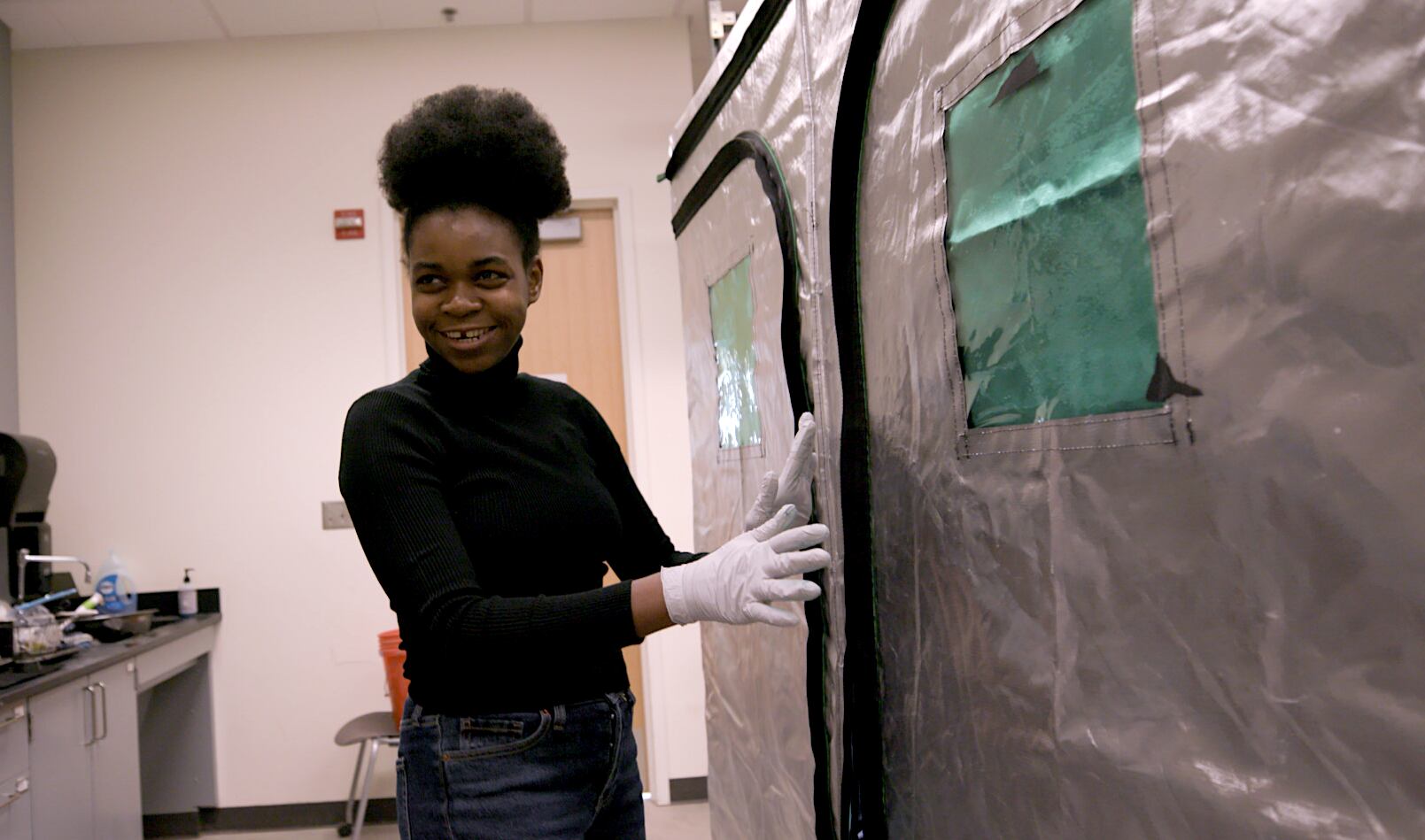
There’s a small silver tent in an engineering lab at Portland State University — the heavy-duty type that you can walk into.
“This is what I call the magic tent, where all the chemistry and all the reactions are happening,” said Portland State University Ph.D. student Fadzai Zivanai, unzipping the flap on a late-October morning last year.
She steps inside with a bucket full of deep blue liquid and places it beside a tank filled with horizontal layers of white sand and silty gray-brown soil.
“This silt layer is the one which is most common here in Oregon — Portland,” she said, pointing to the dark layer in the tank.
This is especially true along the Willamette River and Valley, where thousands of years of floods created rich silt deposits that created the fertile farmland we know today.

The liquid in the bucket is a mix of nutrients, soil microbes and blue food coloring that makes the solution easier to track as it seeps through the sediment layers.
Zivanai drops a hose into the bucket and starts a pump that will simulate in the tank what she wants to happen underground.
There, the tiny, hungry soil microbes will gobble up the calcium nitrate and calcium acetate nutrient mix and produce nitrogen gas.
These microbes are key allies in an innovative new technique to prevent damage to buildings during major earthquakes. If the science holds, the gas they produce in the soil will guard against a phenomenon called soil liquefaction by pushing out water that can turn solid ground into quicksand.

What is soil liquefaction?
Here in the Pacific Northwest, we’re due for the Cascadia Megathrust Earthquake.
The subduction fault off the Pacific Northwest coast can generate a magnitude 9+ earthquake that will be felt hundreds of miles away, and our communities are not prepared for what will follow.
The quake will cause intense shaking, tsunamis, subsidence, and soil liquefaction — when ground shaking causes the soil to turn into a soupy, liquid mess.
“If you think back to the 70s and 80s kind of B movies [with] quicksand, that’s what we’re talking about in terms of liquefaction,” said Kayla Sorenson, a Ph.D. candidate at Portland State University.
In these movies, the hero would unwittingly run into a pit of quicksand and get sucked in.
“Can you imagine how a building would react if the ground underneath it suddenly turned into this substance?” she asked.
Liquefaction causes buildings to sink and tilt. Bridges can destabilize. Underground pipelines can rise to the surface and break. The combination of shaking and soil liquefaction from a big wobble — whether it be from Cascadia or from a more localized earthquake (like Portland Hills Fault rupture) — would wreak havoc in Portland and beyond.
Liquefaction happens when vibrations — usually from an earthquake — hit soil that’s fully saturated with water. These saturated soils are most often found along rivers and waterways where the water table is high.
That’s also where many cities are built.
In Oregon, there are spots of high risk on the coast, in river valleys, in the mountains and beyond.

“Here in Portland, we have a lot of structures that were built before we had a real understanding of the seismic risk in the area,” said PSU geotechnical engineer Diane Moug.
Oregon’s modern seismic building standards weren’t adopted until the mid-90s.
“The types of soils that we know are vulnerable to liquefaction — and we see this repeatedly, earthquake after earthquake … are areas of reclaimed land or areas where there’s fill,” she said. “Where it used to be a lake, and they filled it in, or where they’ve built out into a bay or other means of reclaiming land.”
This is exactly what the ground is under sections of Portland’s Critical Energy Infrastructure Hub, also known as the CEI Hub or the tank farms. The CEI Hub is where 90% of Oregon’s total fuel supply is stored and handled. Much of the industrial area where the tank farms are located used to be a lake before it was filled in.
That means the liquefaction risk is very high.
The state is taking steps to bring the tanks up to seismic standards. The legislature passed a law in 2022 that requires owners of the large fuel terminals to assess their risk, devise a plan to shore up their infrastructure, and then execute that plan.
“We want to make sure that the tank contents will remain inside tanks during the earthquake. That’s the bottom line,” said Svetlana Lazarev, an analyst with the Oregon Department of Environmental Quality, the state agency overseeing the improvements.

So far, only two companies covered under the law — Portland General Electric and PDX Fuel Company, LLC — have had their plans approved. They now have 10 years to get the work done.
Most companies operating in the CEI Hub haven’t yet finished the risk assessment.
“A majority of the [seismic vulnerability assessments] will come in between June and December of 2026. And a couple of facilities might take longer than that,” Lazarev said.
If the Cascadia earthquake hits before the hazard mitigation work is done, the outcomes could be dire. Emergency officials are expecting chemical leaks, fires and a devastating disruption to fuel supplies.
“The one thing that we’re really fighting against is time. Because it is not a matter of if it will happen. It is a matter of when it will happen,” said Sorenson.
Burping microbes
The Portland State University team’s microbe-based solution to prevent soil liquefaction hinges on being able to decrease the amount of water in the soil. The technique is called “microbially induced desaturation.”
Normally, when shaken, particles of soil want to settle — like beans in a jar when you tap the side. But saturated soil can’t compress, because there’s water in the way.
The intense downward pressure of the settling soil causes the water to squeeze in and fully surround the particles, breaking down all friction between the grains of soil. This makes the previously solid ground flow like a liquid.
“The idea is that for the soils to liquefy, you need to have 100% saturation,” said PSU engineer Arash Khosravifar. “This method works by reducing that saturation ratio from 100% down to whatever level required for it not to be liquefiable.”

Imagine you have a building that’s not up to seismic standards sitting on liquefiable soil. The way the technique would work is you’d drill two shallow wells on opposite sides of the structure.
“You inject the treatment on one side of … the infrastructure and then do some extraction on the other side,” explained Moug. “You can induce that treatment solution to flow underneath the structure and react to the soils underneath.”
The microbes that naturally live in the soil feast on the nutrients and produce tiny air bubbles that push the water out from between the grains of soil. If you can displace enough water, you can prevent liquefaction — no matter how big the earthquake.
Moug says the technique has the potential of being cheaper and less invasive than other methods, like jet grouting, an underground injection used to ward off liquefaction under existing structures.
The team has tested their liquefaction fix under real-world conditions at two different field sites in the Portland area — one near the Portland airport and another near the CEI Hub itself.

“For the first time, I believe in the U.S., we applied this method in the field with the field conditions to see if it works,” Khosravifar said.
The tests, which began in 2019, have shown real promise. All those burping microbes reduced the soil saturation considerably — below 95%. Khosravifar says previous lab testing suggests that it should be enough to stop liquefaction.
“About two weeks into the treatment, [the saturation rates] dropped down and they stayed down for like five years,” he said.
Then they were able to re-treat their site near the Portland International Airport in 2025 to similar results.
Microbes to the rescue?
Despite the promising results, there are still many research questions to work through before the team’s liquefaction fix is ready for the big time.
Even the question of how much desaturation is actually needed to prevent liquefaction in the real world is difficult to answer.
“One of the big hurdles we need to overcome — and it’s a challenge — is we can’t just wait around for the earthquake to occur to see if this method works,” Khosravifar said.
For example, the team brought in a specialized “shaker truck” all the way from Texas to their field site near the Portland airport to test the treatment.

But they still weren’t able to generate enough ground shaking to mimic a Cascadia earthquake, and they couldn’t get the soil to liquefy.
Add these unanswered research questions to the inevitable regulatory hurdles that would have to be cleared before the treatment could be used more widely, and it’s unlikely the new technology will be available in time for the state’s CEI Hub deadlines.
But Khosravifar and his team aren’t discouraged about the potential for their technique. The tanks and infrastructure at the CEI Hub aren’t the only structures in the Pacific Northwest that are at risk because of soil liquefaction. And the Northwest isn’t the only region at risk for major earthquakes.
“This method, if it works - a big if - but if it does work, then it would have a real impact,” Khosravifar said.
News Source : https://www.opb.org/article/2026/03/25/microbes-could-protect-pacific-northwest-buildings-from-cascadia-earthquakes/
Other Related News

03/25/2026
Spring is here with great deals on Spiral Sliced Hams for only 299lb Also enjoy Organic Ma...
03/25/2026
For several days the national retail average for a gallon of regular gasoline has hovered ...
03/25/2026
The ban is expected to impact consumer choices and potentially lead to shortages
03/25/2026
In this special QampA episode of Enable The Disability Podcast co-hosts Geoff DeafGeoff He...

03/25/2026
Portland starts off Wednesday with dry skies and streets as we see a break in the rain for...

Follow

Download Our App


Copyright 2022 © EPUERTO. All Rights Reserved