

Published on: 04/26/2026
This news was posted by Oregon Today News


Description

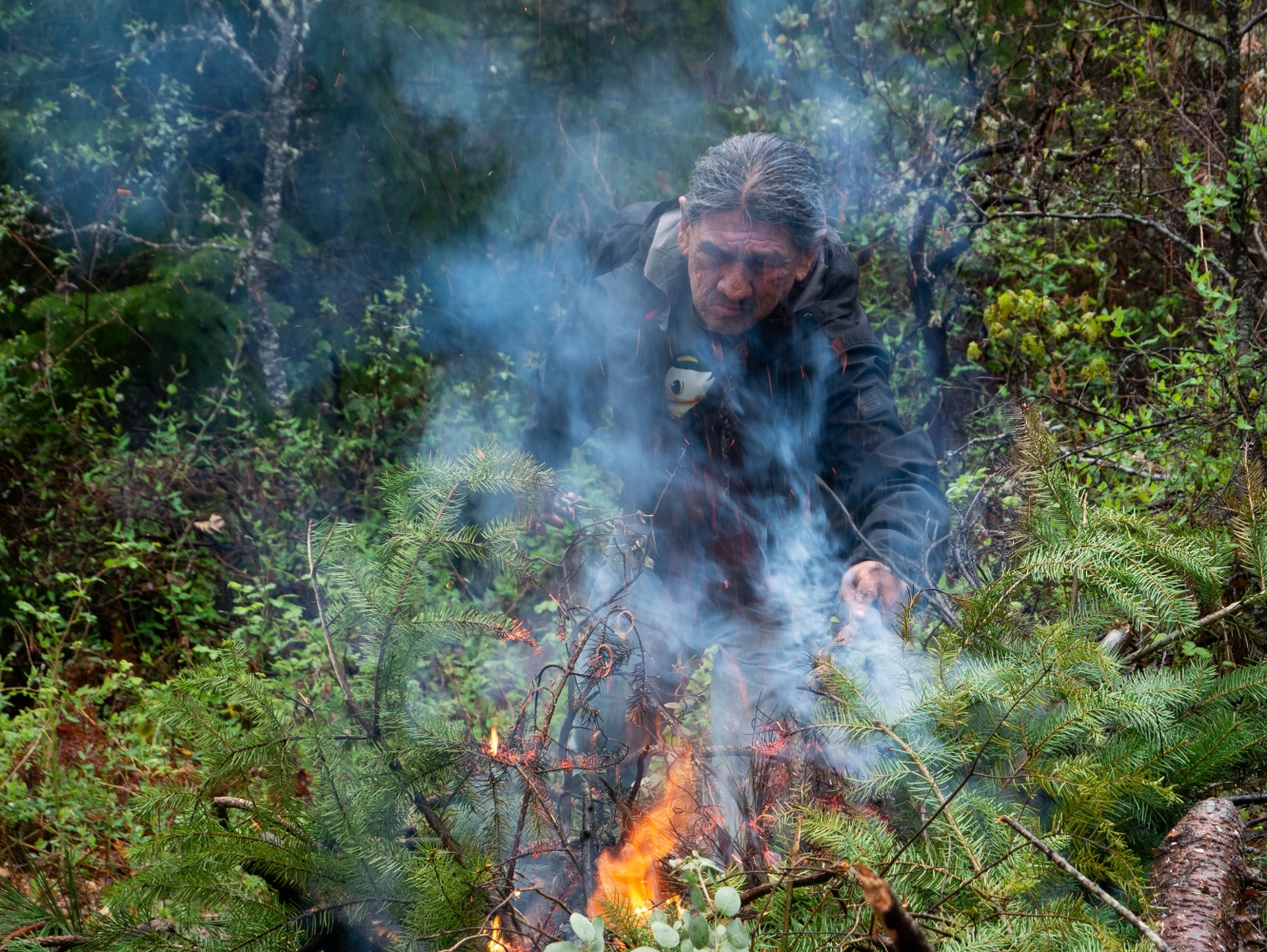
A soft rain fell around Joe Scott as he unwrapped the leather cord fastening halves of a mussel shell. Scott, an elder from the Confederated Tribes of Siletz Indians, packed each half of the shell with stringy willow wood — his insulation. He added chunks of smoldering fungus — his fuel. The small fire stayed lit, even when he closed the shell.
This is how Scott carried fire to a cultural burn ceremony near Selma in Southern Oregon this month. It’s also how, historically, his ancestors carried fire into the mountain forests of the Pacific Northwest.
Scott is part of a growing Indigenous movement to revitalize the knowledge and burning practices that once commonly shaped many Oregon landscapes. Even its wettest ones. Emerging research from Oregon State University is affirming this fire history, one long held among accounts from Indigenous communities.
Scott said he turned to traditional Indigenous history to learn how to reconstruct the shell fire-carriers.
“It’s science, it’s inquiry, it’s recovering ancestral knowledge,” he said. Like his ancestors did, Scott keeps fire — revered as kin — safe in these small packages, no matter the conditions. “This is pretty much what I mean when I’m saying ‘carrying fire.’”

Indigenous peoples of the Pacific Northwest have long used intentional fire for ceremony, and to steward the land, managing everything from food and wildlife to medicines and basket-making materials, according to Indigenous experts and researchers with the U.S. Forest Service. Glenn Jones, a Hoopa Valley tribal member, grew up in this tradition of low-severity, cultural burning in Northwestern California.
Now, as an OSU College of Forestry master’s student, Jones’ research suggests that historically, fire passed through the Coast Range’s damp forests much more frequently than previously thought. His study shows some areas burning as often as every 10 or 20 years, others every few centuries.
“We’re seeing a ton of fire,” Jones said.
His findings contrast with the prevailing notion among some fire ecologists, conservationists and media reports that hotter burning fire typically consumes these temperate rainforests once every 200 to 300 years or so.
“My research is really poking holes in that whole narrative,” said Jones, a cultural fire practitioner.

Jones analyzed fire scars in Douglas fir and western hemlock forests, south of the town of Alsea, where annual precipitation ranges from 60 to 80 inches. The project’s 13 research sites collectively covered more than 10,000 acres.
The fire scars tell a story, Jones said, one that parallels the history of the land’s Indigenous peoples, including ancestors of the Confederated Tribes of Coos, Lower Umpqua, and Siuslaw Indians, the Confederated Tribes of the Siletz Indians, and the Confederated Tribes of Grand Ronde.
More than a century ago, colonization, removal from the land and fire suppression disrupted their traditional burning.
Jones’ data indicates mixed severity fires blossomed on the central Coast Range’s eastern slopes in the 1600s. As European settlers, and diseases, arrived, Indigenous populations shrank; fire quieted in the early 1700s. By the 1850s, it declined significantly, just as tribes were removed from their lands onto reservations.
Then came 1910. Massive wildfires in the West spurred state and federal policies of fire suppression and more criminalization of Indigenous burning.
In the Coast Range?
“It’s just no fire after that,” said Jones.

He sees human fingerprints on these fire diversity patterns. He plans to submit his research for publication with his master’s thesis later this year. He’s been presenting his findings to tribal communities over the last year.
“It’s awesome that he’s doing that work, and at the same time, it’s almost kind of sad that we have to do that type of work,” said Jesse Beers, CTCLUSI member and tribal cultural stewardship manager.
Elders, oral histories, and ethnographies from the Coos, Lower Umpqua, and Siuslaw Tribes have long shown cultural fire’s presence in the Coast Range, even after the practice stopped.
He said the tribes’ ancestors would use fire to steward key foods in mountain meadows, drive elk herds, and manage brush. Eventually, the tribes plan to carefully reintroduce cultural burning, Beers said, “meeting the landscape where it lives today, but slowly improving upon it.”
CTCLUSI Director of Culture and Natural Resources and Tribal Council Member Ashley Russell hopes Jones’ research can help shift the scientific and management paradigm around fire’s role in these forests. His work reveals “that what the Western science is showing just validates Indigenous knowledge related to cultural fire,” she said.

In 2024, Oregon enacted a law to reduce some of the legal barriers to prescribed and cultural fires, with the launch of the pilot Prescribed Fire Liability Program. It offers cultural fire practitioners enrolled in the program some protection against legal claims in case a cultural burn were to escape and cause damage.
While Jones finds stories of fire in old trees, Siletz elder Scott finds fire in old stories. The shell fire-carrier came from the Grande Ronde’s Book of Fire, a collection of traditional and contemporary stories about fire. Scott also serves as a tribal advisor to OSU’s Tree Ring Lab.
The lab helped establish methods for proving up fire history in rainforests, and it supports Jones’ project.
Seeing where long-ago fires once touched a tree cross-section connects Scott to the fire work he does today.
“That fire scar has been grown over and embraced by time,” he said. “It’s like this visible truth that people were taking care of the land.”
For him, though, fire doesn’t belong in a lab but out on the land. That’s why Scott shared traditional fire techniques, including some old ones he’s blended with new approaches, with Indigenous youth and adults at the recent cultural fire exchange near Selma. The event, hosted by the Traditional Ecological Inquiry Program, OSU Extension and the Siskiyou Field Institute, aimed to connect those working to rekindle cultural fire in the region.
Scott shared how carved elderberry branches can serve as “pitch stick holders” — think of a long staff holding a pine matchstick naturally infused with resin — and how to launch pitch-covered, flaming pine cones over a wet lawn.
At the close of the soggy weekend, the group of around 30 people gathered next to towering black oaks to put the principles they had learned into practice.

A circle formed around ceremonial flames, with people sharing songs and intentions. Scott took the mussel shell from his pocket and opened it, smoke rising.
“‘Cultural fire is not about the flames, it’s about the community that you celebrate those flames with,’” said Scott, quoting a friend and elder who was unable to attend that weekend due to health reasons.
The event paired young people with experienced adults who guided them through the day’s burn.
For Isik Cushman-White Eyes, 10, it was his second cultural burn. His older brother, Kanim, 12, has been part of six burns. The Chinook Indian Nation boys used Scott’s pitch stick holders and resin-covered pine cones, and after some frustration with trying to burn damp conifer boughs, they found their own ways for keeping piles lit beneath the oaks.
This story was reported by Ashley Braun, a contributor to OPB’s rural freelancer network. OPB is a nonprofit, statewide news organization with a mission to tell stories for communities in all parts of Oregon and Southwest Washington. As part of that goal, we work with partner news organizations and freelance journalists to identify stories like this that might otherwise go untold. If you have an idea for a story, live in an area outside Portland and want to work with us, send your freelance pitches to [email protected].
News Source : https://www.opb.org/article/2026/04/26/indigenous-leaders-carrying-fire/
Other Related News

04/26/2026
North Texas woke up Sunday to destruction after severe overnight storms turned deadly Mult...
04/26/2026
Pakistans top political and military leadership are scrambling to reignite talks between t...
04/26/2026
Steve ODonnell wants to bring some fun back to NASCAR which he calls a badass American spo...
04/26/2026
Before Walter even reached kindergarten his teachers were kicking him out of classI kind o...
04/26/2026
When entertainer Bob Hope serenaded Queen Elizabeth II and Prince Philip at the White Hous...

Follow

Download Our App


Copyright 2022 © EPUERTO. All Rights Reserved