

Published on: 05/10/2026
This news was posted by Oregon Today News


Description

Get the latest on the science of healthy living in the NPR Health newsletter, sent weekly.
When Mel Mann was diagnosed with cancer at 37 years old, he was told he’d have three years to live.
It was January 1995. He was an Army major based in Detroit and thought the back pain he had been experiencing for six months had something to do with working out. But an MRI scan showed there was a problem with his bone marrow. He had an aggressive blood cancer called chronic myeloid leukemia.
“I was shocked because that was the first time I had to face my own mortality,” says Mann.
“Immediately you’re going to think of your family,” he says of the diagnosis. He realized his daughter would be 8 years old when he died. Her time with him looked scarce. “And, you know, I was trying to bargain for more.”
So he volunteered for clinical trials of every experimental new drug he could. Some worked for a few months and then didn’t.
Mann lived longer than doctors expected, but he wasn’t doing well.
“By then, I was like, really tired,” he says. “You know, I’d sleep for eight hours, drink two cups of coffee, wake up and feel like I never went to bed. And I … really lost a lot of weight. So I asked the doctor, were there any more drugs?”
There was one: the drug that became Gleevec.
Mann started taking it in August 1998, as part of a clinical trial. By the next June, he was running a marathon in Anchorage, Alaska. “I did it in a pretty decent time, too,” he says.
Gleevec would eventually become one of the first targeted cancer therapies approved by the Food and Drug Administration, helping to usher in a new era in cancer treatment. But getting there wasn’t so simple.
The setback
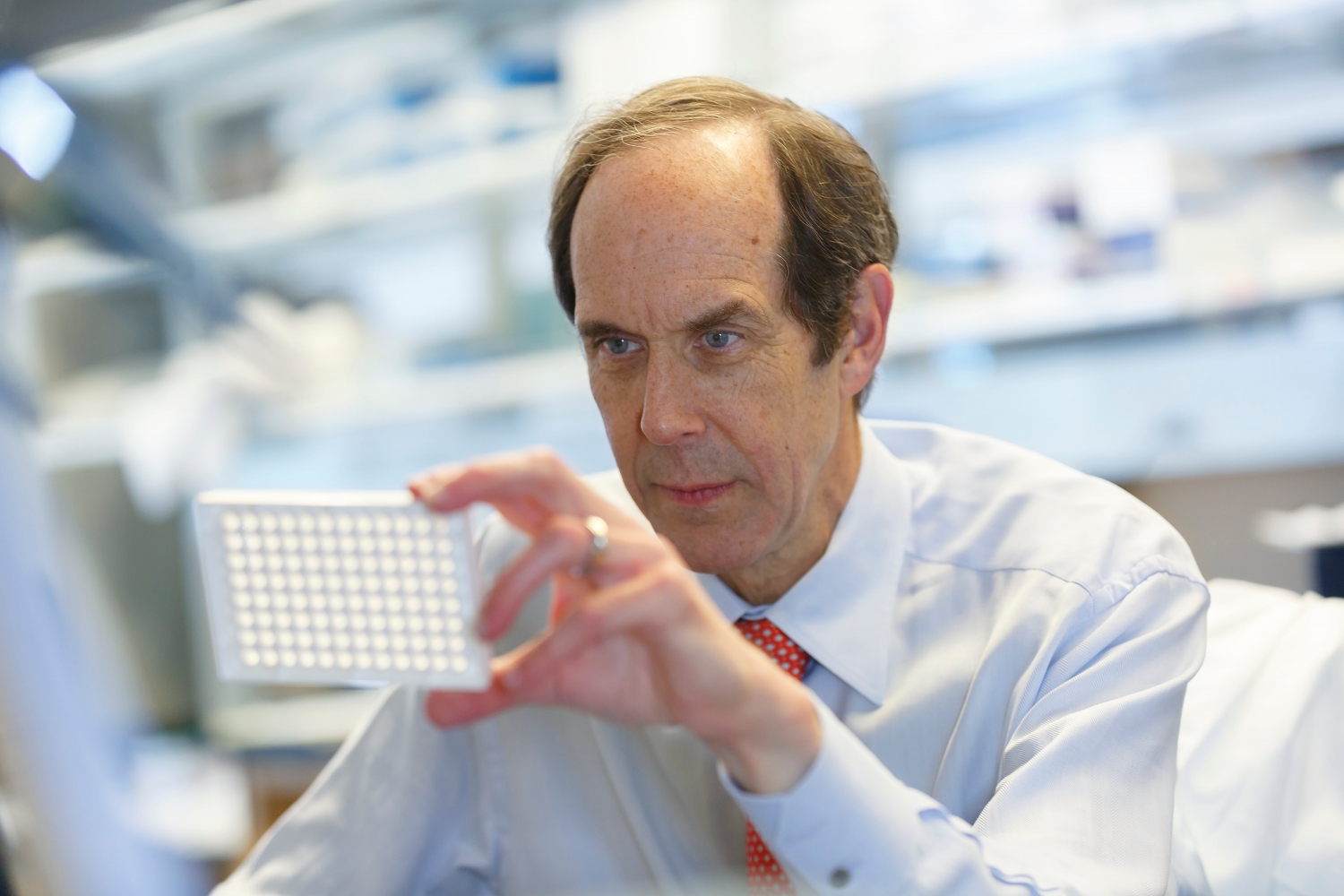
In the 1970s, oncologist Brian Druker had an idea that at the time was pretty new in cancer medicine: What if instead of just trying to kill cancer cells and hoping that healthy cells were mostly spared, you could target the reason that cancer cells were growing out of control in the first place?
“What I saw with chemotherapy is that we were giving patients pretty toxic drugs,” he says. “We didn’t quite know if they’d work. And my view was there had to be a better way. And that better way had to be based on a knowledge of what was driving the growth of a specific cancer.”
There was an appealing target. Chronic myeloid leukemia was one of the first cancers to be linked to a genetic abnormality: Philadelphia chromosome.
Scientists knew that people with this chromosome produced an abnormal enzyme that regulates one of the on-off switches for cell growth. This one gets stuck in the “on” position, leading to the uncontrolled white blood cell growth of chronic myeloid leukemia.
Druker looked for a drug that would be an off switch for the abnormal enzyme.
“The problem was not a lot of people believed that was going to work,” he says. Oregon Health & Science University was willing to back him, so he left Boston, where he was working at the time, and headed west.
The studies
Within six weeks of arriving in Oregon, Druker was in a lab testing five compounds from the drug company that would become Novartis. One of them was Gleevec — though at the time it wasn’t known by its brand name. It was just called imatinib, a compound discovered by biochemist Nicholas Lydon.
And it worked — at least in the lab. Whether it would succeed in patients was unknown.
“The reality is, I wasn’t just a researcher,” Druker says. “I also had patients and many, many patients who believed in me thought that this was a potential way forward for them. And it allowed me to have enough courage to be their mouthpiece and voice to lobby, to get this drug into clinical trials.”
When they began, the clinical trials were distinctive because they only included patients with this specific kind of leukemia.
Within six months, every patient in a clinical trial who took a high dose of the experimental drug responded to the treatment. And the side effects were generally mild. It was unheard of.
And because this was 1999, it was also the early days of blogging and internet chatrooms. Patients were talking to each other.
“So all of a sudden I was getting contacted by patients from around the world who wanted to enroll in this clinical trial,” he says.
Everyone involved knew they had to scale up testing and get the drug application to regulators. Fast.
The approval
The next step would be for the drug company to take this drug to the FDA for approval. But to do that, the company had to gather the data and prepare a whole package.
That’s where 33-year-old Insa Gathmann comes in. She was right out of school when she got hired at Novartis as a biostatistician.
“It was apparent back then that this is a game changer and that we needed people with energy who could make this drug development even faster in bringing this to authorities as fast as we could,” she says.
She became the statistical lead on the Gleevec project. One of her tasks was to produce charts that showed how long patients were living, so-called survival curves.
“When I was first running them for Gleevec, I was like, OK, I must have done a programming mistake. Something is wrong because the curves were just I mean, they were all doing fantastic and they were all alive. And I’m like, ‘No, no, no, something is wrong. This can’t be right.’”
But she was right. Gleevec was able to switch the abnormal enzyme off, shutting down the cell overgrowth and letting patients’ white blood cell counts return to normal. And the side effects were generally mild.
When Gleevec was approved on May 10, 2001, it was the fastest FDA approval at that time — taking just 72 days.
Druker was at home in Portland, Ore., and remembers the moment: “I felt sort of like I was sending a child off to college and I wanted them to go out in the world and succeed and do great things for the world.”
The significance
Ameet Sarpatwari, an assistant professor of population medicine at Harvard Medical School, says the Gleevec story is an example of the public and private sectors working together at their best to bring forward meaningful medical advancements.
“You can think of it as really ushering in this era that we have now of targeted therapies, targeted cancer, drugs on the market,” Sarpatwari says. “There’s now over 100 targeted cancer drugs on the market, which in many cases have meaningfully improved the overall survival and quality of life.”
However, Gleevec was also considered incredibly expensive when it launched at $26,000 a year. And it got more expensive over time. “So we have this remarkable system to develop drugs, but Gleevec is also reflective of problems we have when it comes to pricing drugs and ensuring access,” he says.
The drug is now generic, costing a few hundred dollars a year, so it’s become much more affordable and accessible.
Druker and other oncologists still prescribe Gleevec. And when patients are diagnosed with chronic myeloid leukemia, he can tell them that they have a strong chance at living a normal life.
He remembers one patient who had leukemia as a child and started taking Gleevec before she turned 10. Eventually, she was able to come off the drug with no recurrence of her cancer. She now has two kids. “Her parents thought that she would never live long enough to graduate from high school, and here she is with us today,” he says.
The epilogue
Biostatistician Gathmann stayed at Novartis and moved up the ranks. She’s about to retire.
“I’m very grateful,” she says. “I’m lucky that I could have been part of this drug development. Not everyone has a chance. I mean, we work on good drugs, but Gleevec, surely. I mean, that was a game changer.”
As for Mel Mann, the dad given three years to live in 1995 is 69 years old. He got to watch his daughter grow up. He even went back to school and got a second bachelor’s degree. He wants to run the Boston Marathon next year.
“I’m just thankful for the physicians I know had to burn a lot of midnight oil to make it happen,” he says. “And the researchers and people who were involved in the whole process, you know the people at the sites, the people who crunched the numbers and just so many people that I have to be thankful for. And so it means a lot. You know, I got a second chance at life.”
Druker has watched people given a death sentence actually go on to live normal lives. For him, Gleevec’s 25th anniversary is a milestone.
“It is a remarkable and magic moment of reflection because some of the patients on that phase one, first in human trial are still with me,” he says. “And they’ve seen weddings, births, graduations, grandchildren — all the things that they never thought that they could imagine would happen.”
Correction: A previous version of this story misstated biostatistician Insa Gathmann’s age when she started working on Gleevec. She was 33, not 25.
News Source : https://www.opb.org/article/2026/05/10/how-gleevec-changed-cancer-treatment/
Other Related News

05/10/2026
Yet long after the flowers wilt and the restaurant tabs are paid the real meaning behind M...

05/10/2026
Heavy rain that fell through the end of April reduced drought conditions in southeast Wash...

05/10/2026
The boat named Soulmate was being moved from where it was docked in the Bahamas according ...

05/10/2026
As of Sunday May 10th 2026 Kalshi has extended their promo code OREGONLIVE1 for the second...
05/10/2026
Paper flowers lined the walls and bubbles and classical music flooded into the streets as ...

Follow

Download Our App


Copyright 2022 © EPUERTO. All Rights Reserved