


Published on: 11/07/2026
This news was posted by Oregon Today News


Description
In her studio with sweeping views of Ashland, Kristy Kún stands before a large sheet of felt that she has run through the ringer.
She shapes the starched textile slowly, coaxing curves, hills and valleys into the fabric before building architecture underneath to support it. She transforms the textile into something that hovers between sculpture and landscape.
“I usually get it in one try,” Kún says. “It’s that initial instinct of what the material is saying and how I’m responding.”
“I’m looking for balance. I’m looking for energy.”

Just beyond her studio, her husband, wood sculptor Christian Burchard, begins his morning milking their goats while singing deep Tuvan throat songs.
“I think they love it,” he says of the singing. “It’s good vibration into their bodies.”
He tends to the goats and makes cheese before he enters his studio.
Kristy Kún
Kún spent 13 years building furniture before she began making and sculpting felt, one of the world’s oldest textiles.
The process is grueling, involving multiple steps and serious muscle. She blames herself because she innovated many of the techniques that she’s since taught around the world.
She designs her compositions by studying dead insects that are found around her studio. She then chooses colored wool fibers, inspired by the setting outside her studio window. She layers the colored wool and machine felts them together before she slices the panel into narrow strips. Afterward, she connects the strips to another sheet of fabric by hand.
It takes five to seven days to hand felt the narrow strips into a single piece again.
The physical demands are considerable. Large pieces of felt are rolled into heavy bundles and then rolled like a log repeatedly with her arms.
She then unrolls the felt and lowers it into a tub and beats the fabric in the hot, soapy water.
“When I’m working with a piece this way,” she says, “I come out renewed. I come out feeling stronger,” she said.
“I’m interested in how something becomes better or stronger under stress.”
Afterward, she takes the textile to the floor and repeatedly grinds it down with a plate compactor. The compactor is a machine that is normally used to compress loose materials like asphalt, soil, or gravel.
She’ll repeat all the steps multiple times until the individual wool fibers lock together into an almost indestructible fabric.

That conversation between maker and material continues until the final shaping, when the sculpture seems to reveal its own direction.
“I just want to trace my fingers in each of the channels that she’s creating to feel the speed,” said art curator Bruce Guenther. “They crawl and then they run and they bend and they come back and they accelerate as they go up the wall across space. It’s a dynamic and exciting place to to be visually.”
“I think Kún stands out as an artist in the fiber world by both the dedication and the scale of her work.”
“It’s beyond her reach. You wonder how did that happen because it’s bigger than any frame that an artist could lift, said Guenther.
Kún’s abstract work sometimes draws people deep into memories. One woman stood before a felt sculpture and suddenly recognized the stream behind the childhood home. She burst into tears.
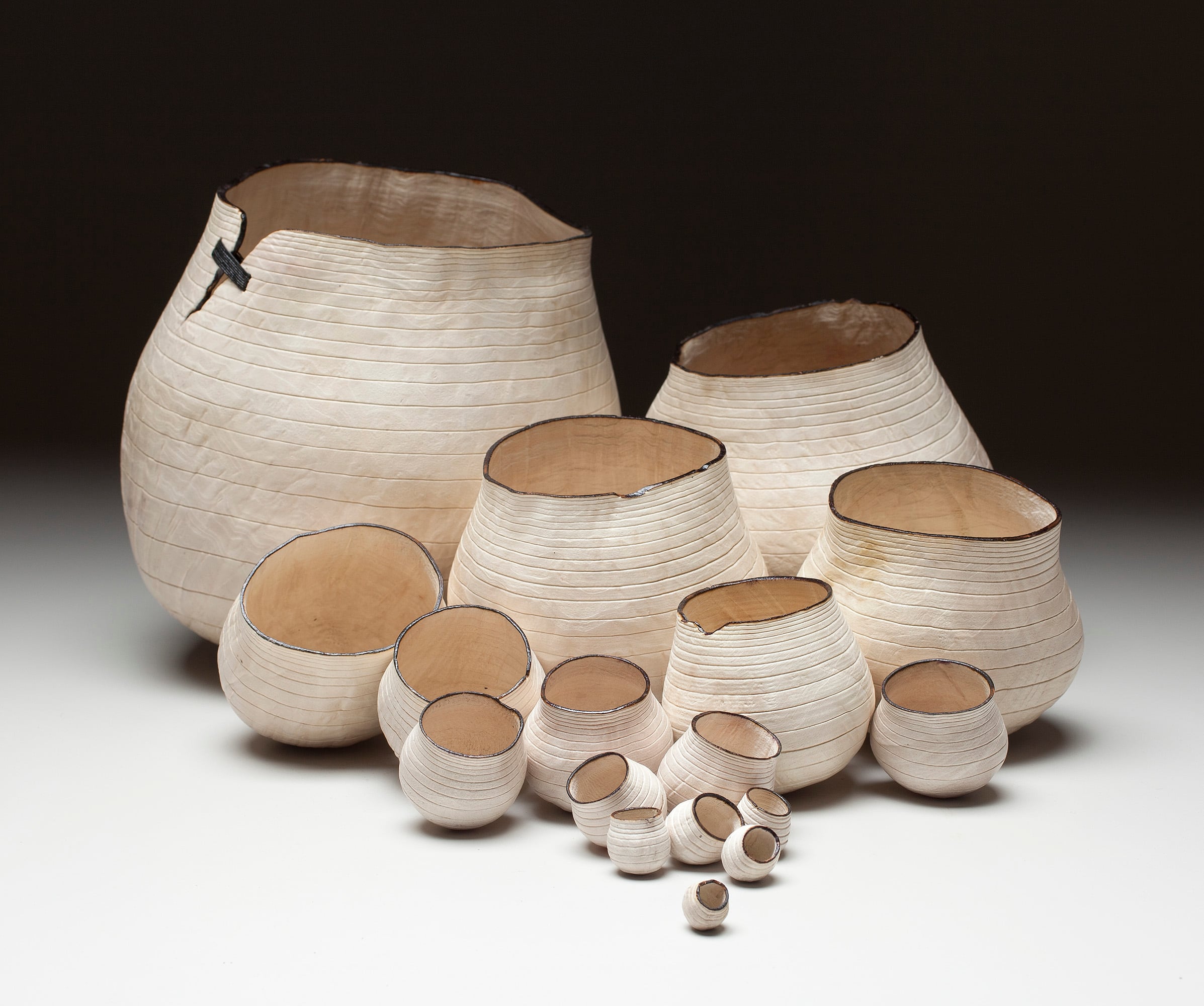
Christian Burchard
Raised in Hamburg, Germany, Burchard left behind generations of family expectations to become a woodworker. He decided to pursue timber framing and furniture making because he thought they were skills that made him employable anywhere.
He has an adventurous backstory: He has been a cowboy in Australia and he learned throat singing in Siberia.
He settled down in Ashland, where his ex-wife’s parents had bought some land.
A little bored with the predictability of furniture making, he now focuses most of his energy on wood sculpting.
“I love unpredictability,” said Burchard.

He turns green madrone bowls so thin that light passes through their walls.
“You have to go to an edge. If you go safe,” he said, “you make work that looks safe.”
“Failure is your biggest teacher.”
The risk is real. Hours of careful turning can disappear in an instant if a bowl explodes on the lathe.
“If it doesn’t blow up, there’s a satisfaction. There’s a pride,” he said.
He is particularly passionate about his books project.
In October, his sculpture Never Again won the Visitors’ Choice Award at Homo Faber, a prestigious international craft exhibition in Venice, Italy. The sculpture looks like a pile of strewn books. It is a response to book burnings and book bans and a reminder of what happens when stories, poems and history are erased.
He creates the wavy, delicate book pages in his book sculptures by heating green madrone in microwave ovens that he finds on the side of the road. The microwave heats the wood from within and pushes the water out of the wood, he said. After a couple of days of drying and a few more rides in the microwave, the structure of the wood relaxes and the pages open “like a flower.”

Partners in art and life
Both Burchard and Kún have exhibited work and garnered commissions internationally.
When the two collaborate, the combination of wool and wood is stunning.
“The felt comes out into space and they’ve lifted up and across in a physical way that gives them almost an amoebic freedom, said Guenther.
The two artists critique each other’s work often, but Burchard emphasizes that it is essential to be careful.
“There is a sensitivity,” Kún admits. “I can be easily crushed.”
Burchard says Kún’s feedback has prevented a few disasters.
“Working together with your partner,” Burchard says, “is like another set of eyes.”
A lot of their important discussions happen at the end of the day, when both artists emerge from their studios and come together to enjoy wine, Burchard’s homemade goats cheese and their expansive view of Ashland. As the sky turns lavender and the turkey vultures float above, they are filled with new inspiration for the next day of making art.

News Source : https://www.opb.org/article/2026/11/07/ashland-wood-wool-artists/
Other Related News
11/07/2026
Philip Rivers the former NFL and NC State star saw his high school teams playoff run end o...
11/07/2026
Dear Miss Manners I am having the family Thanksgiving dinner for my sons my sisters and th...
11/07/2026
The Oregon State Beavers and Texas State Bobcats face off tonight at Reser Stadium
11/07/2026
From ice cream to cereal Reeses makes plenty of snacks based on the unique flavor of its i...
11/07/2026
Dear Mayo Clinic My husband has been diagnosed with atrial fibrillation Weve heard this co...

Follow

Download Our App


Copyright 2022 © EPUERTO. All Rights Reserved