

Published on: 09/30/2026
This news was posted by Oregon Today News


Description
Beginning about 14,000 years ago, a wave of humans crossed into the Americas via a land bridge running from modern-day Russia to Alaska.
Although it’s likely these early migrants weren’t the first to arrive, archaeological evidence suggests these so-called Clovis people spread rapidly — within a few hundred years — across North America and eventually down into South America.
One of the biggest questions we have about these people is, “What did they eat?”
Now a research team that includes an archaeologist in the Pacific Northwest has a new answer.
What we know about early humans in the Americas comes from a scattering of archeological sites across the continents, including the East Wenatchee site in Washington. The sites often contain stone tools, animal bones and the occasional human remains.
Interpreting those sites to answer the what’s-for-dinner question has prompted rich scientific debate.
Some researchers argue the Clovis were generalists, eating animals of varying sizes as well as plants, birds and fish.
The analysis published by a joint team from Washington, Alaska, Wyoming and Argentina directly counters that generalist theory. The researchers say these early Americans were actually dietary specialists, almost exclusively eating large megafauna like mammoths and giant sloths.
They looked at data from 50 archeological sites in North and South America from three general population groups or complexes — East Beringia, Clovis and Fishtail Projectile Point peoples (in South America). They analyzed the preponderance of food items found at the different sites, concluding that up to 99% of their diets came from big herbivores, most larger than 2,000 pounds.
Based on this conclusion, the researchers also suggest an answer to another big mystery about these early human settlers: how and why were they able to spread across the continents so quickly?
“Because of their megaherbivore focus, these populations tracked their preferred prey into additional regional ecosystems enabling their rapid dispersal across North and South America. In this manner, Early Paleoindians were dietary specialists but habitat generalists,” they write in the paper published in the journal Science Advances.
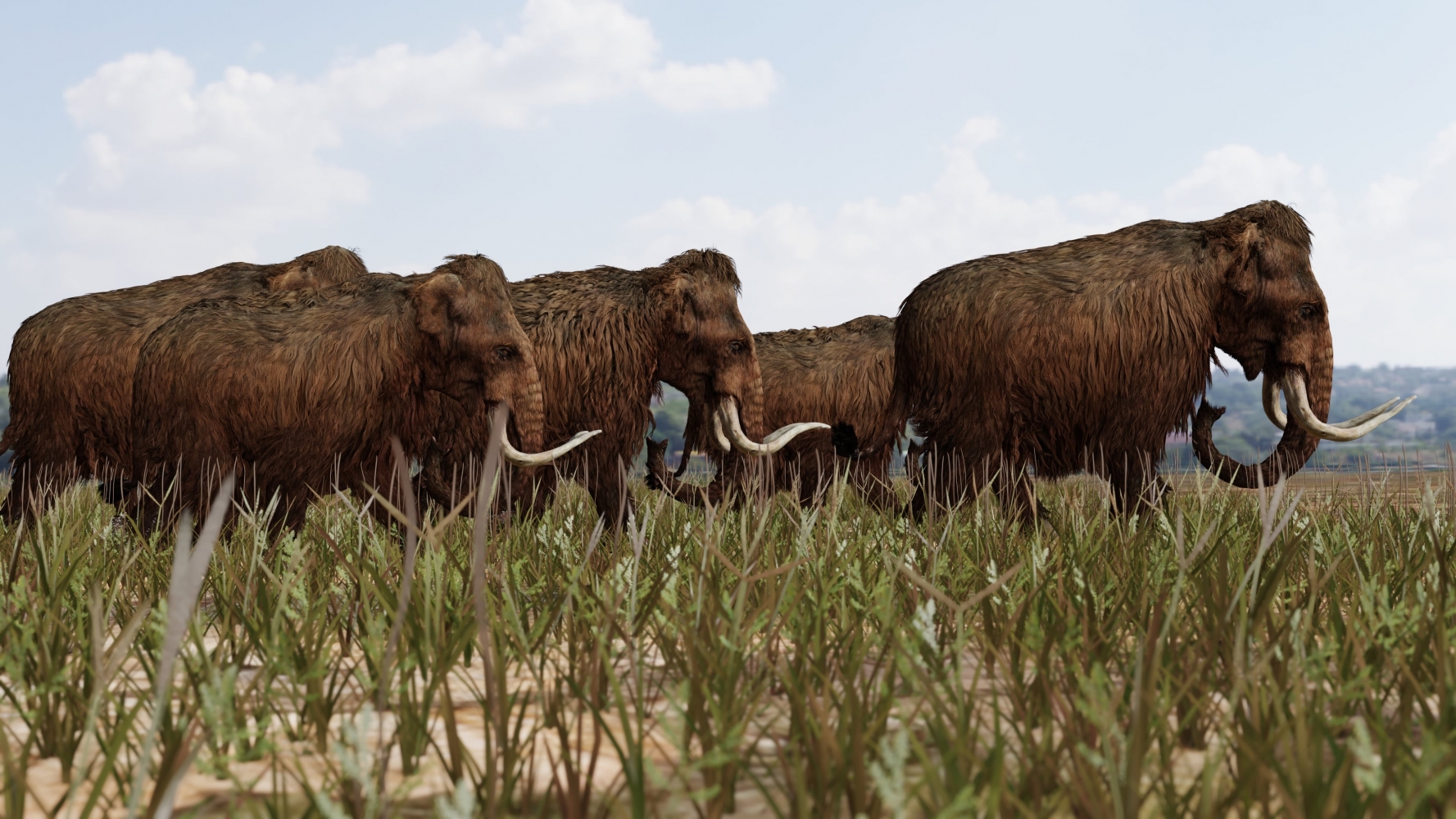
The early Americans first followed woolly mammoths across present-day Alaska and Canada, then encountered the even larger Columbian mammoth a little farther south. Columbian mammoths ranged all the way down into Central America.
The paper says it wasn’t until the large megafauna went extinct around 11,500 to 13,000 years ago that humans started focusing on smaller animals like bison, elk, camels and deer.
The team also concludes the extinction of mammoths and other massive herbivores eventually led to the development of more cultural diversification among the Clovis, as human groups stopped moving around as much and started adapting to their local environments.
In these All Science Snapshots, “All Science. No Fiction.” creator Jes Burns features the most interesting, wondrous and hopeful science coming out of the Pacific Northwest.
Find full episodes of “All Science. No Fiction.” here.
News Source : https://www.opb.org/article/2026/09/30/all-science-no-fiction-mammoth-meat-early-american-migration/
Other Related News

09/30/2026
If you have a hankering for Chick-fil-A on a Sunday and the restaurants are closed you can...
09/30/2026
In the current economy people are looking for deals Not many consumers can afford luxury i...

09/30/2026
The crash happened Wednesday morning at Northeast Front and Norway streets

09/30/2026
The new campus on Northeast Stanton Street will give mentors and children a place to spend...

09/30/2026
Celebrating his 100th birthday Benjamin De Los Angeles reflects on a life dedicated to ser...

Follow

Download Our App


Copyright 2022 © EPUERTO. All Rights Reserved