

Published on: 09/17/2026
This news was posted by Oregon Today News


Description
After a federal court ruled earlier this year that the Bonneville Power Administration must take additional steps to protect fish populations passing dams along the Columbia and Snake rivers, the region’s hydropower giant says it’s preparing for a rate hike that could push up electricity costs by 6% or more for its customers.
Those customers — including consumer-owned utilities like Emerald People’s Utility District in Eugene and Salem Electric — say those increases will ultimately fall on their ratepayers, most of who are already facing high energy bills.
The Bonneville Power Administration announced Thursday it has begun the process that would allow it to raise its rates to make up for a $250 million revenue shortfall.

That shortfall stems from President Donald Trump’s decision, less than six months into his second term, to cancel a historic treaty that sought to address a decades-old lawsuit over fish protections.
The Trump administration’s withdrawal from the agreement reactivated the court case, prompting environmental groups to seek even more spilled water over BPA’s dams.
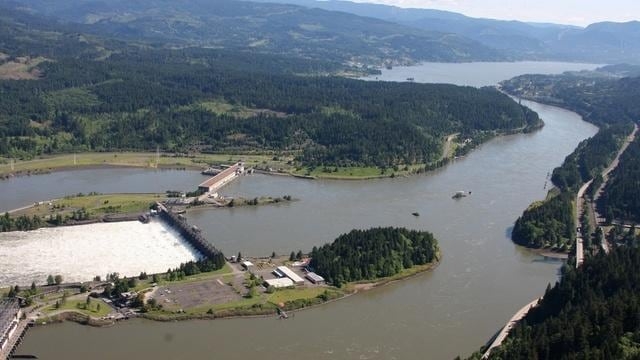
BPA, which owns about 75% of the region’s transmission lines, operates nearly three dozen hydroelectric dams in the Pacific Northwest. It sells electricity generated at those dams at a wholesale price to more than 300 customers throughout Oregon, Washington, Idaho, Montana and parts of California. They include a wide range of consumer-owned utilities, electric cooperatives, and larger for-profit utilities like Portland General Electric.
Dams, power lines and statistics: What the Bonneville Power Administration is and does
In a public filing, BPA said it needs to increase rates after a recent federal court decision in a case filed by the National Wildlife Federation, Oregon and Washington, and several tribes.
In that decision, U.S. District Court Judge Michael Simon ordered Bonneville to send more water over eight Columbia and Snake river dams rather than through power turbines. That, in turn, would help the nearly extinct salmon populations move downstream toward the ocean. But spilling that water also prevents BPA from generating the much-needed electricity the region needs.
That court ruling was also costly for BPA, the hydropower giant said in its filing.
But utilities that rely on its electricity, as well as environmental groups, were quick to criticize BPA’s push to hike its rates.
Earthjustice, an environmental nonprofit involved in the lawsuit, said BPA’s request to increase rates is “premature” and wrongly shifts the blame of the court ordered measures that were needed to protect the salmon populations.
The law group said the federal agency may be able to absorb the costs related to the other, and in turn prevent the proposed increases.
Instead, BPA is pushing those costs onto people who may not be able to afford higher electric bills, said Kyle Roadman, the general manager of Emerald People’s Utility District.
He said BPA’s proposed rate increase will affect Emerald PUD’s customers, “dollar for dollar,” and could add hundreds of dollars a year to the cost of electricity for some households.
“We’ve tried really hard to keep our rates reasonable and not pass along costs where we don’t have to,” Roadman said. “But with BPA being our single largest expense, this is just not something that we can absorb.”
BPA declined OPB’s request for an interview, saying it cannot comment because the rate case proceedings have already begun.
If the rate case moves forward at the expedited schedule it seeks, BPA expects the review to begin on Oct. 5.
A final decision is expected on Dec. 18.
A Trump order reopens salmon negotiations
Since 2001, environmental advocates, tribes and the states of Oregon and Washington have argued that dams on the Columbia and Snake rivers played a central role in endangering multiple salmon populations.
Over the years, judges have ordered federal dam operators to let more water spill through gates in the dams rather than pass through hydropower turbines. The increased spill is intended to help young salmon on their journey out to the ocean.

Environmental groups, states and tribes reached an agreement with the federal government to halt the long-running court case in 2023 in exchange for some new protections for the fish and an unprecedented investment in salmon restoration.
When the Trump administration withdrew from that agreement less than two years later and sent the battle back to the court, environmental groups seized the opportunity to seek further protections — even more spilled water at the dams.
Earlier this year, Judge Simon largely granted that wish when he ordered BPA to release more water downstream over longer periods of time through eight dams, up to 24 hours a day, during salmon migrations. The order also called for the federal entity to operate with smaller reservoirs.
In turn, that would help salmon populations have a better chance at survival reaching the Pacific Ocean, according to the groups that backed the lawsuit against the agency. The order largely restored measures that were already in place before the Trump administration canceled them last year.
A changing climate, data centers and a strained electrical grid
But the cut to hydropower generation comes at a time when the region is grappling with rising energy demands. Hydro is the region’s No. 1 power source and its abundance has historically helped keep energy costs low.
And fossil fuel-driven climate change is worsening hydropower performance as droughts become more frequent, and less snowpack during the winter impacts river water levels.
BPA’s bureaucracy has also slowed efforts to respond to those challenges, with developers of renewable energy projects like wind and solar facing a tedious and slow process.
Power Struggle: What Stalled the Northwest’s Push for Green Energy?
And with power-hungry data centers accounting for about 23% of Oregon’s electricity sales in 2025 according to a report released Thursday, the region’s electric grid is not prepared to meet the rising demand in the next few years.
Data center growth is also making it hard for regional power planners to determine exactly how much the region will need in the future.
But meeting demand is one issue, paying for it is another.
Roadman at Emerald PUD said that’s what worries him — the households and small businesses that will have to pay higher costs if BPA raises its rates, including many that are struggling.
Oregon has more than 30 consumer-owned utilities that serve about 1 million people across the state.

In surveys, the affordability of electricity is a top priority for his customers, Roadman said.
“We’re going to have to pass a good portion of it, if not all of it, through to our customers,” he said.
But Roadman emphasized that BPA’s decision coming from a federal courtroom is not the “place to work this issue out” and there are other ways to come to better decisions for everyone.
“The courtroom is this very blunt instrument where you have a judge telling the federal operators of the system how to run a hydroelectric system, and that just is not the way it should be done,” he said. “ It raises costs for everybody and you get these types of very dramatic outcomes where all of a sudden our costs are gonna go up 6%.”
News Source : https://www.opb.org/article/2026/09/17/bonneville-power-administration-asks-to-hike-its-electricity-rates-by-63/
Other Related News

09/17/2026
The Jerify Magnetic Humanoid Toy Sets have magnets that can detach and be ingested the CPS...
09/17/2026
Members of the Washington County board urged Chair Kathryn Harrington to resign or face ce...
09/17/2026
An Oregon-led coalition of states sued to block the administrations abrupt and confused ad...
09/17/2026
Prosecutors say an SUV driver was under the influence of drugs when she swerved into the w...

09/17/2026
On Thursday September 17 2026 Polymarket upgrades promo code OREGON for this weeks NFL and...

Follow

Download Our App


Copyright 2022 © EPUERTO. All Rights Reserved