

Published on: 02/17/2026
This news was posted by Oregon Today News


Description

Anthony Broadman is an attorney in Bend. He’s also an avid hunter and the Oregon state senator for Bend, Sisters, Redmond and most of Deschutes County.
“If it was during bird season, I could take you to a couple of corners that I … might consider corner crossing next chukar season,” he said.
Chukars are fast-flying partridges found in steep, rocky terrain. And corner crossing is unique to the American West, where land ownership was long ago divided into a checkerboard pattern.
Some squares are private and some are public. But the pattern means reaching adjacent public lands can be difficult without trespassing on private property — a gray area that has dogged hunters, hikers, anglers, birdwatchers and other outdoor enthusiasts for years.
“As hunters, we’re really clear with following the regulations,” Boardman said. “It’s part of what’s important about being responsible with firearms.”

A new bill in the Oregon Legislature, sponsored by Boardman, would address these challenges by blocking a landowner from pursuing trespassing charges against someone who is trying to “corner cross” from one piece of public land to another.
The law would only apply to those attempting to do so on foot.
Oregon has more than 32 million acres of public lands, and nearly a half-million of them are estimated to be “corner locked” in the checkerboard pattern, meaning it’s hard to get from one public parcel to the next.
The bill, which is supported by public lands advocates and the Oregon Hunters Association, has faced significant opposition from landowners and ranchers.
A history of expansion
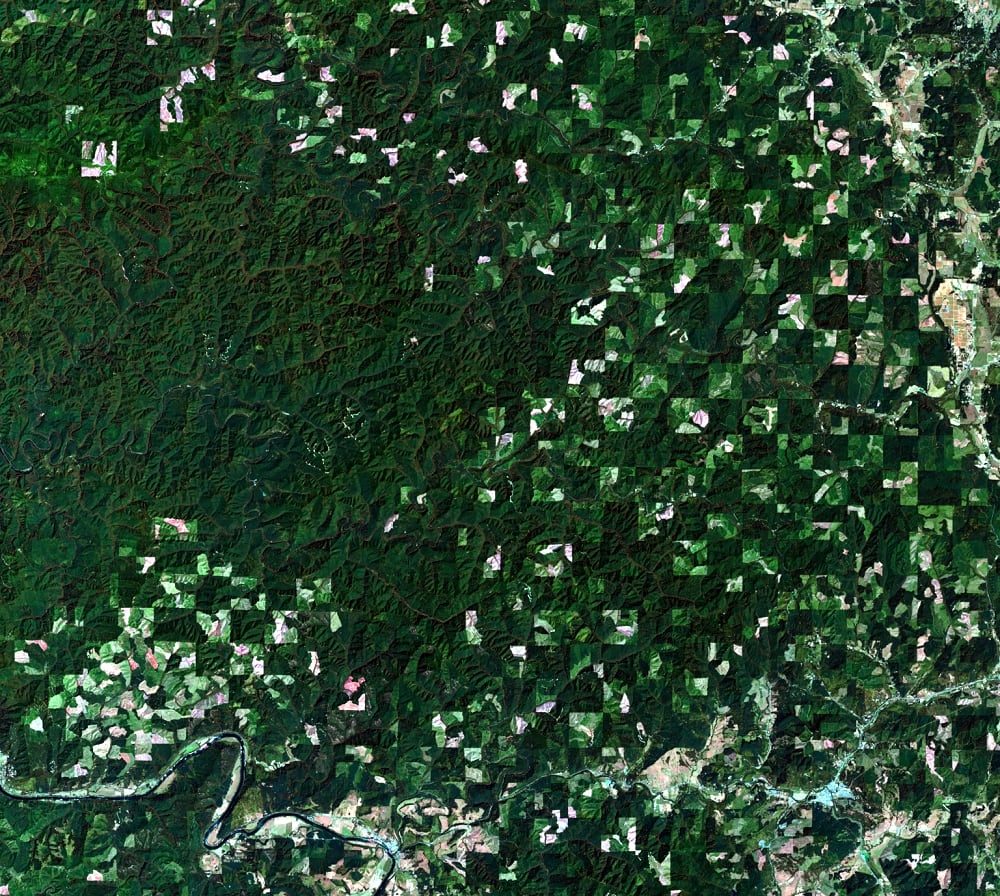
The checked pattern is a result of Congress’s desire in the 1800s to spread west. The nation didn’t have the money for expansion, so instead it granted swaths of land to railroads that pushed westward. But the worry was that railroads would monopolize the land, so Congress came up with the checkerboard pattern, with each square measuring 1 square mile.
The pattern was meant to ensure that land use would be mixed. Picture a checkerboard with the black squares being given to the railroad and the white squares remaining with the federal government to be used for things like homesteading, the National Forest or the Bureau of Land Management. Railroads have since sold and transferred a lot of their land to private timber companies, ranchers and developers.
The land grants did not work well for the tribes who already lived there. But it was a win-win for the railroads and the federal government, as land became accessible by rail and its value increased.
The checkerboard patterns are still visible from the windows of an airplane, where different land uses are evident in different squares.
“We are deeply entrenched in our public lands,” Boardman said. “It’s part of who we are as Oregonians. But in order to access those public lands, there needs to be clarity about ensuring that we can.”
Opposition from landowners and ranchers
Landowners say the technology for pinpointing corners is not accurate. While a local county ownership map might say one thing, a ground marker might say another thing, perhaps because it’s been moved. And even a GPS app is only accurate to within about 15 or 20 feet.
That’s a large area when trying to pinpoint an exact spot where someone’s allowed to step; it’s not possible to drive even an ATV over one of these corners without the wheels touching private property.
Jake Seavert with the Oregon Cattlemen’s Association said the bill would create problems for ranchers. He feels the bill is unnecessary because people who want to be on the land should just ask permission.
“Put your phone down and have a conversation face-to-face with the locals,” he told the Senate Judiciary Committee last week.
He even has a suggestion for how people can secure leverage during access negotiations: offer to do some fence work.
“Fence repair, every year due to the wildlife, is a great way to gain access,” he said.
Seavert said if the bill passes, some people will purposely trespass, knowing that the apps are often wrong. And he said that will cause problems with litter and land degradation due to excessive use.
The current legislative session in Oregon is a short one, about 35 days, compared to a 160-day regular session. Landowners say that simply doesn’t give people enough time to discuss and understand the issue.
Testing the trespassing laws

Corner crossing has long been a legal gray area for outdoor enthusiasts who worried they might get charged with trespassing. So in 2020, four hunters decided to test the law in Wyoming.
They accessed public land by corner crossing. They avoided stepping on private land by using GPS, and they used an aluminum ladder to cross at the exact spots where the squares met.
It was a bold move. They ended up being charged with criminal trespass. An adjacent landowner sought millions in civil damages, arguing the hunters had violated his air rights, or his ownership rights above the actual land.
The 10th Circuit Court of Appeals in Denver, CO, ultimately ruled that corner crossing is allowed, as long as private land is not physically touched.
But the ruling only applies in states within that appeals court’s jurisdiction: Colorado, Kansas, New Mexico, Oklahoma, Utah, and Wyoming. It doesn’t apply in Oregon. That’s why Broadman helped introduce Senate Bill 1545 this session.
“Protecting the public lands and protecting access and ensuring access to public lands is really important,” Broadman said. “And I’m optimistic there’s a lot of support.”
The Oregon Hunters Association has been lobbying for the bill. Its executive director, Todd Adkins, conceded that accuracy can be an issue. But he said the law first needs to affirm that the public has access to public land.
“This will actually allow us to identify those corner crossings that are problematic from the technology standpoint,” Adkins said. “But first, we have to get the legal theory in statute. Where, if I am in fact crossing from public to public, whether I’m a birder, a hunter, an angler, anybody else, I am good to go.”
Kristin Kovalik, the director of Oregon’s Trust for Public Lands, said she believes people should be able to access public lands, but that access should be grounded in respect for private property.
“Clear laws help reduce conflict, protect landowners from risk, and support responsible use and stewardship of public lands,” she said in a statement to OPB.
SB 1545 has been designated as a public emergency, meaning if it passes, it becomes law immediately upon Gov. Tina Kotek’s signature.
News Source : https://www.opb.org/article/2026/02/17/corner-crossing-oregon-public-private-land-trespassing/
Other Related News

02/17/2026
The Trump administration is undertaking the biggest overhaul of the Federal Emergency Mana...
02/17/2026
A few weeks ago a police officer made a routine traffic stop in Upland California just out...
02/17/2026
Subscribe to OPBs First Look to receive Northwest news in your inbox six days a weekGood m...
02/17/2026
Officials say 77-year-old William Stevenson remains in custody on 2 million bail
02/17/2026
It was an unusually tense exchange at the Cortina Curling Olympic Stadium on Friday Canadi...

Follow

Download Our App


Copyright 2022 © EPUERTO. All Rights Reserved