

Published on: 09/04/2026
This news was posted by Oregon Today News


Description

Paytyn Loyd arrived at the University of Portland late last month with a full support team. Her mom, dad, brother and both sets of grandparents were all there to help her start the next chapter of her life.
“It’s a little bit less nerve-wracking now,” the freshman said, placing two Golden State Warriors pillows on her lifted, twin-sized dorm bed. “I was here for orientation, and I had fun, and now it’s kind of, like, reminding me, I guess, of how fun that was.”
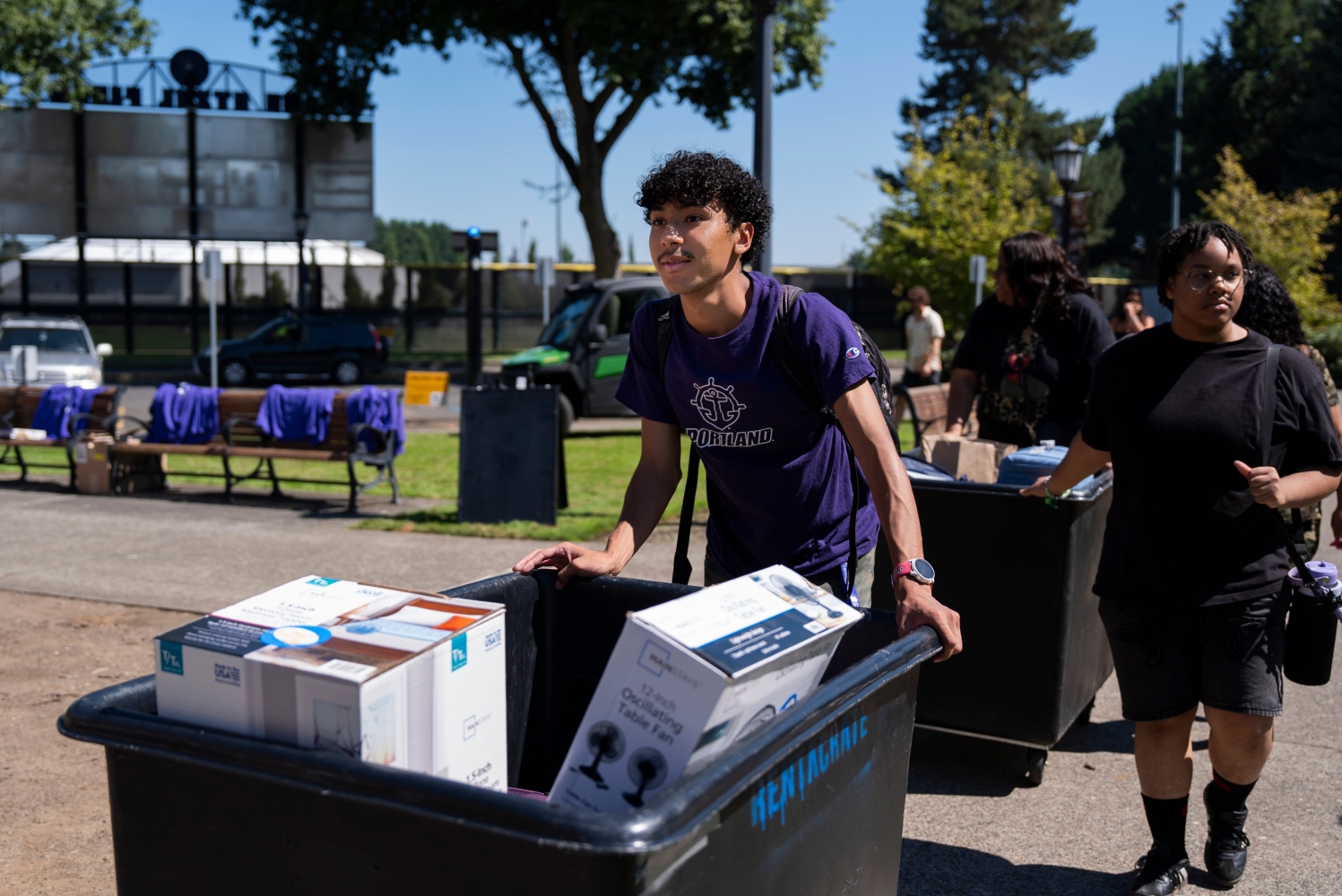
Paytyn and her family drove from their home north of Seattle for move-in day. Like many other families that morning, they stood in a line that wrapped through the lobby and outside her residential hall before they could load an industrial laundry bin full of belongings into an elevator.
Paytyn said she looked for inspiration on Instagram in preparation for the day. Her mom, Tania Loyd, added that there was “lots of Amazon shopping.”
“Today was more emotional,” Nick Loyd, Paytyn’s dad, said of the week. “Driving away from the house, that was a big deal. I think for Paytyn, especially leaving the house was like, ‘Whoa.’”

Paytyn is one of about 800 first-year and transfer students joining the University of Portland this fall term. The private Catholic school in North Portland enrolls about 2,800 undergraduates in total.
Oregon’s higher education institutions serve hundreds of thousands of students across public and private universities, community colleges and career and trade schools. The private colleges, like UP, kicked off this year’s back-to-school season in August.
University of Portland President Robert Kelly said move-in day feels kind of like Christmas morning, filled with “lots of hope and potential and promise.”
But in recent years, college and university leaders — throughout Oregon and nationwide — have not been feeling celebratory. They’ve reported dwindling budgets and declining enrollments, driven in part by decreasing birth rates and fewer international students. Public perception of whether college is worth it has shifted, too.
Still, research shows there are many economic benefits of college degrees, both for individual earners and society at large, despite rising costs to attend these schools. Research also shows personal benefits for graduates, including higher overall health and happiness. Colleges can open doors to better job prospects and professional contacts that young people might not get otherwise.

But beyond all this, colleges and universities can serve as a key developmental gateway for young adults — the chance to live away from family, surrounded by new people, in a supportive environment.
With students moving in around him, Kelly said he hopes students “squeeze the sponge dry” of every opportunity they have available to them before diving full-on into adulthood. He wants them to know they have a four-year safety net to try, make mistakes, and try again.
“Everyone wants their young children, their young adults to have a life of fulfillment, meaning and purpose,” he said. “And schools that are doing that are actually making a difference in the world.”
The social ‘framily’ of college
As Paytyn and her family unpacked her belongings, her roommate, Grace James, and her parents arrived and squeezed into the small dorm.
Paytyn’s grandfather Frank Loyd stressed that the college experience is important for a number of reasons — including what campus life teaches you.
“College attendance is dropping because people can do so much online,” he said. “But what you don’t get online is the personal connections with a new roommate across the room from you, and the social interaction of being in a classroom with other students, and picking the professors’ brains and each other’s brains.”
Grace is from neighboring West Linn. She’s been focused on college for at least a few years, knowing she wants to be a nurse.

“I’m a little nervous,” she said on move-in day, “but I’m also really excited to, like, get to know everyone and get to know my roommate better and just, like, see what adventures await.”
Grace’s dad, Kevin James, said they plan to see each other for dinner and hangouts on Tuesday nights each week. But Kevin sees the value of Grace building new relationships, too, noting he’s still close with people he met in college.
“We call it our ‘framily group,’” he said. “I hope that she can have a similar experience with meeting people here, and those relationships carry on for the rest of her life.”
Paytyn knew she wanted to go to a smaller college, where she would know her peers and professors and wouldn’t get lost in big lecture classes.

She has big plans for college. She’s got a music scholarship, so that’ll be her major, but she also wants to study business and play intramural sports. She’s joined an outdoor group, and by move-in day, she was already booked for kayaking and paddleboarding trips.
Her family described Paytyn as introverted, fiercely loyal, funny and “brilliant.” She’s also aware that college will help her grow up.
“I just need to be more comfortable, like, being independent and making my own decisions, I guess,” Paytyn said. College and living in the dorms, she said, will “be good practice for that — I hope.”
Portland-area students opt to live on campus
Lucy Lunceford is moving in a few doors down the hall, and like Grace, is also studying nursing. Her family lives about a mile away.
Apart from tuition, room and board can be the highest cost families pay for a student’s college experience. UP freshmen can pay as much as $5,750 per semester to live on campus. But despite the extra cost, both Grace and Lucy wanted the dorm experience.

“I’m not really a super talkative person, and I thought that being in the dorms would help me meet people better,” Lucy said.
President Kelly said students not from the area are required to live on campus for the first two years, and he noted that many of UP’s juniors and seniors choose to stay on campus in apartments and townhomes.
UP research shows these students are more likely to return to college the following year and succeed academically; other national research shows that as well, though the increase is modest. In general, there’s a consensus that living on campus makes it easier to get involved and access university resources.
Lucy’s stepfather, mom and brother all joined for move-in day. Her mom, Amy Walls, described Lucy as “an introverted grandma in an 18-year-old body” for her love of crafts, reading and baking. But since she also studies jujitsu, her stepdad, Mark Walls, amended that she’s “an 18-year-old grandma that can also tackle you.”
Mark and Amy both want Lucy to find something she loves for her career — not just a job. Currently, Lucy’s thinking of focusing her nursing degree on pediatrics or pediatric oncology. But even more than that, her parents want her to have a real life, to “finish becoming a grown-up” and “do good stuff.”
‘Making your own path’ as a first-gen student
Alexander Herrera-Hernandez also grew up in the Portland area; his family is about a 40-minute drive away. But he didn’t want to commute to campus out of fear of missing out.
“I was like, ‘No, I actually want to live that university dorm life,’” he recalled telling his family.
Alexander was part of a jump-start program that allowed him to move in sooner. He said it felt a little overwhelming and even lonely at first, but talking to his residential advisor, or RA, helped on that first night. So when the rest of the new students showed up, Alexander felt ready, carrying a bag of groceries back to his dorm as his roommate arrived.
“As a first-gen, you’re like the first one in the family, so you really don’t have anyone to guide you,” he said. “You’re the one making your own path.”
Alexander is among many students in his class and across the university who are the first in their families to attend college. In fact, more than half — 52% — of UP’s incoming freshmen are too.
The percentage of first-gen students in UP’s freshman class has grown in recent years, from 40% in 2024 to 43% last year, according to university staff. Nationally, the organization FirstGenForward estimates that 24% of all undergrads in bachelor-degree programs are first-gen students.
Not only is Charles Sanchez the first in his family to attend college, but he moved from farther away. Two of his aunts and a cousin flew with him from Southern California for UP’s move-in day.

Charles is an athlete who hopes to become a physical therapist. He said he’s not sure what to expect since he hasn’t had anyone to tell him what college is like. It’s an entirely new adventure.
His plans? “Running, studying and hopefully making some new friends.”
His aunts, Navia and Virles Payton, expressed how proud they are of Charles. They said he’s studious and a “beautiful soul.”
“This has been a dream of ours,” Navia said, for Charles to go to college. But she said it was Charles who wanted to move out of state and live in a cooler climate.
Navia and Virles said they want him to accomplish all his goals, but like many families sending their kids off, they’re a little anxious. Still, they’re looking forward to him learning to find his way.
Navia said, “We’re excited for him and always praying for him and making sure that he has what he needs.”
News Source : https://www.opb.org/article/2026/09/04/students-move-in-to-oregon-private-colleges/
Other Related News

09/04/2026
Chrysler is recalling 239131 Ram trucks because of a radio software problem that can cause...
09/04/2026
Former NFL and college football assistant coach Kippy Brown died Monday the Green Bay Pack...
09/04/2026
MANILA Philippines A Philippine court ordered the arrest of Vice President Sara Duterte o...
09/04/2026
Subscribe to OPBs First Look to receive Northwest news in your inbox six days a weekGood m...
09/04/2026
A Portland man pleaded guilty Thursday to randomly attacking a federal security officer th...

Follow

Download Our App


Copyright 2022 © EPUERTO. All Rights Reserved