

For the best experienceDownload the Mobile App
App Store Play Store
An icy reception for Washington Gov. Bob Ferguson’s proposed budget cuts

Published on: 01/21/2026

This news was posted by Oregon Today News

Go To Business Place

Description

Reviews are in for Washington Gov. Bob Ferguson’s debut budget blueprint. They are mostly two thumbs down.

In the course of six hours of public hearings over three days last week, dozens of people criticized the governor’s approach to closing a projected $2.3 billion shortfall.

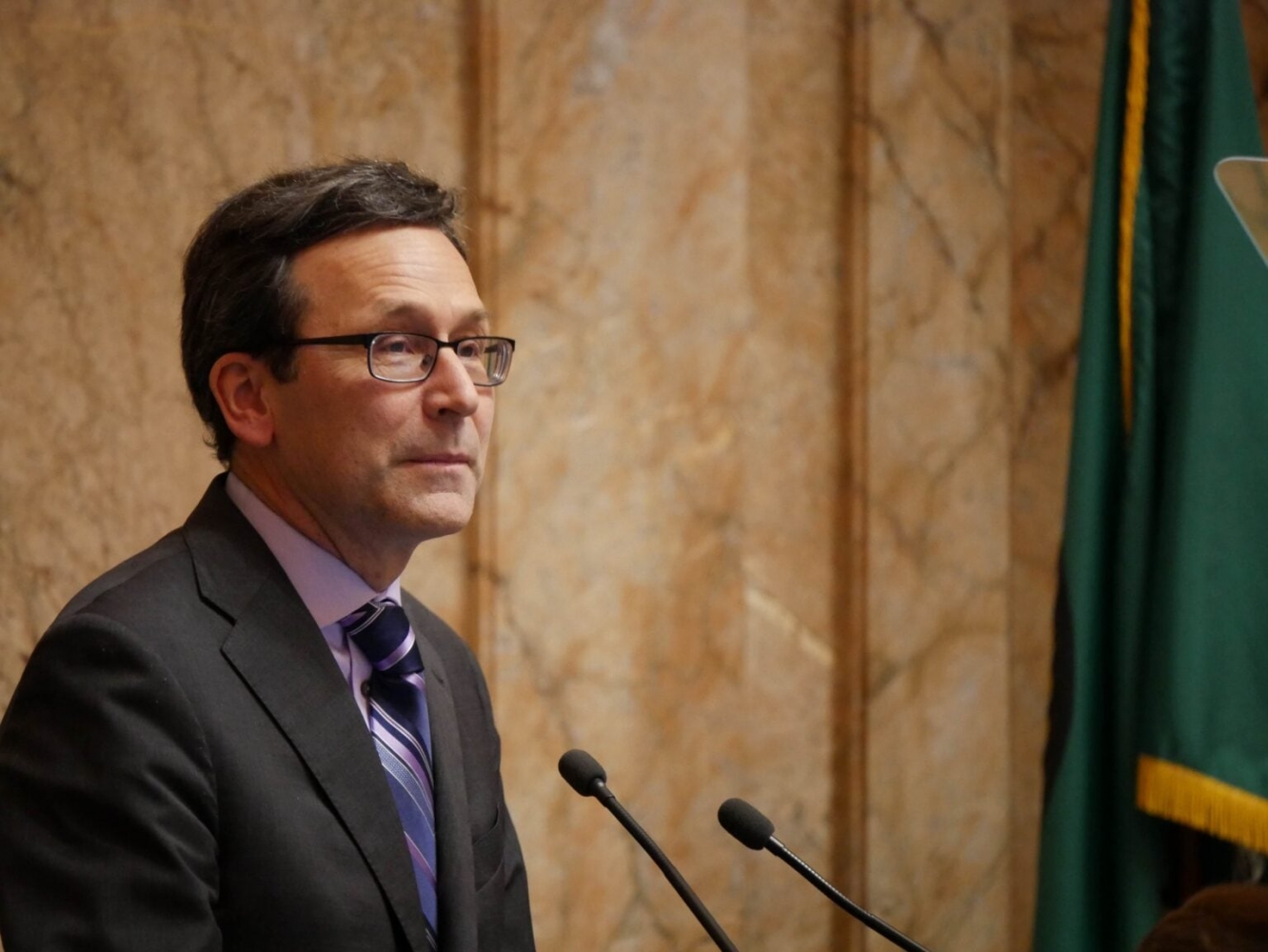
Washington Gov. Bob Ferguson at his State of the State address on Jan. 13, 2026. Ferguson did not discuss the budget cuts he’s proposing in his speech but they’ve stoked plenty of testimony in the first days of the 2026 legislative session.

They booed his push to cap access to a coveted child care program, cut funding for public schools and colleges, and redirect climate dollars away from pollution reduction and toward tax credits for low-income working families.

There was applause for Ferguson’s embrace of an income tax on millionaire-earners. But because it could be years before it might generate revenue, testifiers urged members of the House and Senate budget-writing committees to find ways to raise money sooner.

A recurring theme was the lasting negative effects of further paring public resources after the widespread reductions made last year to plug a budget hole that Ferguson pegged at $16 billion over four years.

Tyler Muench of the Office of the Superintendent of Public Instruction said “significant cuts” proposed to popular programs like Running Start and cancellation of a planned funding boost for rural school districts carry longer-term consequences.

“OSPI cannot continue to absorb cuts and still deliver services that Washingtonians expect and deserve,” he said.

Ferguson’s budget director foresaw the negative response and empathized with lawmakers who are crafting their own spending plans in the House and Senate.

“It’s a very difficult set of budget decisions that we dealt with and that you all will have in front of you as well,” said K.D. Chapman-See, Ferguson’s chief budget writer, in presenting the governor’s proposal at hearings in the House Appropriations and Senate Ways and Means committees.

The big picture

Ferguson, a Democrat in his first term as governor, released his budget proposal Dec. 23. It makes adjustments to the two-year budget he signed in May and that took effect July 1, 2025.

The governor and legislative Democrats balanced the budget with a combination of billions in cuts and more than $9 billion in new and higher taxes.

Since last spring, the state has collected less in taxes than expected while dealing with greater demand for services, rising expenses due to inflation and costly new federal requirements under congressional Republicans’ so-called “Big Beautiful Bill.”

The state is facing another shortfall. This one is $2.3 billion in the current operating budget, which runs through mid-2027. Ferguson proposes to patch it by trimming $800 million in spending, withdrawing $1 billion from the state’s rainy day reserve fund, and using revenues from the state’s auctions of air pollution allowances to shore up other programs.

Chapman-See said tapping into the rainy day fund, formally known as the budget stabilization account, was “a really, really difficult decision” for the governor. It got to the point where they were discussing cuts to critical services that he was not comfortable making, she said.

The reductions he settled on are what drew fire at the hearings.

Tricia Schroeder of SEIU Local 925, center, speaks at a Jan. 19, 2026 rally of early learning and child care professionals who seek better wages and benefits and oppose proposed cuts to programs that could leave families with fewer child care options.

Changes in child care programming account for nearly 40% of the reductions, advocates say.

Ferguson wants to close enrollment to the Working Connections Child Care program that provides lower-income families with subsidies to pay for care. There were 44,333 enrolled as of last February, with an active caseload of 33,465 as of November 2024, the Department of Children, Youth and Families reported in the summer.

The governor wants to halt new sign-ups until the caseload drops to 33,000. It is estimated that this will save $217 million.

He also wants to freeze the level of state funding to child care centers, rather than proceed with a previously approved increase. That is a $41 million cut for providers.

“Child care should never be a discretionary line item as it is the work that makes all the other work possible,” said Alex Galeana, executive director of the Children’s Campaign Fund. “Please reject these reductions and stand by children and families.”

Ferguson’s plan calls for 3% cuts in funding to Washington State University and the University of Washington, and 1.5% for community and technical colleges.

Jacqui Cain, president of the American Federation of Teachers in Washington, said across-the-board cuts would have “immediate consequences. Even modest cuts lead to hiring delays, fewer course offerings, and increased workloads.”

She also called on lawmakers to restore a provision concerning the Workforce Education Investment Account, which derives its money from a tax imposed on very large high-tech firms.

Ferguson and Democratic lawmakers made a change last year to allow the dollars, which will total hundreds of millions in this budget cycle, to be used to supplant spending from the general fund. It is limited to this budget. Absent that revision, those dollars were used to supplement higher education spending.

Not using the dollars as originally intended could lead to hiring freezes, program cuts and less financial aid, critics warned.

Chris Mulick, senior director of state relations for Washington State University, said a proposed 3% cut in the Cougars’ financial hide would be the fifth straight year of reductions.

“Just in the past six months, we’ve cut administration, academic programming, and public service while eliminating several hundred jobs,” he said.

Mulick then delivered uncharacteristically sharp remarks on what he said is a proposed quadrupling of WSU’s premium for the state’s self-insurance liability coverage “without any corresponding increase in claims or payouts.”

To cover the increase, he said, the governor counts on new tuition revenue “that never existed in the first place,” and that had at one point been earmarked for other spending.

“These are the same phantom tuition dollars that were supposed to have partially funded university COLAs but didn’t,” he said, referring to cost-of-living adjustments for employees. “It’s absolute make-believe and it sharply increases our already outlying cut to well beyond 5%. Please don’t do this.”

Some of the strongest criticism came from foes of Ferguson’s desire to redirect $569 million of proceeds from carbon auctions under the Climate Commitment Act into the Working Families Tax Credit program. 

“Our members are outraged at the proposal,” said Robin Everett, deputy director for the Sierra Club’s Beyond Coal Campaign. They recognize the budget challenge and “share the goal of keeping our lowest income folks afloat during difficult times. But we also can’t ignore the climate crisis that is unfolding,” she said.

Use of the money for the tax credits is allowed under the law that created the climate program.

While the idea may be “technically legal, it is profoundly out of step” with the spirit of the law, Everett said. “Gutting this program will set a deeply troubling precedent.”

Not everyone’s unhappy

Those with kudos for Ferguson’s handiwork urged lawmakers to follow his lead.

Dawn Rains, chief executive officer of Treehouse, said a $7 million cut last year forced the nonprofit to end services to 400 students in foster care aimed at helping them graduate high school.

A patchwork of private and one-time funding helped keep the group going. But that approach “is neither sustainable nor equitable,” she said.

The governor’s budget restores $3.5 million, a sum that “would stabilize and expand a proven program” for some of Washington’s most vulnerable students, she said. 

An $8.5 million cut to a program supporting access to abortion-related services was one of the more controversial budget moves last year. Restoring those dollars to the Abortion Access Project is the top priority of Planned Parenthood Alliance Advocates — and it is in the proposed budget. 

The five abortion care agencies in the state supported by the program provided 80% of the total abortions in 2022, according to the Department of Health’s Center for Health Statistics. These clinics are located in 20 out of the 39 counties in Washington state. Planned Parenthood is the largest recipient of funds from the program.

“Without full restoration, patients will likely see reduced services, limited appointment times, higher out-of-pocket costs, fewer management options, and less secure health centers, and even clinic closures,” said Nicole Kern, government relations manager for the alliance.

How much of Ferguson’s proposal survives will become clearer when majority Democrats in the House and Senate release their respective spending blueprints. Those will come out following the next revenue forecast on Feb. 16.

The 60-day session is scheduled to end March 12.

Washington State Standard is part of States Newsroom, a network of news bureaus supported by grants and a coalition of donors as a 501(c)(3) public charity.

This republished story is part of OPB’s broader effort to ensure that everyone in our region has access to quality journalism that informs, entertains and enriches their lives. To learn more, visit opb.org/partnerships.

News Source : https://www.opb.org/article/2026/01/21/washington-governor-bob-ferguson-budget-cuts-icy-reception/

Other Related News

Wrapping it up… By Captain Sean Sanborn It’s funny isn’t it, how fast a year seems to go by. But when one sits and contemplates just how busy the year was it suddenly begins to slow down with perspective. It has been quite a year for your Coos County Sheriff’s Office. There have been successes and failures, ups and downs as is typical with life in general. As we roll into the new year, we celebrate the successes and continue to work on the things which need improvement. I want to introduce to you the fine men and women of my division, the Criminal Division of the Coos County Sheriff’s Office. In 2025, Deputies handled 21,449 calls for service throughout the county. We have handled 3 homicides, one of which is still being investigated, 111 unattended death investigations as well as many other calls for service. We are proud to say that as of October of 2025 we had seen a significant drop in fatal and serious injury crashes in the county. The work of our traffic safety deputy has saved the tax payers nearly $50,000 in guardrail damage alone which is a 77% decrease over 2024, something we can celebrate. Deputy Michael Smith serves in our traffic safety position which is half grant funded and half funded from transportation dollars from the Coos County Public Works Department. Deputy John Owens is our School Resource Deputy at the Coquille School District. John is great with the kids and teaches in his own right. John has taught drivers education to 23 kids over the past year. John was trained to teach this class and has the hair-raising duty of riding in the passenger seat while these young drivers learn. Additionally, he ensures the safety of kids and staff at the Coquille School District. John’s position is fully funded by the Coquille School District. We have trained two new deputies who transferred from the Correction Division and we welcome Deputies Jimmy Lay and John Anderson to the Criminal Division. While they have both been employed with the Coos County Jail for some time, they are learning a new job and got to go the academy (again) to learn the ins and outs of their new jobs as patrol deputies. Our civil division is small, but mighty. Deputy Brison Vitek has been out and about serving legal documents for the courts, DA’s Office, private entities and anyone else who has a need to file documents. In the past year our civil section has served about 5900 documents around the county and served 59 writs of execution (court ordered evictions). The Civil Department is overseen by Chief Civil Deputy Tyrone Hansen and is really ran by our professional staff member attached to civil; Civil Clerk Cindi Cade. Our Emergency Manager Don “Chip” Delyria has been kept very busy. He is assisted by Emergency Coordinator Debbie Mueller and part time professional staff member Tarynne Lay. Chip is very active in our Search and Rescue (SAR) program as a Search Manager but also handles the myriad of other responsibilities associated with his position. In the past year we had a disaster declaration following flooding in March. Chip coordinated people, state and federal agencies to bring assistance to Coos County. The hard work by Chip and Deb ensured that some federal dollars will be returning to Coos County to assist us in the cost of mitigating the damages and repairs which were sustained by that event. Debbie is a miracle of a person, we finally got a grant which pays her part time for some fire mitigation, but she does so much more than that. Debbie largely volunteers her time on a FULL-TIME basis because she loves the work that she does and she loves Coos County, her home. We are blessed to have such an amazing volunteer working at our side for the safety of her neighbors. Our contract deputies have been busy at it. In Dunes we have Deputies Brian Kent, Allen Churchill and Shawn Starr. These poor guys ride around on ATV’s in the dunes every day working to keep the recreating public safe. I say that jokingly, but having worked in that position I can tell you that there is plenty of work to be done out there. These positions are paid for out of a grant by the State of Oregon largely funded through ATV gas sales and off-road permits. In a county where timber operations are a large part of our economy, we have three positions funded, one by BLM, various timber operators and land owners throughout Coos County “TOPS” and a position funded by Weyerhauser Corporation. All of these timber positions ensure that the resources, people and equipment operating on those lands remains safe and un-molested. All three positions are fully funded and independent from the general fund of Coos County. Laura McRee, Kris Mong and Adam Burgo work these woods to fulfill those missions. This past year the Oregon State Marine Board cut our Marine Division funding by 30% across the state of Oregon. This dealt a huge blow to the marine programs across the state and we were no exception. We had to cut one patrol position in order to maintain one Marine deputy where at one point, we had two. Deputy Robert Baker fulfills that role and is responsible for patrolling 190 miles of waterways inside of Coos County. A daunting task. Also, a dangerous task. Deputy Baker has often placed himself in harms way for the people of our county. At the beginning of last year, he conducted a swift water rescue over raging flood waters high in the mountains to attempt to save a person who was stuck in the middle of it. During the course of this rescue attempt, Deputy Baker seriously injured his hand. During the March floods Deputy Baker was in boats and jet skis in the flood waters working to save livestock and check on stranded citizens along with several other citizens. All these folks are overseen by the Swiss Army Knife of Sergeants; Matt Smith. Sergeant Smith has cross trained these deputies to assist in all other areas he oversees. This ensures that if an event which requires two boats is needed, we have trained operators to go out and get the job done. Sergeant Smith is also proficient in the use of this equipment and geography to be able to assist wherever is needed. SCINT, which is largely made up of Coos County Detectives is led by Sergeant Aaron Whittenburg. Sergeant Whittenburg has kept SCINT alive through a vigorous pursuit of grants in addition to the civil forfeiture of various money and items from drug dealers across the county. Also in our detective division is Detective David Ritz. Detective Ritz is an individual who deserves so much credit. He is responsible for the investigation of crimes of abuse against our most vulnerable citizens, children and the elderly. In the past year SCINT has seized, in round numbers, nearly 100 pounds of illegal narcotics from the street as well as 60 or more firearms. Detective Sergeant Whittenburg leads a dynamic team with our very own Detective BradLee Davis and assisted by members of Coos County Parole and Probation, Oregon State Police, and Coquille Tribal Police. The work these men and women may not be directly seen, but it is directly felt throughout the county and beyond. Our professional staff who works in the front office keep this place running and help out everyone who walks through our doors in Coquille. We would like to welcome Ellen Knudsen who started with us in September and hit the ground running! Tarynne Lay and Ellen move all police reports and documents to their final destinations. These ladies help out with concealed handgun license processing and help sort and move evidence. Dede Clements takes care of all court ordered expungements, public records requests, grants and is an analyst for SCINT and the list goes on. Dede is always smiling and has a great attitude. Heather Sanborn has the difficult task of taking care of our evidence room. We recently moved our evidence room to another location which is a monumental task which she oversaw. Heather also has the job of reporting criminal statistics to state and federal agencies. Melissa Hager handles the finances and payroll of the Sheriff’s Office and is integral in all things budget. All of these wonderful folks help each other out and are cross trained against each other’s jobs. We could use at least two more folks to help them out, but sadly, it is not in the budget. Your patrol staff are the deputies who come out to the calls for service, are the first responders. Sadly, we have seen our ranks cut due to budgetary restraints. However, the crime which occurs in this county has not slowed down. These teams are led by Sergeants Adam Slater, Jon Boswell, Justin Gray and Justin Clayburn. They lead Deputies Hannah Francis, Zac Smith, Seven Converse, John Anderson and Jimmy Lay. These positions are paid for out of the general fund of Coos County and are subject the budgetary limitations of the county. Our Search and Rescue Team is staffed by a group of hardy folks led by Sergeant Gray and assisted by Emergency Manager Chip Delyria. These men are assisted by Deputies Starr and Baker. In the past year our Search and Rescue team have found and recovered 6 individuals. They train monthly to ensure they are proficient in their craft and as a team have logged 1881 hours of training in the past year. The Coos County Sheriff’s Office hosts the Coos County Emergency Response Team (ERT), a multi-agency special tactics team which is led by Sergeants Matt Smith and Aaron Whittenburg. In the past year this team was deployed about 20 times and brought a safe resolution to each event they deployed to. I am proud to lead and serve beside these extraordinary men and women who work very hard and do so much for this county. It would be easy to tout the hard work of these folks as a success on my part, but I cannot in good faith do it. This amazing team serves the citizens of Coos County with an energy and diligence that is un-paralleled. Their successes are all theirs, the failures are mine. Our response times have gone down due to lack of staffing. Our ability to protect you is hampered by a lack of resources. The Sheriff and I continue to work hard to find solutions in these difficult economic times. In the meantime, we continue to appreciate your support and understanding as we continue the good work for you into 2026.

01/21/2026

Wrapping it up By Captain Sean Sanborn Its funny isnt it how fast a year seems to go b...

01/21/2026

The northwest Oregon town is stepping up testing of the river that supplies some of its dr...

01/21/2026

Oregon Attorney General Dan Rayfield has spent much of his first year in office taking the...

01/21/2026

Fred Armisen and Carrie Brownstein reprise their Portlandia personas in a short film to an...

ShoutoutGive Shoutout
500/500