

Published on: 10/10/2026
This news was posted by Oregon Today News


Description
“Does anyone remember what this is called?” Music instructor Amy Thomas pointed to a whiteboard where she had just drawn a solid black circle with a long stem pointing up.
“A quarter note!” the students chanted together.
At the Albany Youth Orchestra, it was the first week of classes and Thomas was testing how much her students remembered from their last lesson earlier that week. She demonstrated the anatomy of the violin, viola and cello — shoulder rest, scroll, fingerboard — before gingerly passing on the wooden instruments to her young pupils.
Even the squirmiest of students quieted once they focused their fingers on stretching out to pluck each string.

Benjamin Pérez, 10, sat in attention, shyly raising his hand to answer every question correctly.
“My grandma wanted me to play the violin,” said Benjamin, whose extended family lives in the Dominican Republic. “I don’t get to meet her often. I would like (to) make my grandma super proud.”
Madison Pritchard, the executive director of the arts nonprofit, said their organization is one of the only music programs that offers music lessons to young students between the ages of 8 and 18 years old. She estimates that they serve close to 200 kids per year, about 2%-3% of the local student population in their city.
But the Albany Youth Orchestra, like many other arts nonprofits strapped for funding, is now facing an impasse as a budget gap looms ahead for the next year. Pritchard said falling donations have created a gap in the tens of thousands, and that the organization might have to make some difficult decisions next year about cutting classes and scholarships.
The cash-strapped music school offers thousands in scholarships per year to students in need
The Albany Youth Orchestra was founded by parents in 2007 because there was no local orchestra program to serve students, according to Lyndsey Lancaster, a student parent and board member.

The school sits on a humble campus of about 1,300 square feet that stores about 350 instruments per year, including over 60 cellos and eight upright basses. The music school carries a high volume of strings because each growing child needs to be measured by height and arm length to match them with an appropriately sized instrument.
Lancaster said the success of this scrappy music school has been sustained by the goodwill and neighborly support of locals. In their private lessons room, she pointed out the DIY soundproofing, dampening fabrics stretched out on makeshift canvas frames. The acoustics help students hear themselves better when they practice.
“The panels, those are donations,” Lancaster said. A local carpenter is helping the school build custom storage stands for their eight upright basses, which can cost upward of $2,000 to buy online. “We put out a need on Facebook or Instagram and people show up for us.”
In any given year, their operating budget lands somewhere between $100,000 and $150,000, Pritchard said. That includes paying their five music instructors, who teach across a total of 18 classes, plus the $40,000 in scholarships they award to students who can’t afford tuition at the school.
70% of students enrolled in the Greater Albany School District in Linn County are eligible for free or reduced-price lunches, according to the Oregon Department of Education. Because of the high financial need in their local community, Pritchard said 43% of their students received scholarships from the music school to cover the $648 enrollment fee they charge for eight months of music instruction.

“We have said yes to every student that needed assistance and we still don’t really say no,” Pritchard said. She sees the program as a safe place where students don’t have to worry about their financial ability to attend. “We don’t need to know why. We just want to give you music,” she said.
The Albany Youth Orchestra even offers classes at local schools in case transportation is a barrier for parents who can’t drop off their kids at the office.
But that generosity has also put a strain on the finances of the music school. Over the past year, yearly donations dropped from $50,000 to about $18,000, according to Pritchard. Tax filings with the IRS show that last year the Albany Youth Orchestra earned a revenue of $118,000 while their logged expenses were $125,000. This past year, they had to drop four classes that had the lowest enrollment.
“As we hit these more financially difficult times, people aren’t able to donate as much as they used to,” Pritchard said. Grants, she said, have also become significantly more competitive. And now they’re looking at a budget deficit in the upcoming year of up to $50,000.
“The number of students, that’s never been the problem,” Pritchard said of the consistent interest in classes as they attempt to expand to classes at their fifth school. “It’s how to pay for our students.”
Why music education is important to local families
For local families on a tight budget, the scholarships make music classes free.
Caroline Pérez dropped off her son Benjamin for class while juggling her three toddlers. She said the scholarship was a big blessing. Previously her son had been enrolled in 30-minute private lessons per week that cost around $200 a month for their family — a hefty price tag as her husband is the sole breadwinner.
“I have to be very wise where I spend the money, time and effort,” Pérez said. “But at the same time as a mom, I don’t want to limit them.”
Pérez, a first-generation student from the Dominican Republic, was working toward her doctorate as a Spanish teacher in Oregon and values providing her kids an expansive learning experience.
“Obtaining an education here, I know the value of having an opportunity and how that can change your future, open your mind to new possibilities,” Pérez said. “I see it as that type of bridge where kids from different backgrounds … can come together and play music.”
Pritchard said, learning music isn’t just fun but also beneficial to the educational outcomes of their students. One study published in the Frontiers in Neuroscience found that learning music had a positive benefit on the brain development of children as they develop better verbal memory, reading and focus.

“Learning music was one of the most important things that I had in my life, growing up a little bit troubled,” said Cheyenne Perkins, another mom who brought her 9-year-old son, Drax Brown, for private lessons. “It’s an important outlet that’s being lost. When I went to school it was part of a curriculum that you could take, then the funding got cut.”
As a child, Perkins had started learning music on the double bass but ended up switching to the smaller viola and violin. When Drax came home with a flyer advertising available scholarships, she jumped on the opportunity.
“Music is usually really expensive to learn,” Perkins said. “All I had to do was send them an email … they just approved me immediately.”
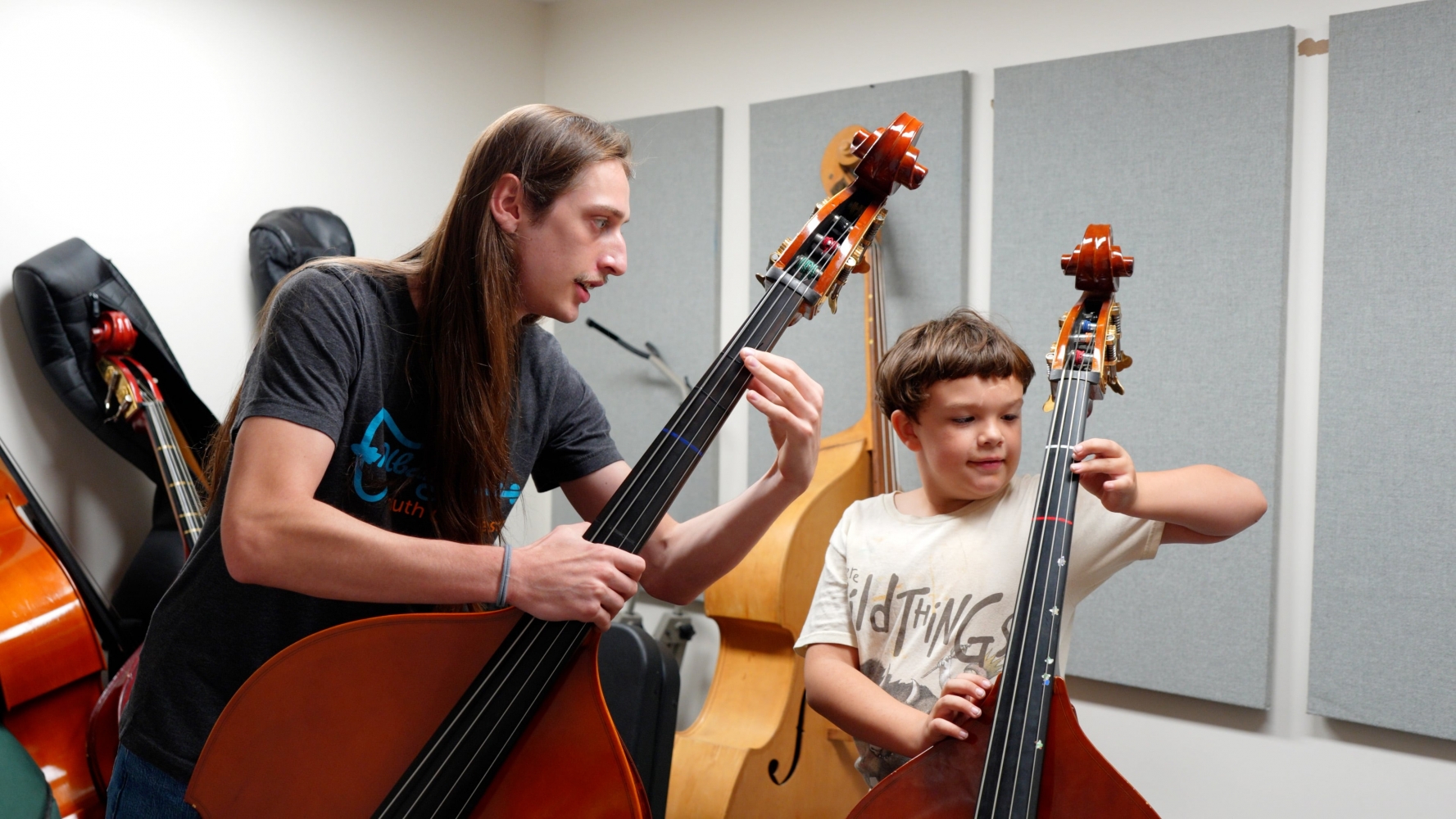
Unlike his mom, Drax was enamored by the largest of all the string instruments. At half-size, the double bass still dwarfs him. Drax’s boundless energy was now contained as he focused all his attention on making sure he strummed on beat with his teacher’s counting.
“Most of my motivation comes from her,” Drax said of his mom. “I would love to play with my mom.”
How the Albany Youth Orchestra makes classical music accessible and relevant to their students
The bowed string instruments that we recognize in today’s orchestral ensembles have maintained their distinct hourglass appearance and cursive sound holes since they were invented in 1500s Europe.
Pritchard said she tries to make the centuries-old musicianship relatable to her Gen Alpha students by playing medleys and adaptations of pop artists like Ed Sheeran and Bad Bunny alongside the Baroque-era Bach.

“We teach classical music primarily, but the number one thing that is important for us is that it’s fun,” Pritchard said. “We want it to be something that the students enjoy and want to continue year over year.”
Forty-five percent of their enrolled students attend South Shore Elementary, a bilingual Spanish-English school where a majority of students are Latino, according to Pritchard. She wants her students to feel like they can connect with their own culture through their musical interests.
“It’s so much fun to be able to introduce mariachi music in Spanish to them,” Pritchard said. “It shows that the music they grew up on is also accessible to them.”
On the scroll of students’ instruments are little ribbons, also known as “belts,” that are tied once they complete a level of “orchestra karate.”
It’s Aries Moloney’s second year at Albany Youth Orchestra and her scroll has so many ribbons it looks like the head of a pompom.
“My uncle’s here and this is my second year having him for my teacher and it’s very exciting,” said Aries, 9. Her uncle, Tyger DeBolt, was also a student in the Albany Youth Orchestra almost 20 years ago. “Music has kind of changed my life,” she added.

DeBolt is now taking music production classes at Linn-Benton Community College. He said teaching kids music is like introducing them to a new language. He likes to play a call-and-response game with his students where they play a tune, and he tries to imitate them by ear.
“Just messing around helps understanding music,” DeBolt said of students who explore improvisation. “You might not know what all the rules are, why that works, but later on you’ll figure that out.”
Other Related News

10/10/2026
If youre serious about Halloween you know the season started the second the air turned cri...
10/10/2026
If you have to make bank transactions on or around Columbus Day on Oct 12 youll need to pl...
10/10/2026
Nick Saban reflected Saturday during ESPNs College GameDay on pulling Jalen Hurts for Tua ...
10/10/2026
WASHINGTON DC Oregon US Sens Ron Wyden and Jeff Merkley both Democrats announced they and...
10/10/2026
The Arizona Wildcats 4-1 square off with the West Virginia Mountaineers 3-2 on the road in...

Follow

Download Our App


Copyright 2022 © EPUERTO. All Rights Reserved