

Published on: 10/05/2026
This news was posted by Oregon Today News


Description
Patti Kraff’s phone used to ring soon after 7 a.m. every day. The voice of her fiancé, Norman Barlow, was her alarm clock, after he left early from their house in Vancouver for morning shifts at the Nippon Dynawave Packaging Company in Longview, Washington.
His job as an instrument technician came with good pay and benefits, important to the 58-year-old as he worked toward spending his retirement years with Kraff, 60. They were going to get married over the summer. After that, they had plans to spend their golden years traveling, Kraff said. Mexico, Italy and Thailand were at the top of the list.
But on the morning of May 26, Barlow didn’t call. Instead, Kraff’s sister did, asking if she’d seen the news.
“When I saw it on the TV, my heart just sunk,” Kraff said.
At 7:09 a.m., a chemical tank at the plant collapsed, its contents slamming into the nearby break room where workers were getting ready to start their day. Barlow was among 11 people killed by burns from the caustic chemicals.


The tragedy has rocked the blue-collar city built on the paper industry, which provides dependable union jobs that pay enough to support a family in Southwest Washington. The trust that many people had in the company was shaken in an instant on May 26, only to be shattered in August when a federal report found that before the fatal spill, inspection contractors had warned the company — three times — that its chemical tank was unsafe. As grief and anger continue to reverberate through the community, questions about corporate accountability and the future of Longview remain unanswered.
A Nippon spokesperson declined an interview. In a statement to employees on Aug. 28, President Matt Peerboom said the company is committed to “allowing a full investigative process to proceed and establish a complete and accurate record before conclusions are reached.”
Ruth Kendall worked as a chemical engineer at the mill for almost 30 years when it was owned by a different company, Weyerhaeuser. Today, she’s a city councilor in Longview.
The federal report about what happened on Nippon’s watch left her questioning whether she had misplaced confidence in industry safety standards.
“This wasn’t just somebody screwing up, somebody taking a shortcut,” Kendall said. “This was actually a management decision.”
‘Lifeblood of this community’


Only Barlow’s engagement ring, made of an extra-durable metal called Serinium, withstood the caustic chemical bath that killed him. Kraff now wears it on a chain around her neck.
They dated through high school, then reconnected much later in life. Kraff described Barlow as having a “young heart, but he was an old soul,” who would do things like open the car door for her. He moved from Kennewick and took the job at the Longview mill so they could be together, Kraff said.
He had only worked at the plant for three months. His body was the last to be retrieved during the initial recovery operations.
The majority of paper mill workers have been called back to work, after many were idled during the months-long cleanup process. Employees will return to work with stable pay through at least Jan. 17, 2027, according to a plan announced at the beginning of October by the Association of Western Pulp and Paper Workers union. Uncertainty over what happens in the future remains a question for many residents, including Wayne Nichols.


He worked at the paper mill for 41 years, mostly as a hazardous piping inspector before retiring in 2017. Now he’s wondering how the families of victims can be fairly compensated if Nippon is found liable. The Washington State Office of the Attorney General has opened a formal criminal investigation into the company. Could penalties and lawsuits hobble the operation or shut it down entirely?
“When you lose that kind of employment in a town our size, there are ripple effects down the line,” said Nichols, who is also a Longview city councilor.
The Longview-Kelso community, population 50,000, is proudly industrial. On any given day, white steam can be seen rising from a tangle of pipes at several paper mills. Huge cargo ships come and go at the Port of Longview, and log trucks rumble down city streets.

The pulp and paper industry supported 4.4% of all jobs in Cowlitz County in 2026, while representing twice as much of the county’s GDP, according to Workforce Southwest Washington. With an average salary of $119,000, paper mill employees’ pay goes on to support countless other sectors, from contractors to restaurants.
“That mill is part of the lifeblood of this community,” Nichols said.
The Nippon plant is also a key piece of the region’s larger wood products industry. The wood chips produced by the nearby timber operator, Weyerhaeuser, are sent to Nippon to be pulped. Nippon’s plant produces steam that is used to process wood chips by a neighboring paper mill, North Pacific Paper Company.

Report spurs calls for regulation, accountability
In the early hours of May 26, a machinery interruption caused Nippon’s “G-tank” to be filled nearly to capacity with almost a million gallons of “white liquor” — chemicals formulated to break down wood pulp, so caustic they are capable of dissolving flesh.
Security camera footage from that morning shows a sudden cloud of white steam as the tank collapsed and released a deadly wave.
Washington Gov. Bob Ferguson called it the “deadliest industrial tragedy in modern Washington state history.” Nine people, including a firefighter who responded to the scene, were injured in addition to the 11 who died.

The next shock for the community came with an August report from the U.S. Chemical Safety Board, a small federal agency that investigates such incidents.
The report detailed how the walls of G-tank had thinned to unsafe levels. It noted that in the 10 months leading up to the disaster, inspectors hired by Nippon had warned of safety concerns three different times. In their earliest assessment, inspectors found that the tank was “not fit for continued service,” and there was a “high likelihood” that it could fail, according to the federal report.
But it was up to the company to choose how to respond. Above-ground chemical storage tanks at paper mills fall into a “regulatory hole,” without oversight from state agencies, according to Marissa Baker, an associate professor with the University of Washington Department of Environmental and Occupational Health Sciences.
A Republican lawmaker from Longview has said he wants to change that.
State Sen. Jeff Wilson was an environmental contractor at paper mills for 23 years, including on the specific tank that collapsed at Nippon, he said. He has promised to introduce legislation in January that would authorize an agency like the Washington State Department of Ecology to inspect and certify such storage tanks, and to fine companies that don’t maintain safe facilities.

“I’m not saying I don’t trust them,” Wilson said of Washington’s paper mill operators. “What I’m saying is it’s time to get away from, ‘We’ll count on you to be responsible for these activities.’”
But inspectors did warn Nippon before the incident, according to Baker, who reviewed the federal report on what led up to the disaster. New state regulations would need to be able to compel companies to maintain a safe workplace, she said.
“Prevention is great, but you still have to have the will of the employer to enact those changes or give that power to the regulatory agency to basically stop work,” she said.
The full Chemical Safety Board investigation could take up to two years to complete. In the meantime, Nippon Dynawave has declined interview requests, citing the ongoing probe.
It’s unclear how and if Nippon will ultimately be accountable to the families of the victims in the tank failure and those who were injured.
Mackenzie Ammons, the wife of Jared Ammons, an electrician who died in the incident, has filed a wrongful death lawsuit against the company alleging a “run-to-failure” policy, where equipment was allowed to operate until broken.
Jared Ammons was at work early the day of the disaster, according to the complaint, so that he could get out in time for his pregnant wife’s ultrasound appointment.
“Jared kissed Mackenzie goodbye and got into his car for the 5-minute drive to work,” the lawsuit reads. “He never saw her again and never had the opportunity to see his child.”
Remembering the victims


When Kory Kranz heard about the disaster and the employees who died, he got to work in any way he could.
“When you’re in that kind of stress and loss and not knowing what to do and not having answers, you try and keep yourself busy,” he said.
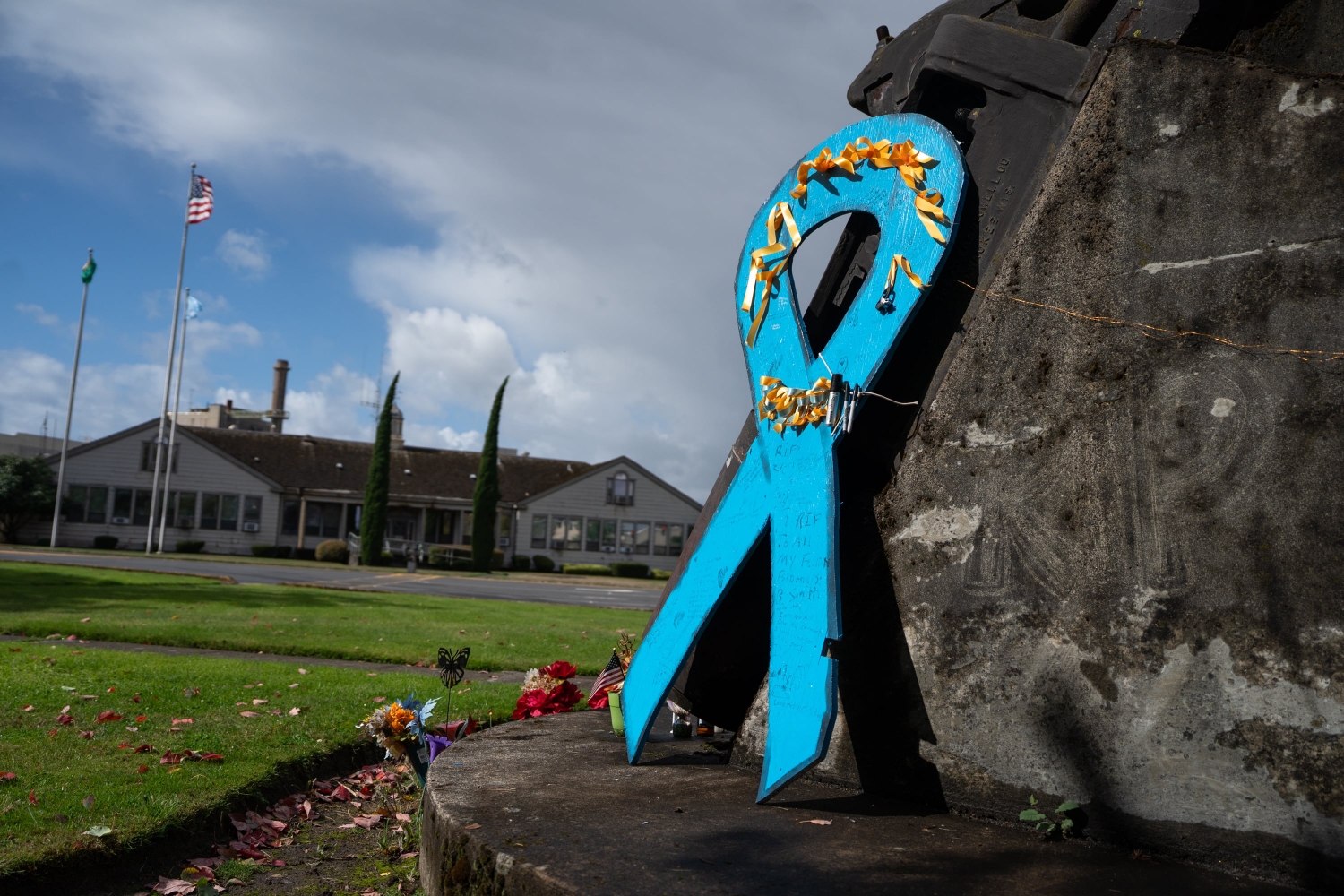
First, the 44-year-old Longview resident made ribbons for people to wear to show their support. They were colored neon orange for the high-visibility vests that plant workers wear, and blue after the Nippon logo. The thousand that he made the first day were instantly snatched up, he said.
Kranz coordinated food donations from grocery stores for victims’ families who had gathered at the local union hall.
He knew Tyler and Brad Covington, brothers who died in the incident. Kranz described them as being like nephews to him.
As weeks passed, he turned his grief toward a 6-by-4-foot slab of black walnut. To the wood, he bolted a steel plate in the shape of Washington, with the words “In Loving Memory” and the names of the 11 victims cut in the rust-orange metal, as well as designs of a hard hat and a pair of work boots. The whole thing weighs nearly 300 lbs.
He’s trucked the memorial to community vigils. As soon as he fixes a spot that got dinged up from the moves, the slab will be transported to Columbia Wellness, a local behavioral health provider that has been supporting the family members of victims, he said. Discussions are ongoing for a permanent home, possibly on city property.
‘Trauma-grief’


In the Vancouver living room she once shared with Barlow, Kraff’s tables are covered with framed photos from their life together before May 26. In one picture taken last December, Barlow looks up at her from a bent knee, an arch of lights on the wall behind them spelling out “Will You Marry Me?”
Their Las Vegas wedding date was just three weeks away when he was killed. Because they weren’t married yet, Kraff said she hasn’t been included in conversations between the paper mill and the other surviving family members about compensation.
She described the experience as a “trauma-grief,” different from the deaths of other family members she has faced.
“Because you wake up and you think your loved one’s going to come home,” she said. “And you never see him again.”
She and Barlow were going to move up to Longview while he worked at the plant and then travel in their retirement. Instead, these days she sometimes talks with the family of one of the other Nippon victims. She’s in touch with therapists at Columbia Wellness.
And she prays.

News Source : https://www.opb.org/article/2026/10/05/longview-washington-paper-mill-disaster-broke-community-trust-lifeblood-industry/
Other Related News

10/05/2026
Man of War is now streaming on MovieSphere
10/05/2026
Do not wait Go out and vote Vote early vote by mail or vote in person on Election Day Nov ...
10/05/2026
The shooting was reported just before 130 am
10/05/2026
The Oregon chapter of the international nonprofit Dress for Success was among the very fir...
10/05/2026
Standing at 14410 feet Mount Tahoma is the tallest mountain in the Pacific Northwest Its a...

Follow

Download Our App


Copyright 2022 © EPUERTO. All Rights Reserved