

Published on: 12/06/2025
This news was posted by Oregon Today News


Description

Over a two-day tour around the Tri-Cities, U.S. Energy Secretary Chris Wright boasted about the low cost of energy in the Northwest, noting prices are largely helped by the region’s hydropower system.
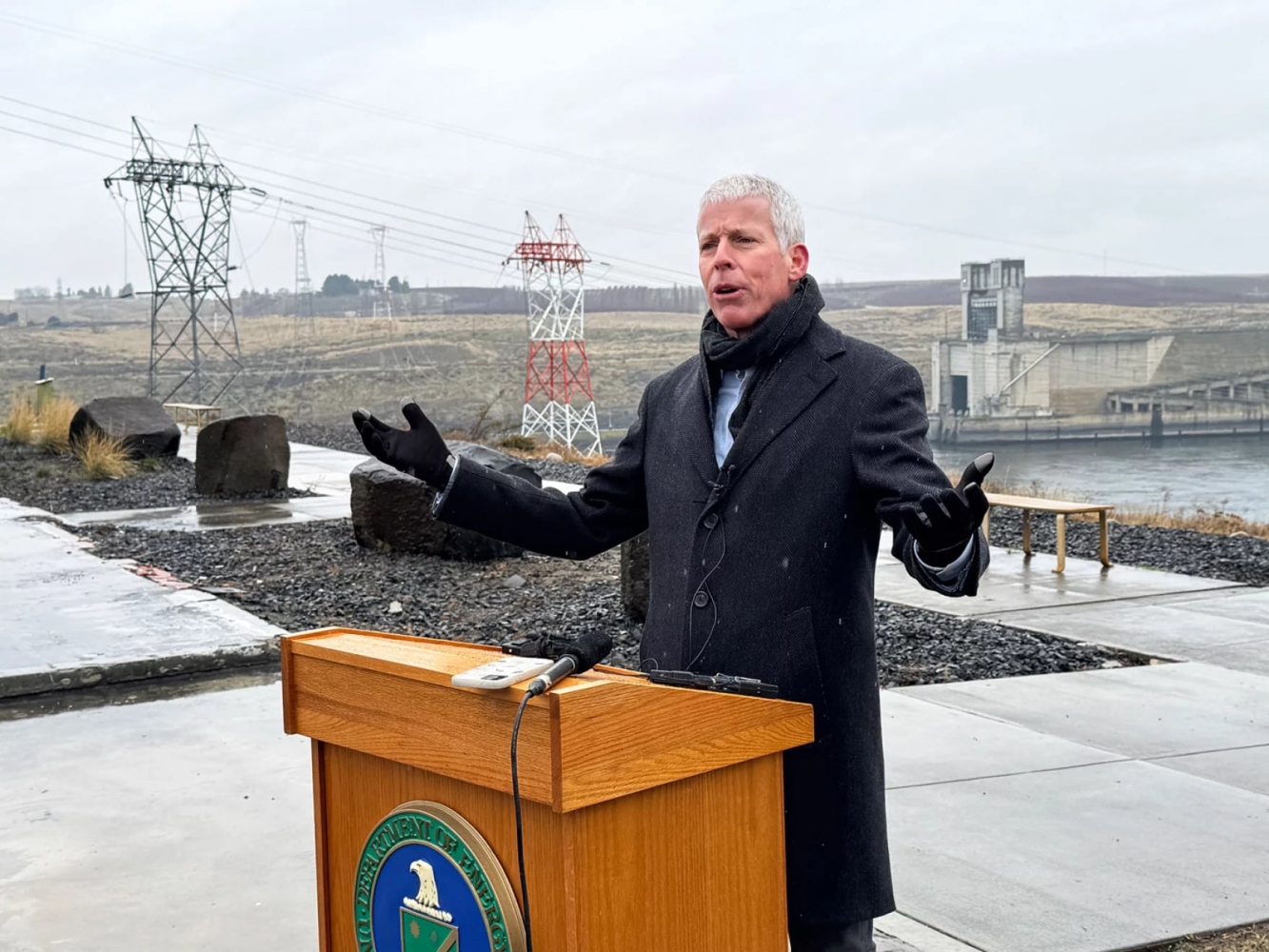
At a press conference on Thursday, Wright stood on a bluff overlooking Ice Harbor Dam, one of the controversial Lower Snake River dams. Fish advocates have pushed to remove the four dams as part of an effort to save endangered salmon and steelhead.
Supporters of the dams, including Wright, said dams like Ice Harbor provide low-cost energy to the region.
“It can deliver (electricity) when you need it, but it’s not flooding onto the grid when you don’t need the electricity,” Wright said.
According to the U.S. Army Corps of Engineers, the Lower Snake River dams are known as “run of the river” dams. That means these dams aren’t used to store water for when energy is needed. Instead, water moves through the dams as it flows downriver.
Wright said the Trump administration “ wants to do everything we can” to keep energy prices low. That would likely include stopping any effort to remove the four Lower Snake River dams.
“ When we arrived in office, those four dams were going be closed and taken offline,” Wright said later in the day.
Earlier this year, the Trump administration put a stop to a Biden-era deal aimed at protecting endangered salmon. Fish advocates saw the deal as a path toward dam removal. The end of the deal sent the decades-long issue back to federal courts.
“So much of the environmental agenda has been hijacked by just climate craziness,” Wright said. “People that don’t understand climate change and that don’t understand the energy system have hijacked all the energy and all the resources away from real environmental issues and have gone in an unproductive direction. We’re trying to bring common sense back.”
Lawsuits against federal government over Columbia Basin dams to resume
He noted the environment, wilderness and wildlife were “central to our agenda.”
That irked fish advocates like attorney Amanda Goodin, who is with the environmental nonprofit Earthjustice.
“Their actions on the ground seem to indicate that they’re going out of their way to deprioritize salmon and wildlife,” Goodin said, in response to Wright’s statements.
Later on Thursday, Wright toured Pacific Northwest National Laboratory, where he helped commission a new technology that scientists said will help biologists quickly study new biotechnologies.
The Anaerobic Microbial Phenotyping Platform, or AMP2, will use artificial intelligence to make new discoveries with fungi and bacteria. Those microbes can be used to make chemicals, energy, fuels and biomaterials, according to PNNL.
The AMP2 fills a small room. It’s made up of what look like large metal boxes. Each “box” has multiple robotic arms encased behind glass with all sorts of scientific equipment. The chambers are air-free, a notoriously difficult environment for scientists to study.
The robotic arms will conduct the experiments. Then, artificial intelligence can adjust experiments along the way, said Jason Kelly, the co-founder and CEO of Ginkgo Bioworks, which builds these “autonomous labs.”
“ If you imagine the AI model, it could look and (say), ‘OK, I see the results from this, and based on what I saw with that, I think we should adjust the experiment in this way.’ It could do that all within the system on its own,” Kelly said.
Congressional Republicans defend Snake River dams as calls for removal mount
The AMP2 is part of the administration’s Genesis Mission, which aims to use artificial intelligence to speed up scientific discoveries.
“ Autonomy and AI are rapidly changing and reshaping the way that science is done, amping up the throughput in laboratories and allowing investigators to accomplish in days what normally would take weeks, months, and oftentimes years,” said Douglas Mans, interim director of Earth and Biological Sciences at PNNL.
The AMP2 is a prototype of a larger $47 million system to be built on PNNL’s campus.
After his remarks, Wright signed the side of the AMP2, joking about his handwriting. He then pushed a button on a laptop to start the technology.
These sorts of technologies are “ going to change the game in our understanding of biology,” Wright said.
Courtney Flatt is a reporter with Northwest Public Broadcasting. This story comes to you from the Northwest News Network, a collaboration between public media organizations in Oregon and Washington.
It is part of OPB’s broader effort to ensure that everyone in our region has access to quality journalism that informs, entertains and enriches their lives. To learn more, visit our journalism partnerships page.
News Source : https://www.opb.org/article/2025/12/06/chris-wright-touts-northwest-dams/
Other Related News

12/06/2025
The woman had been crossing Pacific Avenue before being struck by a car the driver stayed ...
12/06/2025
You can now register for legal sports betting in Missouri as mobile sportsbooks can accept...
12/06/2025
The advisory was for Clatsop County CoastTidal overflow flooding is rapidly decreasing as ...
12/06/2025
Still time to drop of a toy or non-perishable food item at the Bus Jam Thanks to our volu...
12/06/2025
One person was taken to a trauma center via Life Flight while another two people were tran...

Follow

Download Our App


Copyright 2022 © EPUERTO. All Rights Reserved